-
- Address10 East Randolph St.
Chicago, IL 60601 - EmailGet in Touch
- UrlView our Site
- Phone312-739-0120
Joffrey Ballet, The
Robert Joffrey and Gerald Arpino’s uniquely American vision of dance first took form in 1956. The original company consisted of six dynamic and highly individual dancers. While Robert Joffrey stayed in New York to teach ballet classes and earn money to pay the dancers salaries, Gerald Arpino led the troupe across America’s heartland, in a station wagon that pulled a U-Haul trailer. Their repertoire of original ballets by Robert Joffrey set them apart from other small touring companies, who often performed scaled-down versions of the classics. From the beginning, Joffrey and Arpino wanted a company that came out of their roots, out of America.
Advertisement
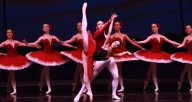
Joffrey Ballet's "Winter Fire"
If there's a medal for sheer guts, the Joffrey dancers should all get one. They must have run the equivalent of several marathons on opening night of "Winter Fire." And they did it with amazing physical and emotional inflection.
What's hottest about "Winter Fire" is its blazing ambition. Running through Sunday, February 26, at the Auditorium, the program comprises three contemporary ballet classics --- if "classic" can be applied to a four-year-old dance like Wayne McGregor's. (I think it can.) Scoring the U.S. premiere of his 2008 "Infra" was a big coup. And though the Joffrey has previously performed excerpts from William Forsythe's 1987 "In the Middle, Somewhat Elevated," set on ballet companies worldwide, it's never before danced the entire mind-blowing work. Christopher Wheeldon's 2005 "After the Rain" completes the program.
Anyone who still believes that abstract ballets lack heart because they lack story should definitely see "Winter Fire." And anyone who already loves contemporary dance should see it because, here in the heartland, we don't get sufficient opportunities to catch the classics.
Thanks to Thom Willems's electronic score, Forsythe's "In the Middle, Somewhat Elevated" begins with a literal bang --- and a spotlight on two ballerinas facing off, displaying their turnout and dagger-like pointe-shod feet. Then the race is on; the piece becomes a diabolical dance engine powered by the all-mighty foot. Raising and lowering this crucial appendage creates the most exhilarating shifts in a work that's filled with them. Men and women alike magically rise and fall from one strata of the stage space to another, in swift moves precisely timed to the percussive music.
There's definitely an 80s edge of competition and even violence to "In the Middle," which is like a machine relentlessly assembling and disassembling itself over and over. It seems we're dropped into the process in medias res, and we wonder when and how it will end, for us and for the dancers, as their limbs continually explode out from their cores.
That innate violence is mitigated, however, by the piece's finesse and detail. The care that's gone into the choreography and the performance (thanks to former Forsythe dancer Glen Tuggle) creates a cogent sympathy with the dancers and the dance's underlying engine: human craft and effort.
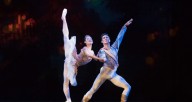
That's a tough act to follow. Wheeldon's "After the Rain," with its focus on everyday humanity, did seem slight by comparison. Opening with a cool, elegant ensemble section for three couples that mourns the passing of time, it closes with a duet by one of the couples. On opening night, clad in a warm, peachy glow and not much else, Victoria Jaiani and Fabrice Calmels embodied the height of romance in what is apparently a flashback to the lost, idyllic relationship.
McGregor's 30-minute "Infra" seemed the biggest struggle of the evening for the dancers, perhaps because it came at the end of a strenuous program and because it was the newest, least practiced piece. Also the 12 dancers seemed, on average, younger and less experienced (kudos, though, to Rory Hohenstein and Jaiani, two expert performers who demonstrated amazing energy and control in all three pieces). Then there's the usual problem of setting a work created for specific dancers -- in this case, the Royal Ballet -- on other performers of differing abilities and body types. That can be a particular challenge with duets, especially those that entwine the dancers as artfully as these do. Duets also dominate the piece.
More time will help the performance. And "Infra" is worth the effort. Created in response to the London bombings of 2005, which killed 52 innocent commuters and injured hundreds of others, it's bolstered by McGregor's trademark technology --- here, Julian Opie's pared but nuanced designs, displayed on a giant LED screen over the dancers' heads, showing lines of people walking purposefully, presumably going to work. Max Richter's score combines feeling and ghostly diffidence.
Insane pliability, control, and speed are the hallmarks of McGregor's choreography. The legs drive into the floor or the air while the torso ripples, the shoulders ripple, heads and hands get tic-cy. The women are spun like pinwheels and cradled like babies. Though little of the movement is gestural, some is hugely so, which gives it a hefty wallop. Despite --- or because of --- the moves' frequent artificiality, they convey intense communication by and between the dancers. "Infra" really does make you feel you've delved beneath the surface of anonymous commuters, people who work and live and die, not anonymously, but with passionate individuality.
"Winter Fire" exposed a sinewy, snaky side of the Joffrey I'd never quite seen before. In more traditional ballet roles, the women can't be this strong, and the men this serpentine. Ricardo Santos was especially sinuous in "In the Middle," while Christine Rocas was especially steely there and in "Infra." But all the dancers deserve props for tackling, and largely conquering, these works. I know it's their job. I'm still grateful.
Joffrey Ballet's Farewell
By Sid Smith
Watching a dancer's farewell is a little like a shot of Tequila--a quick thrill, a suffuse feeling of warmth and then a nagging doubt that regret will soon follow.
The Joffrey Ballet said goodbye to six dancers at the Auditorium Theatre Sunday, and two of them were given special showcases: Calvin Kitten and Suzanne Lopez. In a way, their retirements--both are in their late 30s--are part of the end of an era, as the dancers hired and honed by Gerald Arpino move on, and the company takes on more and more of Ashley Wheater's stamp. Kitten in particular seemed an Arpino trademark, a speedy acrobat in the tradition of Edward Stierle, whose choreographic and dance careers were cut short by AIDS, and Mark Goldweber, who worked here with the company before joining Adam Sklute at Ballet West, where Kitten himself now heads to work backstage
Certainly in the years the Joffrey has resided in Chicago, Kitten soared as one of the troupe's most delightful and reliable stars. He pretty much patented three roles in "The Nutcracker": Fritz, the Snow Prince and Tea from China, his Fritz delightfully puckish and spoiled, his Snow Prince a velveteen display of pure talent and style.
On Sunday, he danced George Balanchine's "Tarantella," partnering with Yumelia Garcia, and, as if in deference to his popularity, a last-minute schedule shift put his farewell at the end of the program. "Tarantella" proved a pungent choice, joyful and radiant with technical frolic and good taste, ideal for the impish, almost childlike delight Kitten often brought to dance. It was also nice that a dancer whose athletics so often rendered him a soloist on stage got to go out dancing with a partner, and the naughty, stolen kiss the he makes at the end allowed Kitten, pun fully intended here, a kittenish final moment. That tempered some of the bittersweet sorrow unavoidable in knowing we'll no longer have him to watch.
Lopez didn't enjoy Kitten's singularity, his role as a special kind of dancer for the troupe. Instead, she vied with all the other ballerinas in classic parts and nonetheless shone brightly whenever on stage. I marveled as I watched her last performance, with Mauro Villanueva in Helgi Tomasson's silky "Valses Poeticos," how well-rounded a ballerina she is. No particular skill or classic position particularly shines in her execution. Instead, she made them all lovely, she brought them together into a lovely and sensuous whole and she glowed on stage, never more so than in this dreamy, romantic pas de deux.
The Joffrey's treatment of these farewells each season is infectious, with all the dancers marching on stage one by one and giving the retirees single roses until a whole bouquet is assembled--in a way, an apt metaphor for the mix of individuality and communal spirit that defines the art of dance. Lopez was even greeted by her two young children, reinforcing the idea of a dance company as a family. Whatever the differences and disagreements along the way, all of these folks deserve credit for succeeding in a merciless, cutthroat, incredibly idealistic pursuit.
It's also a fine occasion bridging that divide between artists and audiences--not just a chance to say so long, which is important, but a sudden burst of intimacy between watcher and watched, a personal connection in a business where a certain professional detachment is built into the enterprise. We watch these dancers year after year as strangers, removed, never even hearing them speak, for the most part, unlike stage actors. Yet, we feel a kinship, an affection, and that blossoms in these farewells, heightened by the very real emotions on stage that remind us these folks are human, real people with vulnerabilities and heartaches, who give up so much and work so hard to entertain us.
Four other dancers are leaving, and they, too will be missed: David Gombert, Thomas Nicholas, Megan Quiroz and Patrick Simoniello.
Bravo and brava! All deserve thanks for hours of immeasurable pleasure.