

Based on the play written by Hungarian playwright, Ferenc Molnár, in 1909, and what served as inspiration for the Rodgers and Hammerstein musical, “Carousel,” “Liliom,” presented by The Joffrey Ballet at Lyric Opera through Sept. 27, is fresh take by returning guest choreographer John Neumeier, which premiered in 2011 at the Hamburg Ballet—for Joffrey’s production, Neumeier is also credited as costume designer and shares lighting designer credit with Jim French. Scenic design by Ferdinand Wögerbauer, known for his work with the Metropolitan Opera, captures the paradoxical vivacity and eeriness of a faltering amusement park called “Playland” during the Unites States’ Great Depression. Musical score by French composer, Michel Legrand, alternates between plucky classical- and sultry jazz-inspired numbers. These elements combine to create a world that feels distinct through its complex stagings of colorful characters.
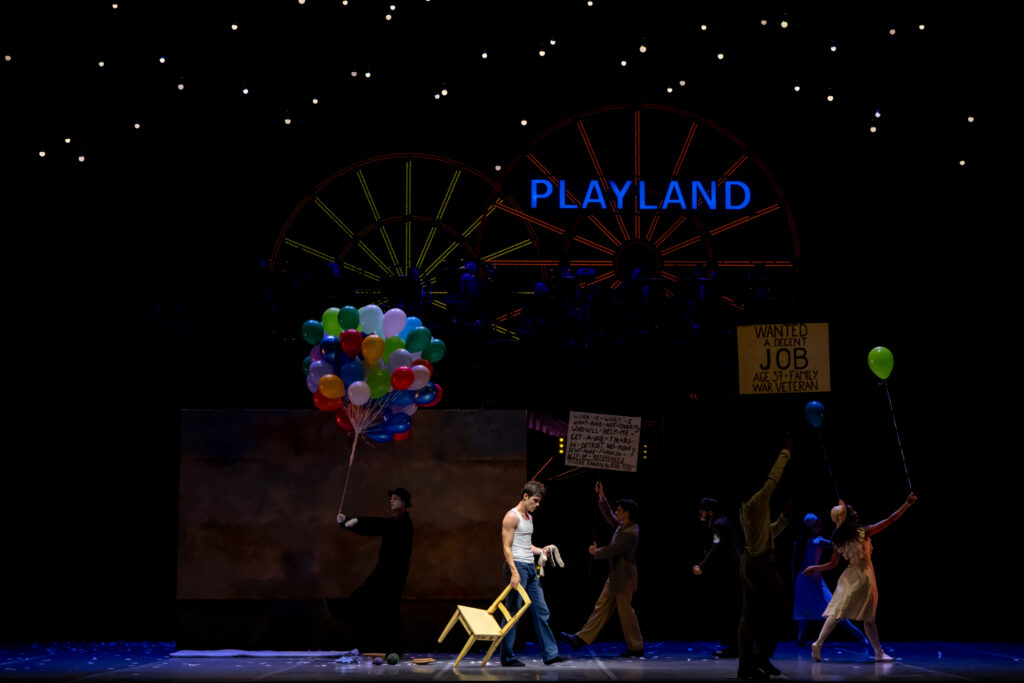
In the Saturday, Sept. 20 matinee performance, striking is Neumeier’s skill at worldbuilding. Nearly every scene includes carnival stock characters wandering through the foreground and background: a mopey tramp (Jackson Miles) with clown nose and a minstrel’s white-painted frown chasing a hat across the stage; carousing couples; and various circus performers—plate-spinners, Chinese jugglers, and acrobats. During scenes of intense festivities, or pandemonium, it can be difficult to keep track of where to place one’s focus, but the lighting design is such that the eye is slightly more drawn to the intended sequence of events. Regardless, the bustling world of “Liliom” feels very much alive.
The story of “Liliom” is a psychological exploration of vice and depravity tempered by love and longing. The titular protagonist, played by tall and well-physiqued Paolo Randon, is dead, trapped in purgatory. Guided by “The Balloon Man” (Evan Boersma), a mime archetype in whiteface who sporadically lunges slowly across the stage like an apathetic angel carrying a long-stemmed bouquet of multicolored balloons, Liliom relives his tragic life.
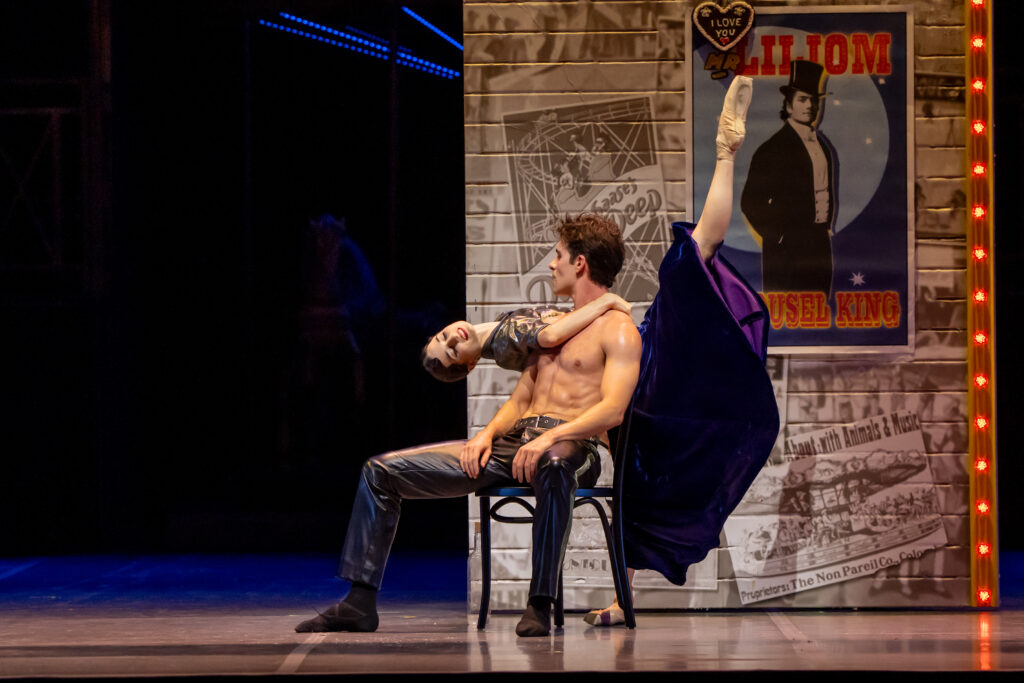
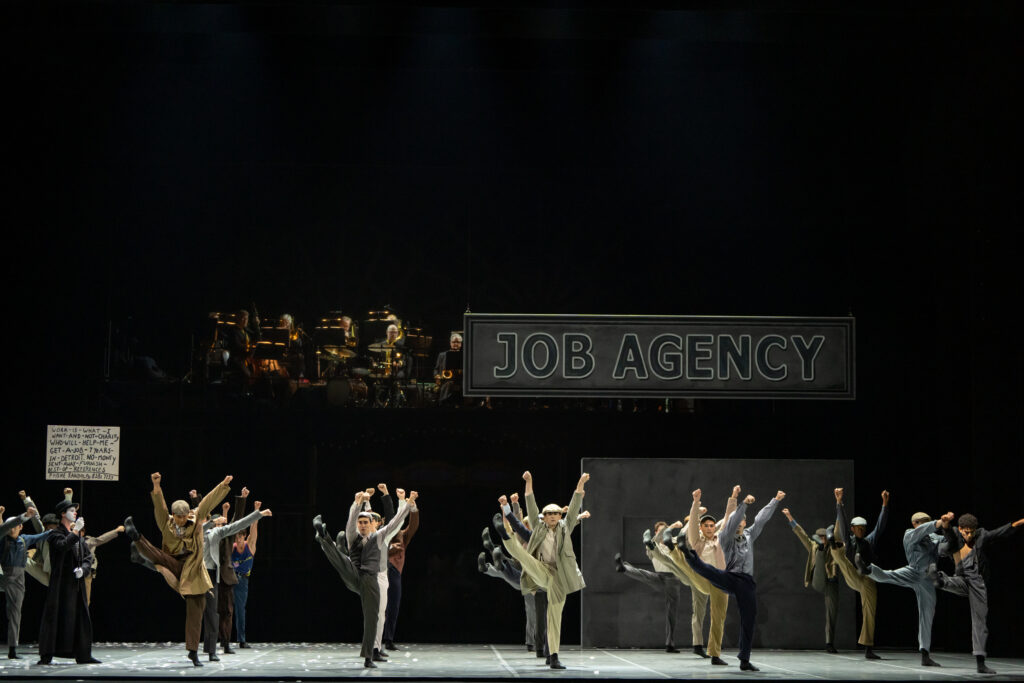
As a grandstanding carnival barker, Liliom woos the timid yet stalwart Julie (Anais Bueno) by dismissing a drunken-sailor suitor (Alberto Velazquez) by catching him mid-leap during an attack and spiraling him to the ground like a bowler hitting a tenpin strike. Freshly in love, Liliom rejects his employer, Mrs. Muskat (Basia Rhoden), who plies him with her liquid body, dripping over his shoulder in a series of sensual lifts. Unemployed, Liliom joins the corps of destitute men, a huddled mass holding job-seeking signs, their stiff arms ticking like a countdown clock, and their hands beating on the wall of the job agency. Liliom and Julie conceive a child, Louis (Wictor Hugo Pedroso), and the father-son duo engage in a sentimental duet, with Liliom dropping his macho persona and steadying Louis as he shakily learns to crawl, then walk. One will appreciate how Neumeier forgoes asking the dancers to engage in pantomime to cross narrative bridges; instead, speech is represented by movement phrases focused on the arms—sharp, blade-like, and resembling hip-hop-whacking style—a surprisingly effective replacement for verbal communication.
A major highlight of the production is the presentation of opposing pas de deux. Julie’s friend, Marie (Natali Taht), and her boyfriend, Wolf (Jonathan Dole), the latter appearing in a red bellhop’s uniform, embody the romantic elements of young love. With nervous smiles, they engage in spirited but formal frolic, with Wolf lifting and spinning Marie in time to a vernal flute melody in asymmetrical meter. In contrast, Liliom and Julie are accompanied by blaring, drowsy horns as they flow into one another and separate several times, their lust for each other both repulsive and enticing. Like Mrs. Muskat before, Julie melts over his sweat-soaked body as he scoops her up in his arms. The contrast between the two pas de deux asks the observer whether they prefer a love that is safe and tender, or precarious and sensual.
After botching a poorly planned robbery and being hounded by police, Liliom stabs himself to death, and Julie becomes a somber puppeteer with his corpse as her doll, animating his hands to brush her face, her fingers crawling across his body like spider legs, pulling him close as if in a mutual embrace, and laying beside him and rising slowly to simulate the elevation of the spirit leaving the body. Neumeier again impresses with another contrast, that after two hours of sex, vice, and violence, it is Julie’s delicate dance with a dead man that steals the show.
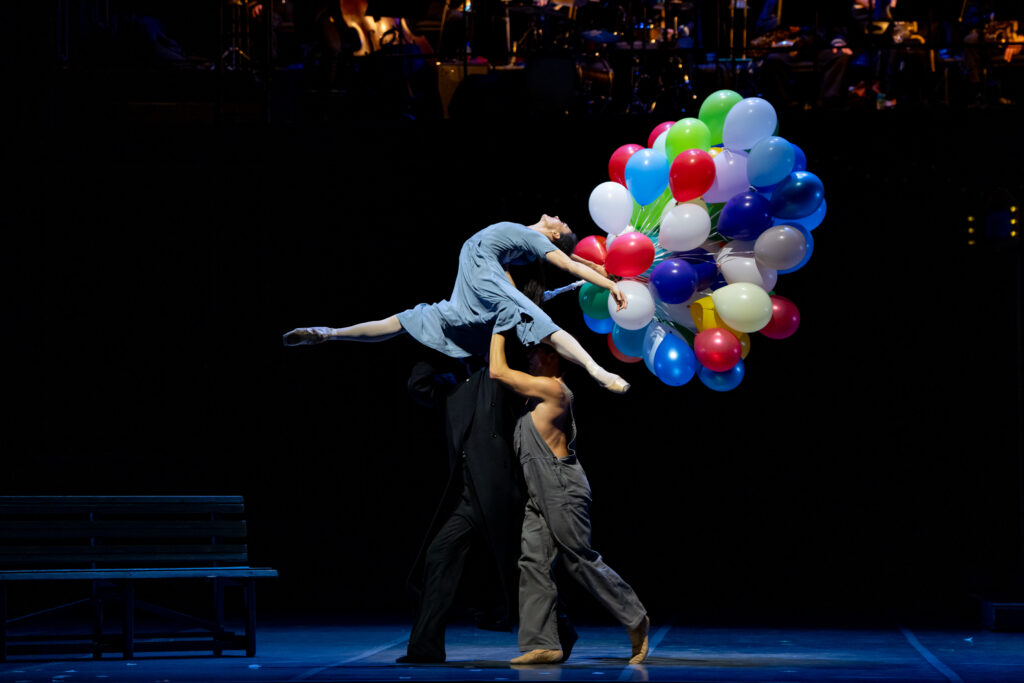
The circularity of the story is both a boon and a burden, beginning and concluding with Liliom gaining reprieve from his sentence to make amends with Louis, but his penchant for anger and violence interrupts his shot at redemption. When his spirit transcends and meets the mysterious “Gatekeeper” (Dylan Guitierrez), the latter god-being conjures a recapitulation of scenes from earlier in the performance, i.e., the former’s life flashing before his eyes. These copy-paste moments previously staged but now devoid of their novelty feel like padding that extends the runtime unnecessarily.
From an audience standpoint, the work feels less focused than previous ones from Joffrey’s canon, with characters roaming in and out of scenes at ostensibly random increments, and the dark and gloomy story longs for a catharsis that never comes. However, rapacious rascals like this protagonist may not deserve a clean catharsis, and the circular storytelling is an adept metaphor for purgatory itself. “Liliom” is a refreshing departure from convention, and Neumeier succeeds in combining the grand eloquence of a formal ballet with the confident, sexy, rough-and-tumble ethos of the American spirit.
The Joffrey Ballet presents “Liliom” through Sept. 27 at Lyric Opera of Chicago, 20 N Wacker Dr. For tickets and more information, check out the event page by clicking HERE.

Copyright 2026, See Chicago Dance, All Rights Reserved