

On November 7, contemporary dance company Ballets Jazz Montréal brought “Dance Me – Music by Leonard Cohen” to The Auditorium. As I stood in the will-call line stretching to Michigan Avenue, the woman behind me remarked that she was surprised the performance was so packed because it was “just a dance performance.” Her comment stayed with me throughout the evening.
While the enthusiastic turnout spoke to Cohen’s enduring popularity, I wondered how many audience members had come primarily for the musical tribute rather than to witness the artistry of Ballets Jazz Montréal. Drawing from Cohen’s extensive catalogue, “Dance Me” translates his poetic storytelling and unmistakable sound into an evening of contemporary dance.
For those unfamiliar with Cohen beyond perhaps his iconic “Hallelujah” (introduced to my own cultural awareness through Shrek), he was a singer-songwriter, poet, and novelist whose work profoundly influenced music, literature, and popular culture. Known for his distinctive gravelly voice and introspective songwriting, Cohen explored love, loss, sexuality, spirituality, politics, and loneliness. His willingness to embrace vulnerability, contradiction, and the darker aspects of human nature cemented his legacy as one of the twentieth century’s most influential artistic figures.
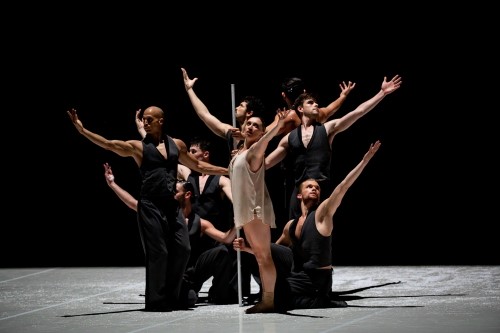
“Dance Me” offers a compelling example of the relationship between music and movement. Cohen’s haunting melodies and introspective lyrics provide an evocative foundation for choreography that translates the emotional undercurrents of his songs into a visceral physical experience rather than simply illustrating their narratives.
The collaboration is particularly significant: Ballets Jazz Montréal was granted exclusive rights to create a dance production using Cohen’s musical catalogue, making it the only dance company to receive this distinction. Through the choreographic visions of Andonis Foniadakis, Annabelle Lopez Ochoa, and Ihsan Rustem, the production approaches Cohen’s legacy through three distinct artistic perspectives.
The dancers bring impressive athleticism, precision, and fluidity to the stage, navigating sweeping gestures, intricate floorwork, angular shapes, and unexpected lifts with clarity and control. One particularly striking moment comes during the duet “Suzanne,” in which the female dancer seems never to touch the ground. For nearly the entire piece, she remains elevated on her partner’s shoulders, moving through fluid lifts, balances, and acrobatic stunts requiring extraordinary strength, trust, and coordination. The result is an almost otherworldly display of physical control, transforming the duet into a sustained image of weightlessness and connection.
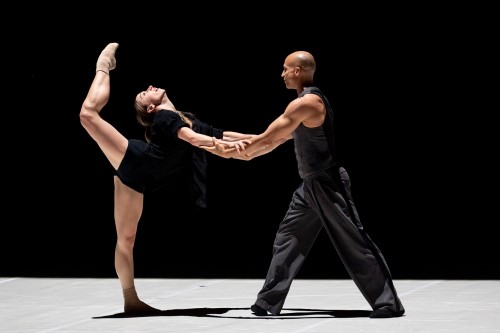
Across the evening, the choreography moves between sensuality, exuberance, introspection, and physical intensity, shifting from high-energy ensemble sequences to intimate explorations of kinship. While the dancers meet these demands with considerable skill and commitment, some sections rely heavily on recurring patterns of pulling, pushing, and counterbalancing, making the evening feel occasionally episodic rather than emotionally cumulative.
A recurring figure—a man dressed in a black suit and hat—provides a visual thread between otherwise separate sections. At one point, he slowly traverses the stage; at another, he sits at a desk writing on a typewriter. In the final moments, he stands motionless with his back to the audience, watching a larger-than-life projection of himself dancing across the cyclorama. Although his significance remains somewhat elusive, his appearances offer welcome moments of stillness within a ninety-minute production filled with relentless energy, thrilling partnering, and virtuosic phrasework. These quieter moments allow the audience to settle into the introspective atmosphere of Cohen’s music. Ultimately, the dancers are most compelling when their physicality and expressive range carry the dramatic weight without additional theatrical framing.
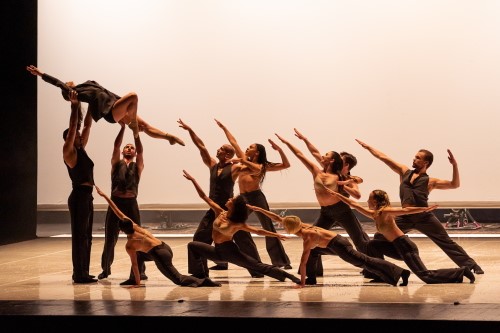
Lighting design by Cédric Delorme-Bouchard and Simon Beetschen functions almost as another choreographic voice, creating physical and atmospheric boundaries for the dancers to inhabit. Solitary spotlights, stark rectangles of light, and vertical light trees framing the stage establish distinct environments for each section. At times, the lights project so intensely toward the audience that they momentarily obscure the view, creating a shifting relationship between visibility and concealment. Moving between darkness, seduction, joy, and introspection, the lighting maintains a cohesive visual aesthetic throughout.
Video projections across the cyclorama offer a varied, though less consistently effective, visual landscape. Falling rain and snow, larger-than-life images of dancers [OMIT: seemingly] descending from ceiling to floor, oversized lips reminiscent of the opening credits for “The Rocky Horror Picture Show,” and text appearing alongside recordings of Cohen reciting poetic lyrics all contribute to the atmosphere. However, these projections occasionally raise the question of whether such literal imagery is necessary to support the choreography.
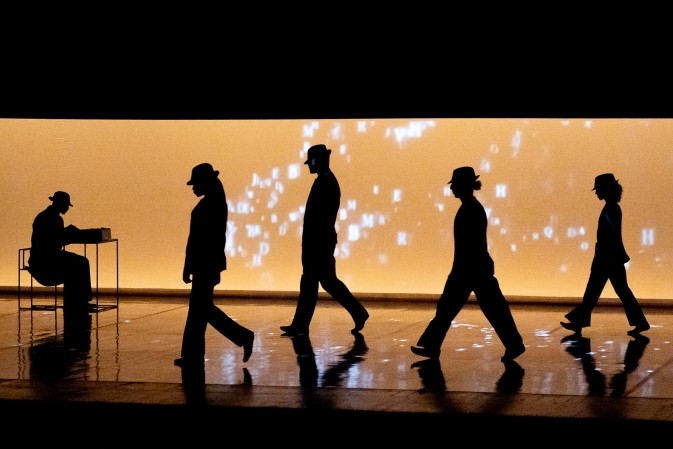
During “A Thousand Kisses Deep,” images of letters pouring from the typewriter onstage feel particularly unnecessary, adding little to the emotional impact. The imagery has an oddly artificial quality, evoking the same discomfort as an obviously AI-generated flyer: an attempt to manufacture meaning or atmosphere that feels less authentic than the material it is meant to enhance.
These visual choices sometimes detract from the dancing itself. The performers are already translating Cohen’s psychological complexity through their bodies, and the projections occasionally impose a literal narrative where the choreography could speak for itself. Cohen’s recordings possess an emotional richness that needs little visual accompaniment. At times, the projections compete with the music and dancing rather than deepening their impact, leaving one to wonder whether the most powerful visual element might simply have been the dancers themselves.
The woman behind me was right about one thing: The Auditorium was packed. But this was far more than “just a dance performance.” It was an opportunity to witness exceptional artists transform familiar music into something entirely new and to be reminded of the remarkable power of the dancing body. Perhaps the greatest achievement of “Dance Me” is not simply that it celebrates Leonard Cohen’s legacy through dance, but that it reminds us why dance itself deserves to be the reason we fill a theater.
For more information, check out the event page by clicking HERE.
Copyright 2026, See Chicago Dance, All Rights Reserved