
For one night only, audiences were invited to step back in time with the Trisha Brown Dance Company as they revived two collaborative works by Trisha Brown, Merce Cunningham, and Robert Rauschenberg. “Set and Reset” (1983) and “Travelogue”(1977) returned to the stage Sept. 17 at the Harris Theater as part of the program, “Dancing with Bob: Rauschenberg, Brown & Cunningham Onstage,” showcasing artistic pioneers who pushed the boundaries of human imagination.
Trisha Brown’s “Set and Reset” establishes a world that feels both constructed and spontaneous. Performed by Savannah Gaillard, Burr Johnson, Catherine Kirk, Cecily Campbell, Patrick Needham, and Jennifer Payán, the movement balances rigid geometric shapes with an improvisational looseness, creating a constant negotiation between freedom and limitation.
This tension is rooted in Brown’s creation process, drawing from memorized improvisation, where dancers generate movement within a set of conditions rather than repeating a fixed sequence. The result feels unpredictable, yet intentional. They cut across one another, abruptly change direction, and weave through shifting formations. A kick might strike another and rebound almost instantly, while one dancer might walk past another only to abruptly turn into their open arms, their geometric swings seeming to anticipate one another.
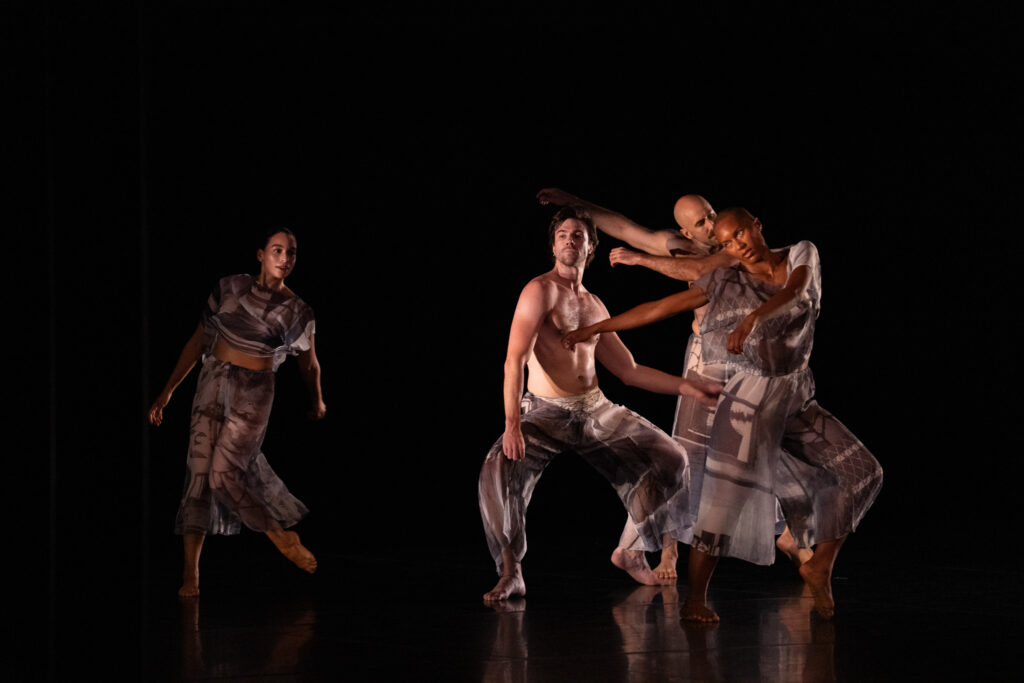
A vibrating, percussive score, created by Laurie Anderson in collaboration with Brown, called “Long Time No See,” features dancers swaying a beat ahead of the music, creating the uncanny impression that their bodies direct the score rather than respond to it. A flick of the wrist summons a chiming bell, while a sharp knee triggers a reverberating crack of wood, creating the illusion of premeditation.
Rauschenberg’s design makes the performance feel weightless. Loose, sheer black-and-white costumes drift effortlessly, blurring the line between body and fabric. Above them hangs a strange geometric cloud, a sharp rectangle flanked by two pyramids. Archival grayscale news footage flickers across its surface. The images dissolve, overlap, and disappear as flowing figures pour across the stage, creating the sensation of watching two events at once. The entire stage takes on a silvery quality, as if Brown’s choreography has slipped out of the present and into an early-twentieth-century film.
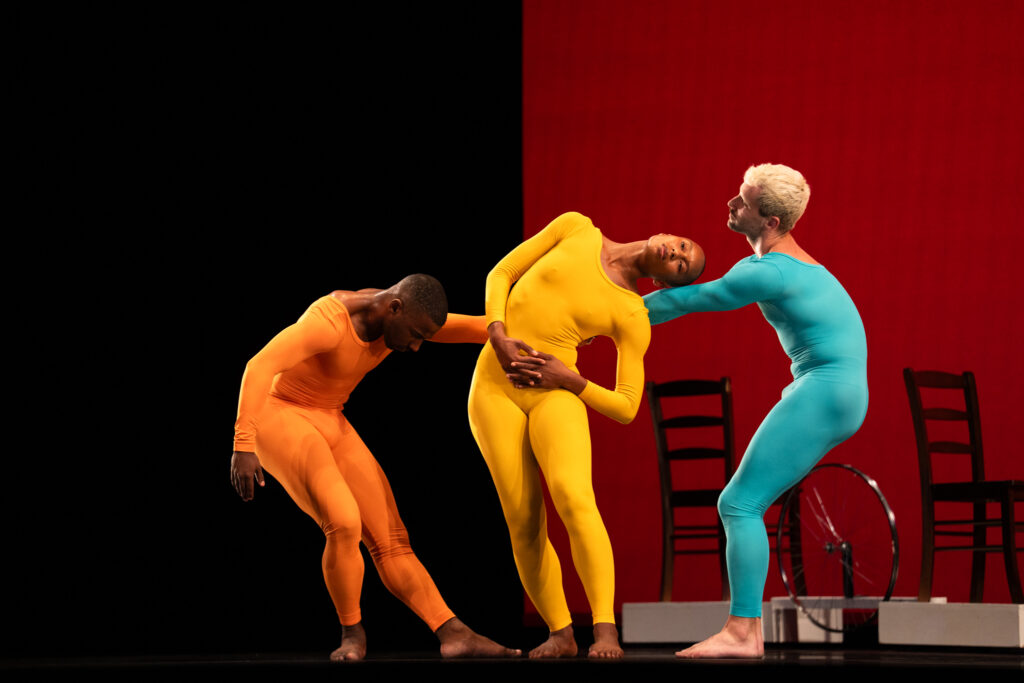
“Travelogue,” choreographed by Merce Cunningham and performed by Gaillard, Johnson, Claude CJ Johnson, Needham, Payán, and Spencer Weidie, takes the collaborative spirit in a different direction. With Rauschenberg responsible for the visual design and John Cage’s “Telephones and Birds” as musical accompaniment, the piece trades dreamy restraint for bright colors, strange props, and gleeful absurdity.
Colorful leotards, a bicycle-wheel sculpture, hanging fabrics, and an assortment of accessories generate a playful atmosphere. The dancers move with straight gazes, hooked arms, and prancing steps, combining ballet-inspired arabesques, tendus, and jetés with awkward, almost cartoonish rigidity. Cage’s score adds another layer of humor, incorporating voicemail recordings from specific places, including the Chicago Public Library, Museum of Ice Cream, and a rejection hotline alongside the call and clucking of a chicken. The effect is delightfully bizarre.
Rauschenberg’s props are more centralized in this piece. CJ Johnson launches into a powerful solo with clusters of metal cans attached to his legs and waist. Every frog leap, hip shake, and chaîné turn sends them clattering. Suddenly, he freezes in an arabesque before slowly dipping into a low ponché, his strength keeping the cans eerily still. The longer he holds, the more the audience waits for the inevitable rattle. The progression becomes a game of tension and release, making the silence just as compelling as the noise itself.
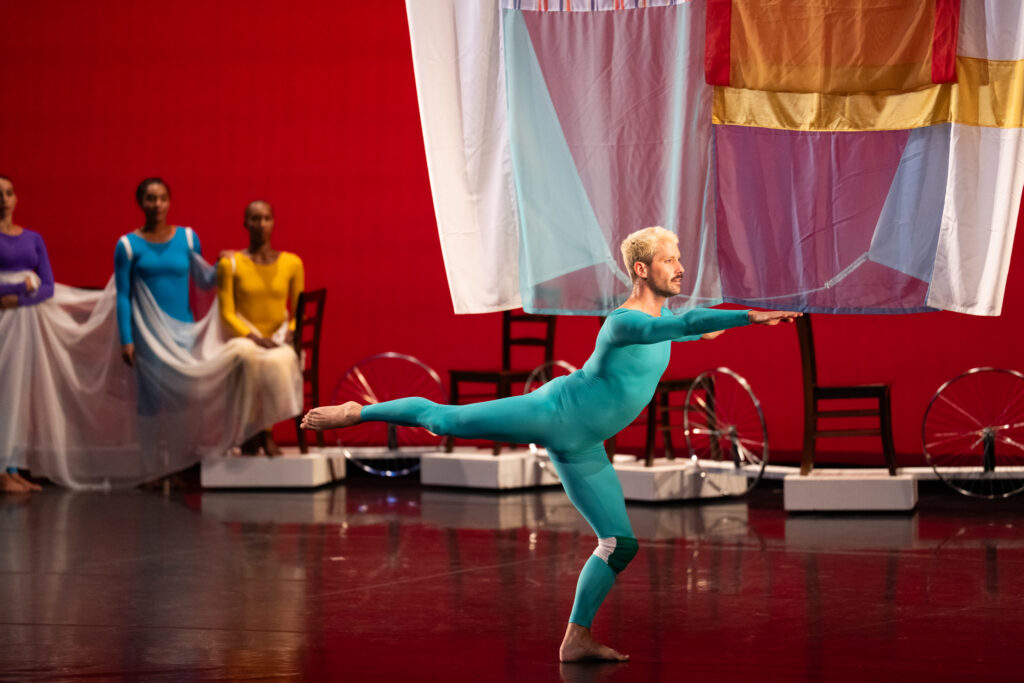
Then come the wings. Circular fabric attached between the dancers’ legs opens outward, transforming their bodies into strange, birdlike forms. They strut, flick, and swirl the fabric, as if engaging in an elaborate mating ritual, striking poses before suddenly shaking and flapping their wings. The color is overwhelming and creates a hypnotic spectacle that seduces the audience. It is another great example of a successful collaborative between visual art and dance.
Revisiting these works offers more than a trip into history, it reveals how collaborations between Brown, Cunningham, Rauschenberg, Anderson, and Cage expanded what dance could look like and how their ideas still challenge modern audiences. Decades later, their work refuses to sit quietly in the past. They remain unpredictable and full of possibility, a fitting legacy for artists who were never interested in staying between the lines.
The Trisha Brown Company presents “Dancing with Bob: Rauschenberg, Brown and Cunningham, Onstage,” Sept. 17 at the Harris Theater of Music and Dance, 205 E Randolph St. For more information, visit the event page by clicking HERE

Copyright 2026, See Chicago Dance, All Rights Reserved