

“Alas, on pleasure’s wild variety,
I’ve wasted too much life away!
But, did they not corrupt society,
I’d still like dances to this day.”
(“Eugene Onegin,” 1, XXX*)
The early-nineteenth-century Russian novel, “Eugene Onegin,” by the father of modern Russian literature, Alexander Pushkin (1799-1837), receives a ballet makeover in a recent re-staging at Joffrey Ballet, running through June 14 at Lyric Opera. The story of a social gadfly turned country-bound recluse is brought to life by choreographer Yuri Possokhov, following the success of his “Anna Karenina” at Joffrey in 2023, and composer Ilya Demutsky, whose sweeping score is replete with uneven rhythmic phrasing, giving even pastoral scenes a sense of underlying tension.
While the novel unveils the plot gradually, Possokhov’s rendition is more surprising. The ballet skips the first chapter but for a prologue introducing Eugene at the funeral of his uncle, attended by a flock of hooded mourners leaping and clawing the air as if attempting to escape from hell—a fitting metaphor for Eugene’s longing to escape from urban society. Eugene, played on June 5 by longtime Joffrey dancer Dylan Guttierrez, appears dressed in black, stiff and scowling, his tall frame casting an imposing presence. After inheriting his uncle’s country estate, Eugene arrives in a land that is opulently colorful, the grounds punctuated by tall and twisting tree trunks, the horizon lined by images of rustic chateaus— scenic design by Tom Pye, lighting design by Jim French, and projection design by Finn Ross.
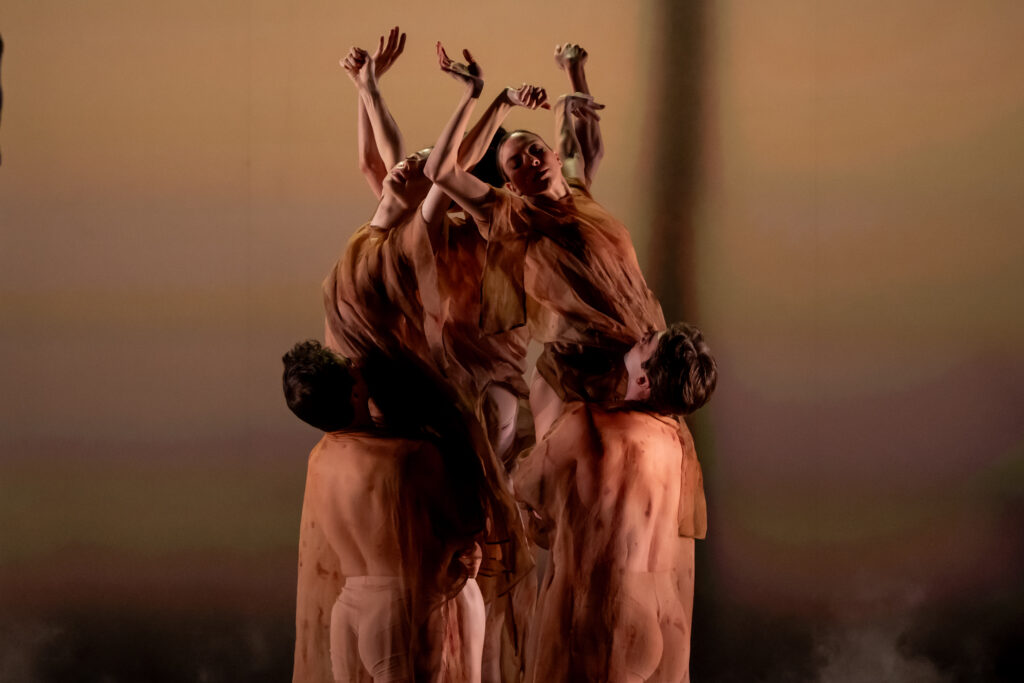
The first surprise: the woods are inhabited by spirits! Women dressed in billowing dresses the colors of spring and summer drift nimbly through weaving routes, and brawny men baring their naked chests pop up like perky flower buds. The season dances incorporate a fair amount of floor work—the nymphs, bent low and pressing the stage with their fingertips, engage in lopsided weight distributions that bounce more than glide. There are no supernatural elements in the novel, but Pushkin extols the beauty of nature often—“O flowers, and love, and rustic leisure/o fields – to you I’m vowed at heart”—and one may suppose that the ballet’s string of nymph numbers are abstractions of the author’s vivid descriptions reformed into lithe and airy physical movement.
At a party, Eugene meets Tatiana Larina, played on June 5 by Joffrey veteran Jeraldine Mendoza. Tatiana is the sister of Olga (Tenley Connors), the fiancé of Eugene’s only friend and characteristic opposite, Vladimir Lensky (Jonathan Dole). Upon their introduction, Tatiana falls in love with Eugene; while meeting privately, Eugene, who is not interested in the opine of a young woman, rejects her.
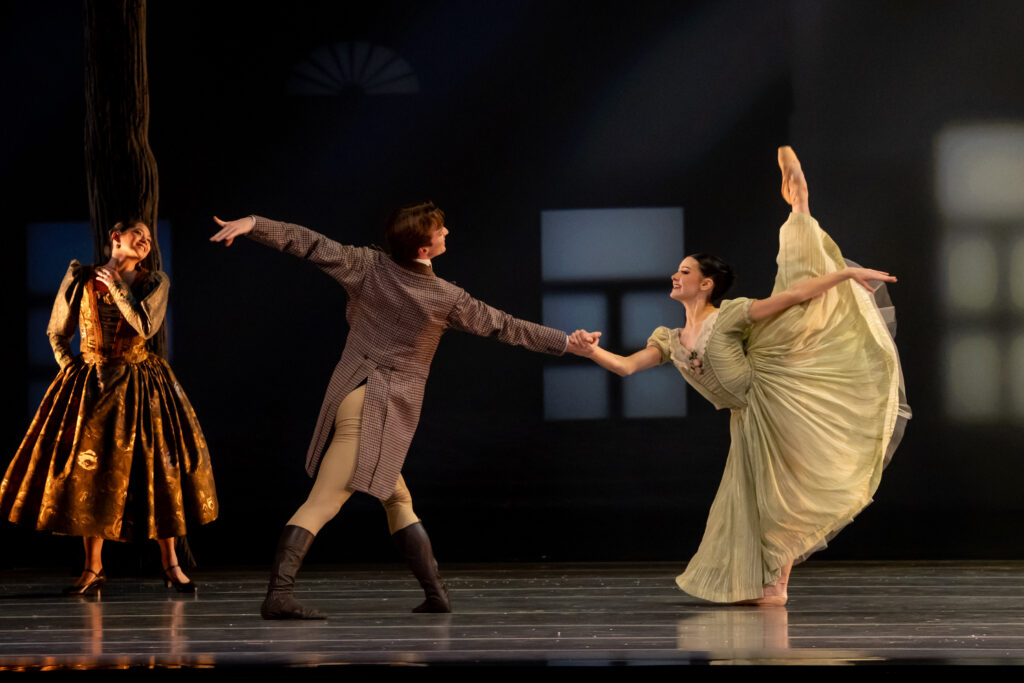
The emotions in their interaction are deliciously layered. Tatiana, filled with girlish glee, appears lighter-than-air, blown back and forth as if by an impish wind. Eugene, caught between temptation and disgust, wraps around her and lifts her high, her legs compassing mid-air, only to place her gently to the side but slightly out of reach. In short, this pas de deux is a perfect metaphor for “letting her down gently.”
Bright, colorful, mostly happy… One thought that this was supposed to be based on Romantic-era Russian literature? Where’s the gloom, doom, and savage social critique? Just wait…
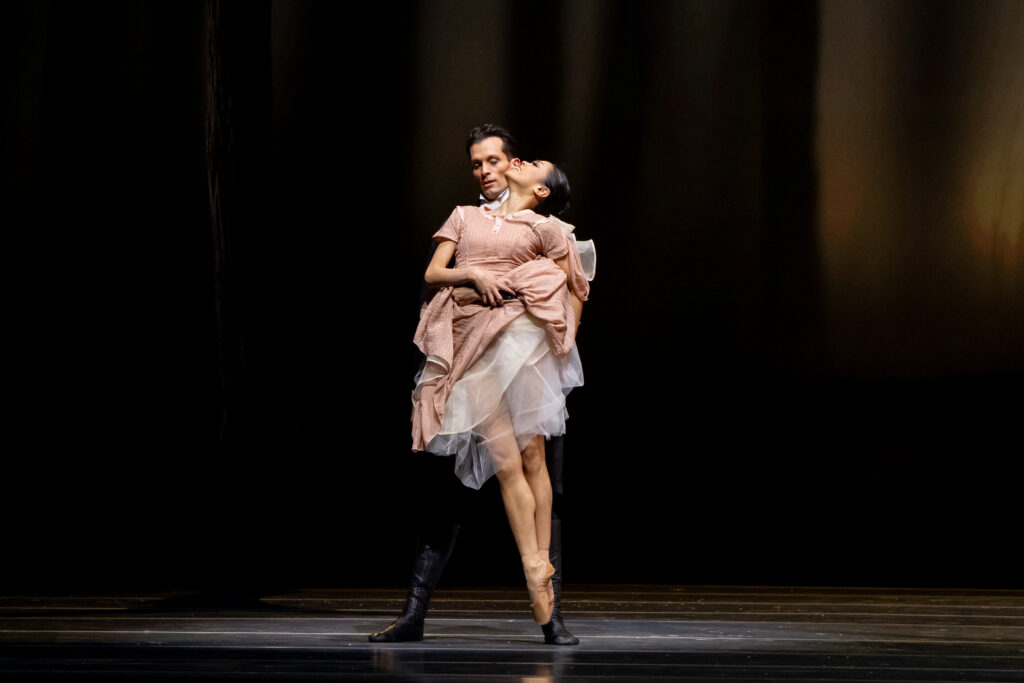
The first-half finale ends with Eugene upset at Lensky for dragging him to another frivolous party at the Larin’s family estate. Eugene takes his revenge by engaging Olga in a frothy dance, which leads a jealous Lensky to challenge his former friend to a duel with pistols.
The second half takes a dramatic turn. The scenery undergoes a stark transformation: the brown trees take on a sickly grey, the sky turns ashen, and the music becomes foreboding. The duel between Eugene and Lensky is staged like a fight scene from an action movie, with both dancers continuously leaping high and clashing midair. Victorious yet downtrodden, Eugene once again escapes, this time back to the city, leaving a trail of death and broken hearts in his wake—now this is gloom!
Doom comes in the form of Tatiana’s nightmare, a hellish soiree attended by a perverse assortment of human-animal-hybrid creatures engaging in a rakish party dance. From among the orgy of serpentine limbs emerges a tall man with a bear’s head revealed to be Eugene, who bares a knife, ready to attack… This prescient nightmare of future doom recalls the Tatiana from the novel, smart, introspective, and forward-thinking, one who not only subconsciously foreshadows Lensky’s death and Eugene’s exile but also her final decision in the end.
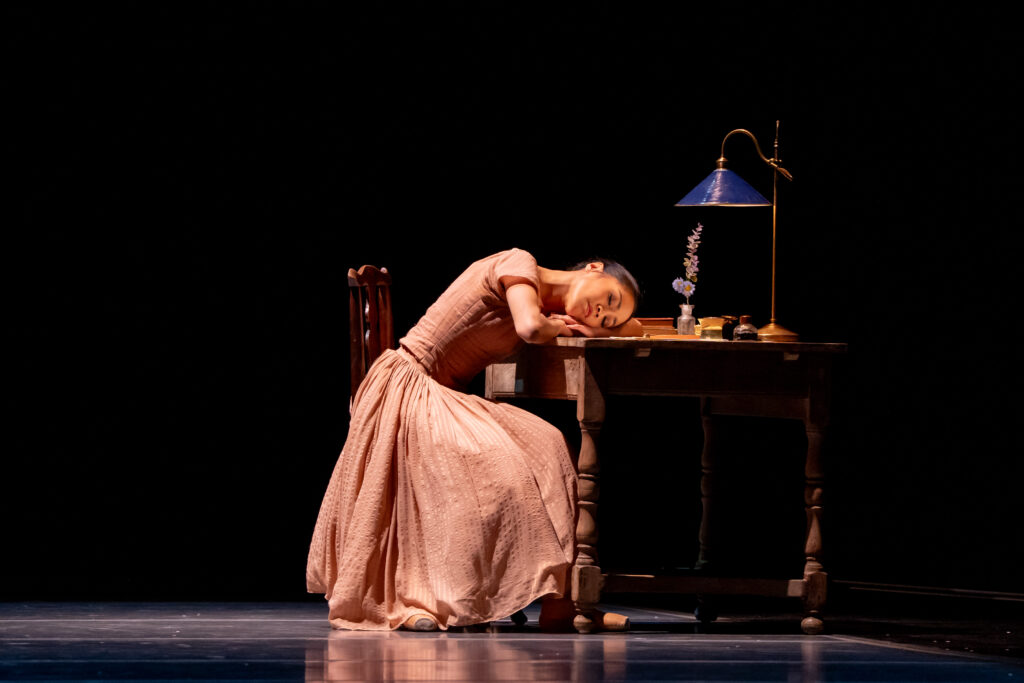
In the denouement, one finds the social critique lacking in the first half. Years later, Tatiana is married to a wealthy prince and lives in a lavish mansion with floor-to-ceiling marble columns and walls lined by blood-red drapes. It is here that Eugene reencounters Tatiana and finds romantic feelings thought smothered suddenly inflamed. As the party guests waltz out of the scene, another stunning pas de deux ends with Eugene, on his knees, confronting Tatiana; the former has realized that following his stoic principles has led to loneliness and is ready to concede; the latter must choose between a comfortable lifestyle and the former love of her life.
While lacking the grandeur of “Anna Karenina,” Joffrey Ballet’s “Eugene Onegin” is more concentrated. Every moment of action serves the narrative, and occasional repetitive movement phrases can be imagined to mirror the structure of Pushkin’s unique “Onegin stanza.” Not a drop of Pushkin’s genius is wasted, and Possokhov’s respect for the source shines through evidently.
The Joffrey Ballet’s “Eugene Onegin” runs through June 14 at Lyric Opera of Chicago, 20 N Wacker Dr. For more information, check out the event page by clicking HERE.
*Quotes are from the 1977 translation by Charles Johnson.
Copyright 2026, See Chicago Dance, All Rights Reserved