
On November 14, Compagnie Hervé Koubi brought “Sol Invictus” to the Harris Theater for a one-night-only performance. Inspired by the ancient Roman festival honoring the unconquered sun, the eighty-five-minute work explores individuality, community, and renewal.
Koubi brings together dancers with diverse cultural backgrounds, movement vocabularies, and personal histories to create a choreographic language that resists classification. Rather than erase differences through uniformity, he embraces the possibilities of distinct individuals moving alongside one another.
Before the performance, Koubi emerged from behind the curtain to address the audience. I am often skeptical of this approach, as an artist’s explanation can shape interpretation or set expectations the work fails to meet. Neither proved true here. Koubi described his desire to “create a manifesto for life,” calling “Sol Invictus” a declaration of his love for dance. He cautioned that his dancers “absolutely do not dance together,” at least not through the conventional unison audiences might expect. Instead, they bring individual experiences, training, and personalities to the stage. Rather than pursue perfection, Koubi celebrates the unpredictable beauty of our humanity.
The piece begins with dancers entering a sparse stage illuminated by hazy golden light. In silence, one performer traces a circle around the space, accelerating into a sideways run before propelling himself forward on all fours like a cheetah. Suddenly, he stops in a headstand. The audience enters a world where the human body seems capable of defying gravity.
What follows is an exhilarating display of physical virtuosity. Performers launch into flips, head spins, windmills, helicopters, and other acrobatic feats. Circular pathways recur in their traveling patterns, sweeping arms, and breaking vocabulary. The human form takes center stage, and the choreography is carefully constructed so one movement flows into another. Solos transition into duets and quieter exchanges: hands finding one another, an embrace, or a performer offering support for another.
The dancers are as distinct as their movement vocabularies. Their costumes share a muted palette, but each retains an unmistakable individuality. Some perform in shirts, others bare-chested; tattoos and natural hairstyles further distinguish them. Each dancer arrives onstage as themselves.
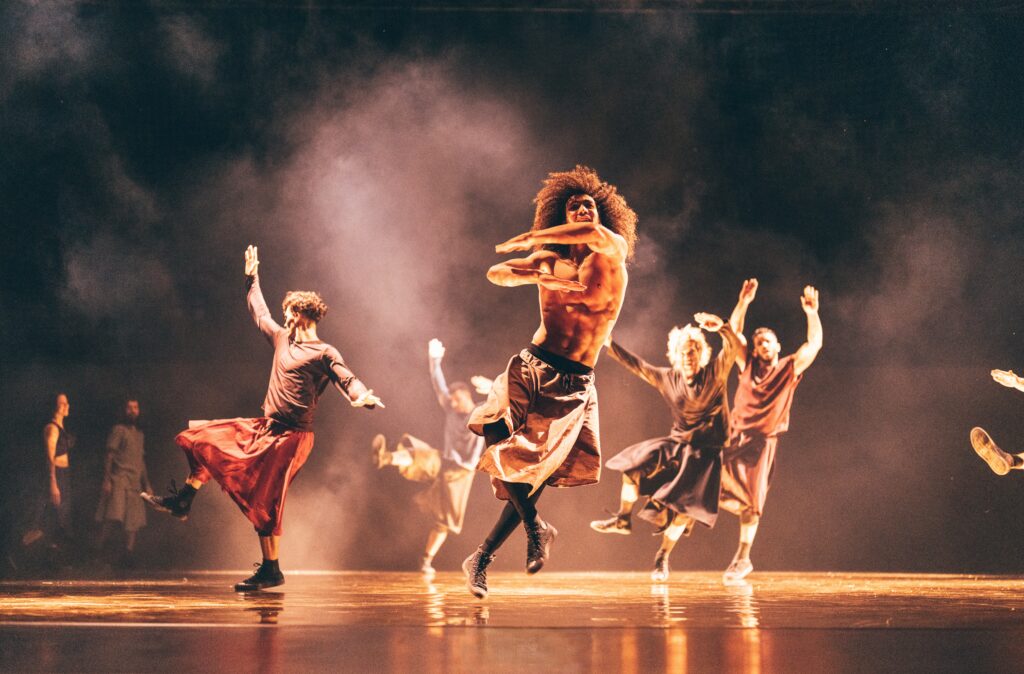
As the work progresses, recurring motifs emerge. A traveling skip, arms extended overhead, seems to summon the sun. Breaking vocabulary, traditionally associated with improvisation, is woven into choreographed sequences. The concert stage offers breaking a compelling home, allowing its artistry, musicality, and communal roots to be appreciated alongside its athleticism.
The dancers at the sides of the stage evoke a cypher, the communal circle familiar in vernacular traditions such as hip-hop and tap. Even when not center stage, they keep time and respond. A dancer’s handspring prompts another to prance across the stage; they encounter a third performer, and their movements merge as individual expression becomes collective momentum.
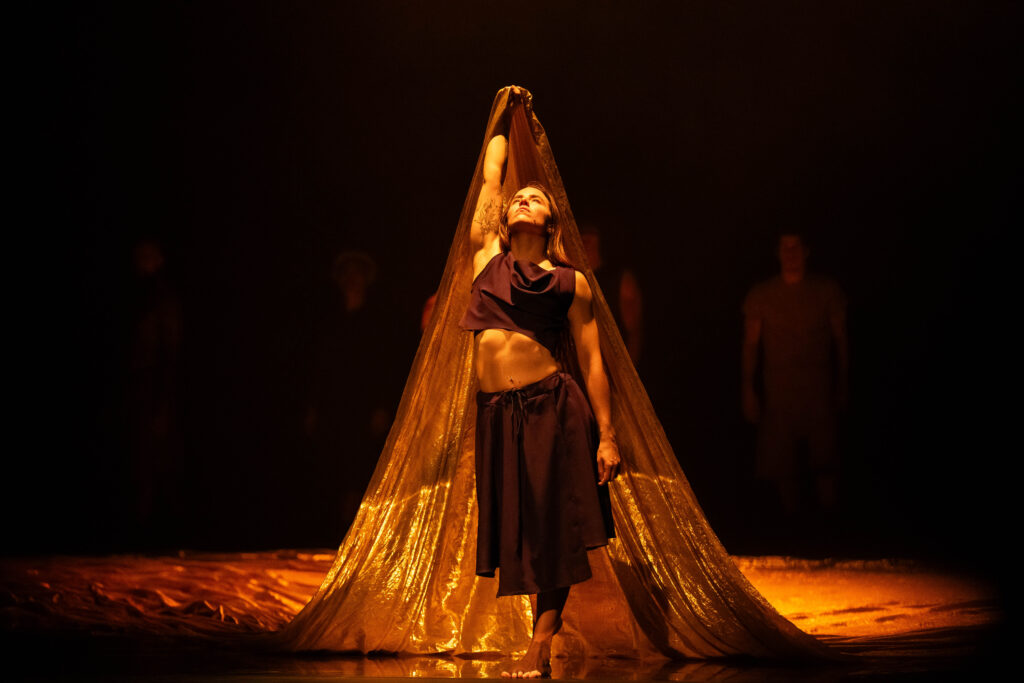
This cooperation extends beyond the choreography. In one striking sequence, a dancer appears to float across the stage on fabric. Rather than rely on theatrical technology, Koubi uses the combined strength of his performers. As she stands nearly motionless, the others manipulate the material beneath her, transporting her like a moving walkway. It is theatrical magic achieved through human effort. Elsewhere, dancers balance on shoulders or fall backward into waiting arms, lifted like pendulums. Individual strength is extraordinary, but cooperative strength makes the seemingly impossible possible.
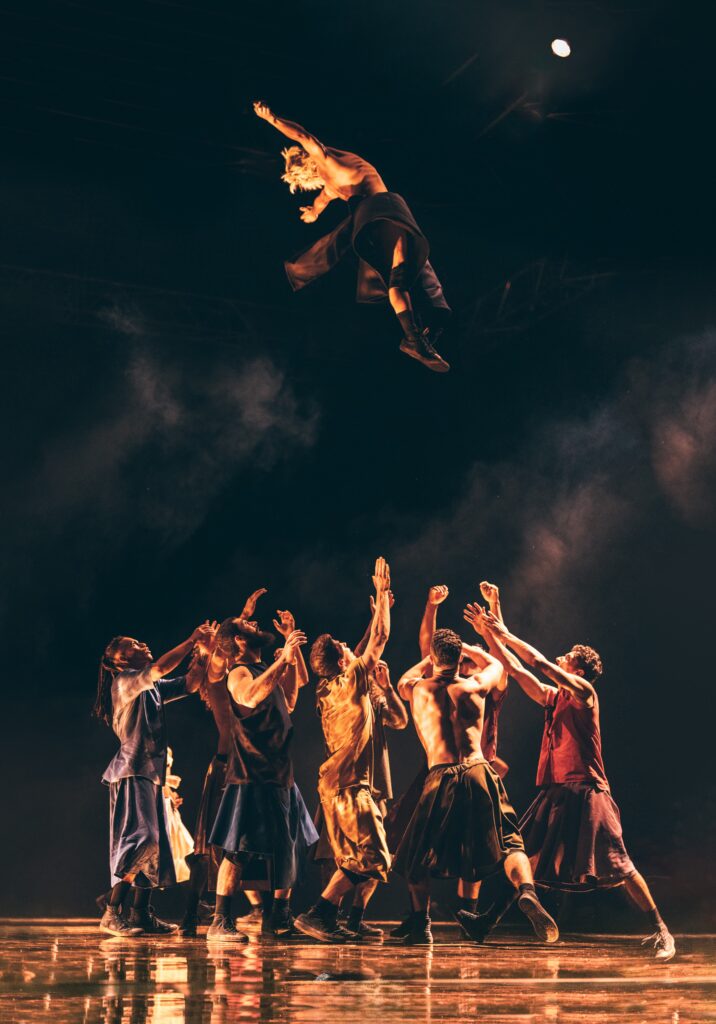
The music shifts between classical orchestration, industrial machinery, and female choral voices. The mechanical sounds suit the dancers’ physicality, yet the performers never become machines—they use verbal cues to coordinate. Koubi rejects traditional counts, preferring that dancers see and feel one another to establish timing.
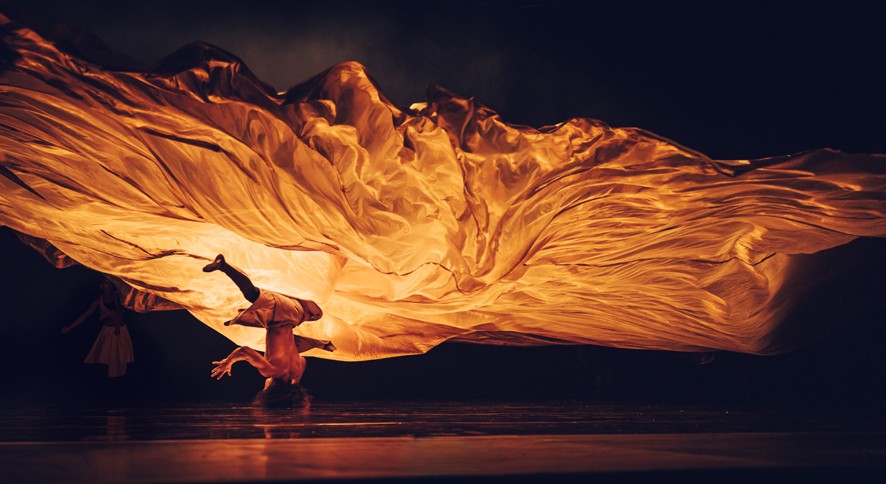
In one memorable sequence, dancers hold hands in a circle as a woman performs in the center, bathed in golden light. They lift fabric around her, creating a shimmering enclosure. When it collapses, she emerges beneath it, suggesting rebirth. The fabric spreads across the stage, transforming it into a golden landscape. Later, performers spinning on their heads send it whipping around like propeller blades. The image is arresting, although repetition diminishes its impact.
Recurring circles and ceremonial gestures recall Stravinsky’s “The Rite of Spring.” Whether a conscious reference or a convergence around ritual and renewal, the resemblance is difficult to ignore. As the work builds toward celebration, dancers cheer while groups gather at the stage’s edges. Performers travel across the space and return like waves, creating a communal gathering.
It is tempting to describe these performers as godlike, as some reviewers have, given their seemingly superhuman physical abilities. I would argue that doing so is a disservice to Koubi’s work. To be a god is to be ineffable, untouchable, and incapable of error. Koubi explicitly asks the audience to recognize the humanity of his dancers, even acknowledging that mistakes may happen onstage. Perhaps superheroes are a more fitting comparison. They possess extraordinary abilities, but their vulnerabilities are precisely what make them interesting. The occasional imperfection does not diminish their artistry but makes their accomplishments more remarkable.
Unfortunately, the work does not sustain its momentum through the final moments. At eighty-five-minutes, it feels overextended, particularly when earlier sequences offer more natural conclusions. The ending arrives abruptly, with the music cutting off like a technical mishap rather than an artistic decision, a conclusion that feels unresolved.
“Sol Invictus” is most compelling when individuality coexists with collective energy. Koubi does not erase the distinctions between breaking, acrobatics, contemporary dance, and other movement traditions; he allows them to meet and complement one another. His manifesto is not one of perfection, but of life: messy, varied, collaborative, and full of possibility. The work reminds us that the extraordinary does not require individuals to become the same. Sometimes, the most powerful thing is to consolidate our differences and discover what becomes possible when we move together.
For more information, check out the event page by clicking HERE.

Copyright 2026, See Chicago Dance, All Rights Reserved