
Hubbard Street Dance Chicago showcases remarkable prowess with a sweeping range of works in their evolving repertory, edging closer to the noteworthy half century mark of existence. Celebrating their 48th season, the company continues to challenge itself and its audience in their “Fall Series” season opener at Steppenwolf Theatre for a two-week run of four dynamic and diverse works.
In the moderate-sized Steppenwolf downstairs theater, Hubbard Street’s program becomes immediate and intimate. This closeness leads to a shared experience between audience and performers. The audience absorbs the sound of dancers’ breath and footfalls, and dancers hear the audience gasp and sense them shifting in their seats. This collective experience on opening night created a wild ride of transformation, entertainment, curiosity and fun.
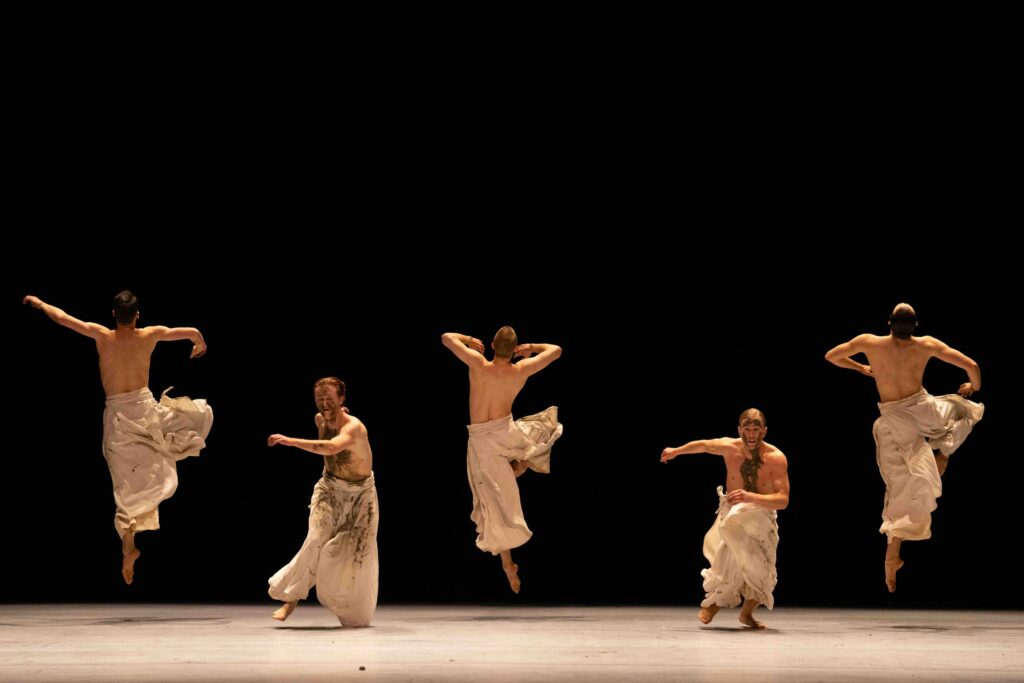
Hubbard Street has had Ohad Naharin’s timeless “Black Milk” in their repertory since 2002, and the piece looks fresh on Friday’s group of five. (Three different casts rotate throughout the run.) A gentle gaze sets things in motion as soloist Elliot Hammans dances as a vulnerable outcast in Avi Yona Beuno’s sculptural lighting, which defines each subtle, supple ripple and pulse of Hammans topless torso. A gentle, slowly evolving body-painting ritual draws Hammans to join the group. Like creatures of a slow-moving earth, the group sweeps Hammonds among them in a mesmerizing cannon. Suggesting a pack of wounded animals, earthbound and very horizontal, or adopting an off-kilter limp, the tension in these broad expansive creatures comes from heavy strides punctuated by athletic jumps.
In a swirl and spiral, two become one as partners take each other’s weight. Equally gentle sensuality and rough manipulation, the two roll with such curves as if devoid of bones. Sensuality turns dark as one dancer grabs the other by the face and violently, repeatedly jams their head into the floor. This is not what the lone Hammans signed up for, and in a poignant turn, he breaks from the pack, washing himself clean of the mud warpaint.
With a commanding and sly attitude, Aaron Choate accentuates every beat of Bob Fosse’s straight up “Percussion IV,” a slice first taken from Fosse’s “Dancin’” extracted for Hubbard Street in 1991. In a wonderful personal moment, the piece opens with Choate standing in simple light, relaxed, as if unaware of what will happen next. What does follow when they take a simple step into a spotlight is four minutes of solid pyrotechnical bravura dance. In a fusion of highly demanding ballet and jazz with flashes of trademark Fosse— a drop to the knees and shoulder shimmy, a sequence of turns into a supple fan kick–Choate embodies the surprises and demands with ease, cutting like a switchblade, long limbs piercing the air with each trick and turn.
The eye can hardly keep up as Choate pirouettes, quickly spinning, then drops to a dead stop in a heap on the floor. With their leggy line and carefree vibe, one gets the feeling this piece will be very different when danced by others in the rotating cast. Now that Hubbard Street is the exclusive repertory home for Fosse/Verdon works, there’s hope to see more from these legends in the future.
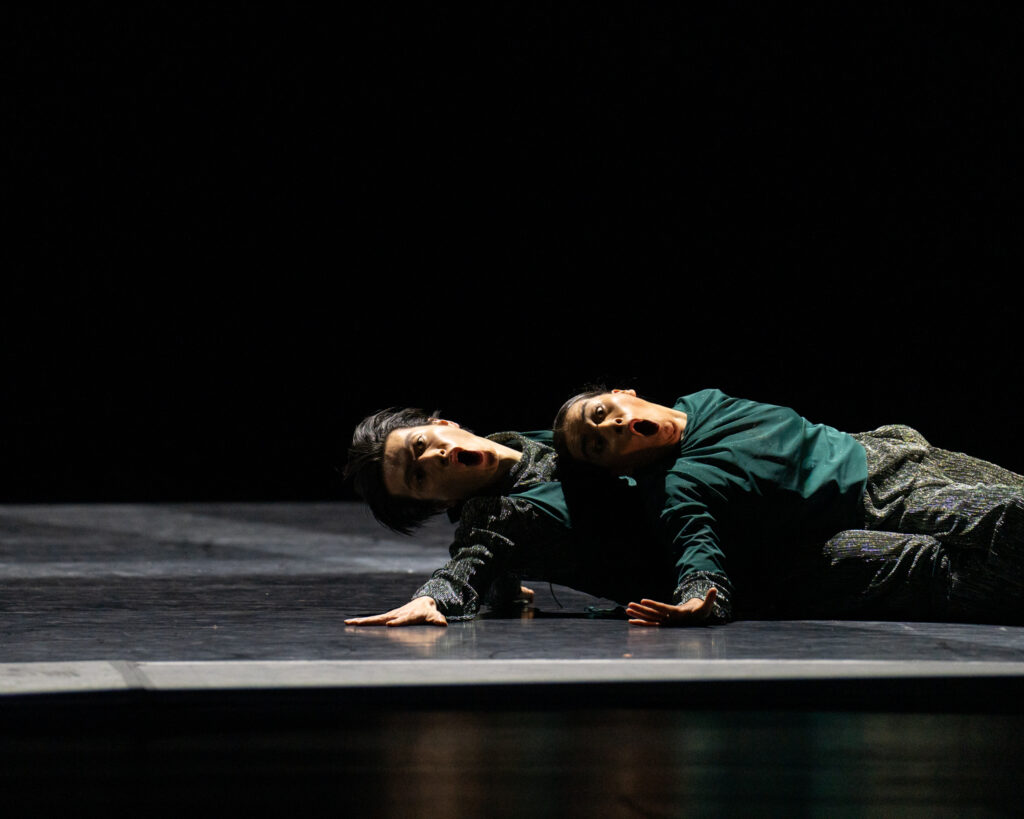
The gem of the evening comes from Aszure Barton’s “A Duo.” Here, Shota Miyoshi and Cyrie Topete (the opening night cast) immediately transport us to a different world, appearing like a weird pair of impish scarecrows eerily advancing upstage. Exquisite costume design of baggy, shimmery silver pants and green velvet from Rémi van Bochove adds to the whimsy. Quirky humor and athleticism reveal layer after layer of a unique, silly, inventive dance language.
Miyoshi and Topete are like two rag doll windup toys slapping feet on the floor, grabbing crotch and exploding into high kicks. Unusual articulation of ankles, wrists and neck gives the illusion that these extremities are disconnected from the rest of the body. Leaning back, with mouths agape, they mimic the haunting otherworldly soundtrack vocals by Marina Herlop. This dance pair is so beautifully matched, at times, it’s difficult to tell one from the other. Side by side unison morphs seamlessly with slithering, sliding and spinning partnering. The level of detail seems impossible and yet there it is, constantly revealing and shifting.
The rousing “Impasse” closes the evening in a full company blowout from choreographer, Johan Inger. Inger builds a dense take on survival and the power of group influences.
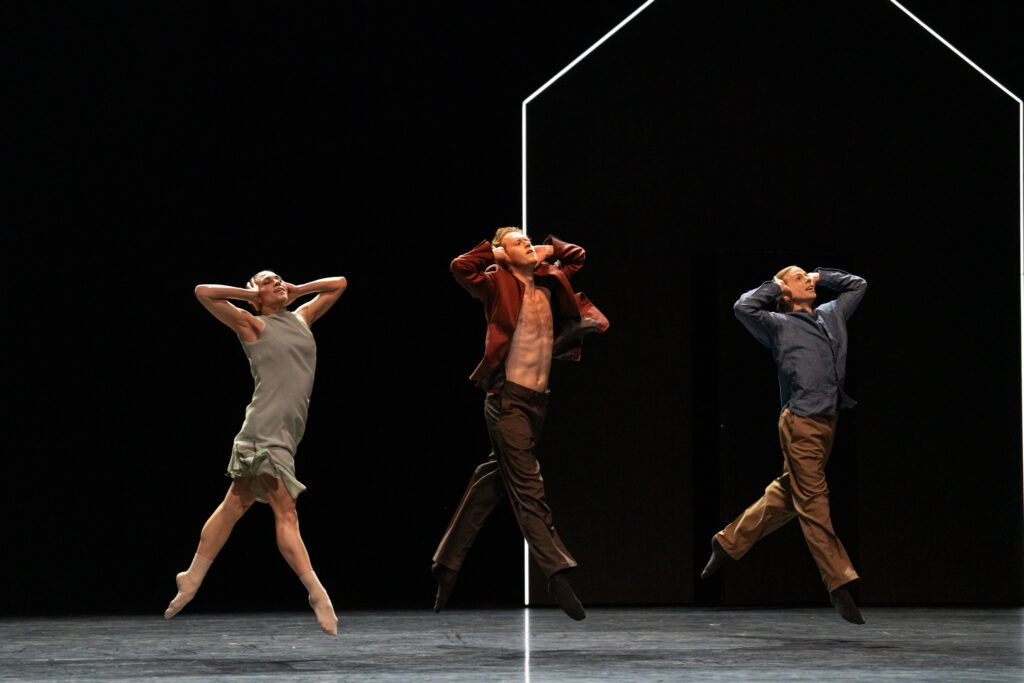
Tender and vulnerable, like a knock-kneed baby deer, Jacqueline Burnett gracefully introduces the piece like a breath of fresh air, emerging from the single door of Inger’s house facade outlined in neon light. Gliding down the diagonal, Burnett is pastoral, soft and familiar. When David Schultz and Choate arrive on the scene, the three laugh and flirt. Falling and tugging at each other’s heels, they are a playful assembly line of would-be/could-be friends, family or lovers.
All seems well, until temptation bursts through the door (a smaller version of the house facade) in the form of powerhouse ringmaster, Topete. Energy immediately ramps up as Topete summons a group of rabble-rousers through the fun house door to stir up the pleasant party. Like a Greek chorus in black, the crowd encircles the trio and absorbs them into a growing frenzy of spread-eagle leaps and exhausting pony prances.
Hands behind head like bird wings, the group struts and grinds to full on craziness as an even more motley group barges in. A clown car of characters—kings, queens, Vegas-style show girls and clowns in a never-ending stream of seductive characters—stifle the original trio. (Wildly inventive costumes by Bregje van Balen elevate the scene.) Partygoers are swept into a campy, orgy-level revelry replete with simulated sex, chicken fights and bodies being tossed into the air. This is high-octane, playful, almost cartoonish delirium.
In the Steppenwolf, the power of the full ensemble of dancers is palpable. As the group beckons with hands outstretched and frantically pulses from foot to foot, the trio attempts to escape this tireless world enclosing around them. They do escape and relish in that calmness, but unlike “Black Milk,” the influence of group seduction remains.
Hubbard Street Dance Chicago presents “Fall Series,” Nov. 14-23 at Steppenwolf Theatre Company (Downstairs Theater), 1650 N. Halsted St. For more information, visit the event page by clicking HERE.

Copyright 2026, See Chicago Dance, All Rights Reserved