
Tap and modern dance styles are more intertwined than one might think. The United States saw a renewed interest in tap during the “Tap Dance Renaissance” of the 1980s, a social, political, and artistic movement immensely influenced by women dancers, many of whom came from traditions of modern dance. The application of modern concert dance aesthetics to tap—like large companies of dancers performing thoroughly-composed, evening-length works—left a significant and lasting impression on the art form.
Dancer and choreographer Michelle Haskell follows in the footsteps of dance pioneers with the debut of “Empty Are My Hands,” August 28-29, at the Dance Center of Columbia College. Choreographed in collaboration with the dancers, four works intertwine tap and modern dance styles while innovatively using the complications that come from such a merger, like changing shoes and the placement of boards for tap dancing, to their advantage.
“Fragments of a Youth Found” sets the tone for the evening. A trio—Haskell, Robin Davis, and Cindy Johnson—wearing blue and red loose-cloth overalls, embody juvenility through the practice of simple pleasures, like tug-of-war and jumping rope but with the rope replaced by a long red ribbon. A slap fights break out. A three-headed totem pole is formed. Tantrums are thrown on the floor, palms pounding organized rhythmic “thumps” that set time for the arhythmic, ambient audio accompaniment, produced by composer Chien-An Yuan crouched over a dim-lit table in the corner.
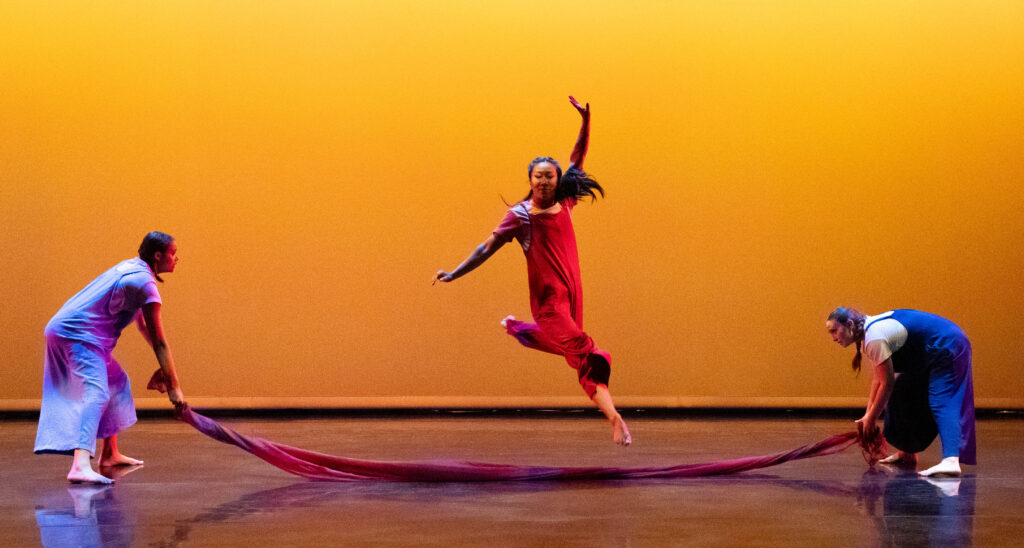
It’s not all fun and games. Isolation and exclusion mar the good vibes. The red ribbon becomes a crimson cobra, coiling around them, squeezing. The ribbon is pulled through one’s center, appearing as a long intestine being tugged from the torso. From separate points they coalesce, tumbling and leaping in sync against the swirling soundscape, trying to outrun the sense of time they themselves introduced through their tantrum drum. If the ribbon is memory, it implies that the further one follows it back in search of nostalgic pleasures, the harder one is snapped back to reality. “Fragments” is playful without being puerile, and the capricious red ribbon is a fine metaphor for the double-edged tendency to reminisce about the past as one grows older.
“Fragments” melts into “Through It All” via a simple and superb transition. The three adult/children look right as dancer Tristen Sanborn enters wearing a grim expression and dragging behind him a square slab. He crosses slowly to the left corner, places the slab on the ground, and begins to tap dance bare footed, his skin striking muffled “whumps” and sizzling slides. All the while, the stage has been filled with similar ascetic-looking individuals carrying not boards but limp bodies. The slight-of-foot distraction created by Sanborn allows for the unnoticed construction of this somber scene and establishes a continuity of flow that connects the former work to the latter.
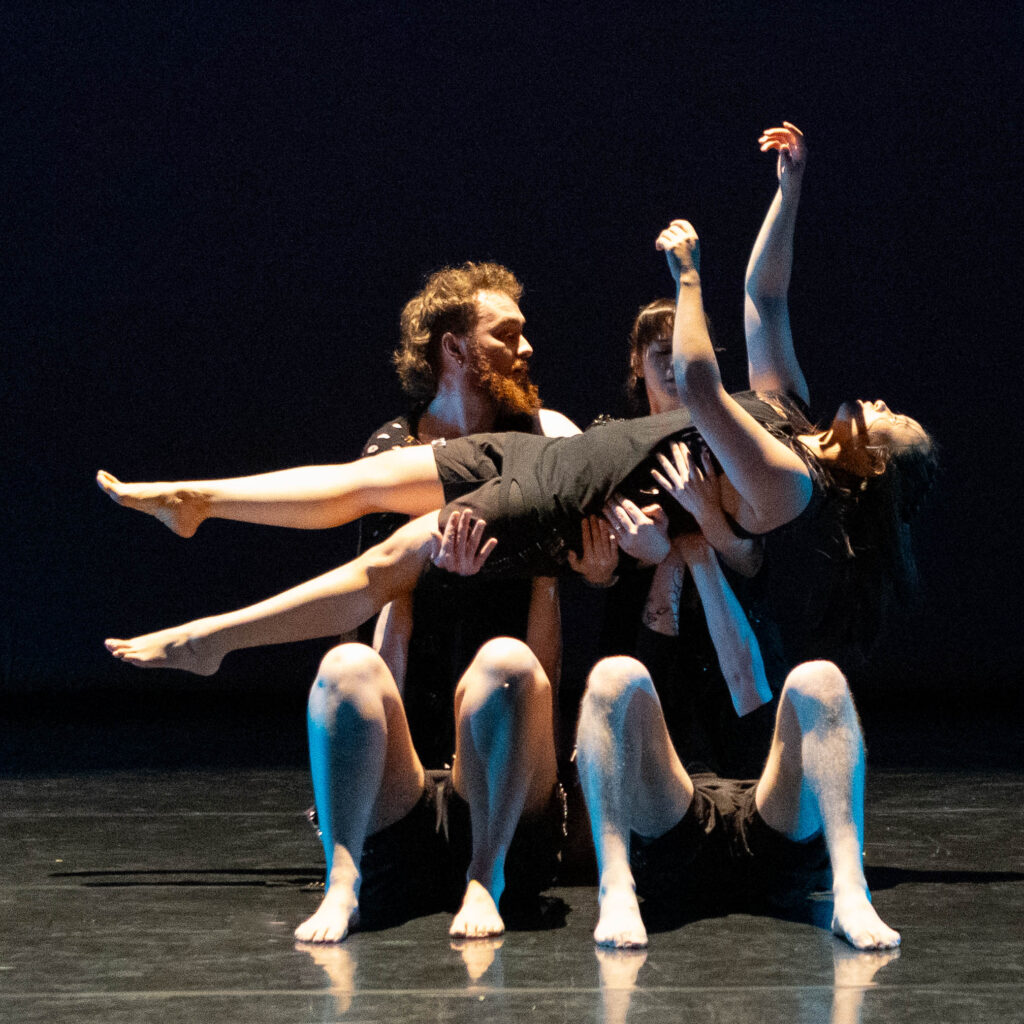
In “Through It All,” dancers dressed in black bound about like particles within a nucleus, colliding, sticking to one another, bumping others out of rotation, and explosively separating into clusters that roll across the floor. The mass stabilizes and walks cautiously down a narrow path composed of white light, emerging on the other side as primitive animals prowling for prey, some leaping high in the air and bending their spines backward in the shape of a waning crescent moon. From the chaos a leader emerges. Dancer Nik Graves stands firm in the gale, their full beard and strong frame conjuring an image of Odysseus pushing back against the winds of Zeus unleashed by his crew from the ox-skin bag of Aeolus—instead of hampering the journey home, Graves’ “crew” gathers behind them, and together they push past the tempest and celebrate their victory in a synchronized climax, rolling their shoulders dramatically, and what began as dark and creepy finishes with an optimistic flourish.
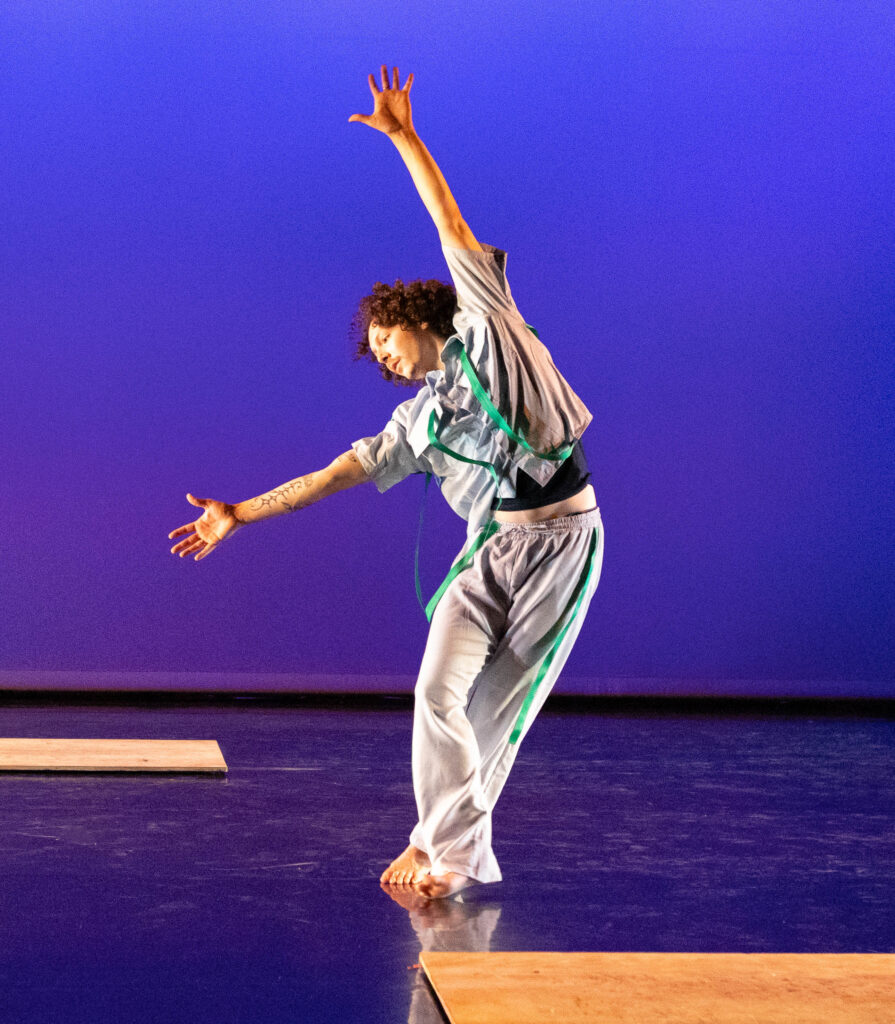
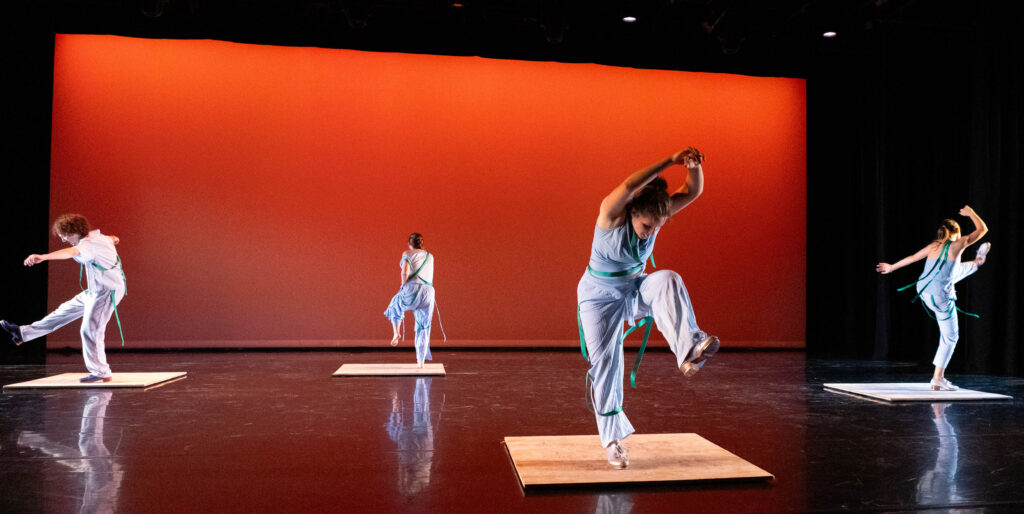
Thus far, tap has been teased, and there is a great sense of anticipation, but now the wait is over. In “The Arena,” four dancers—Haskell, Sandborn, Greta Loomis and Abby Wildak—wearing pants and shirts of relaxed blue cotton affixed with loose green fabric strips, appear barefoot beside multi-colored pairs of tap shoes. Before they put on the shoes, they present themes of sacrifice—dancers carrying one another on their backs and carrying the boards like weights of penance. Tap shoes are put on one foot at a time but with dance breaks in between, sounding simultaneously the sharp clack of aluminum and the “whump” of flesh. The question of “How to change into tap shoes without slowing the pace?” is not only overcome but answered creatively.
The climax of the piece is an explosion of tap. Dancers leap from board to board, maintaining the sense of momentum built up thus far. On the boards, the tapping is fierce, funky, and fast, with each dancer trying to fit in as many notes as possible during rotating solos. “The Arena” is a cathartic culmination after the long tease of tap, even though the change in mood from chill and spooky to high-energy dance party is a bit jarring.
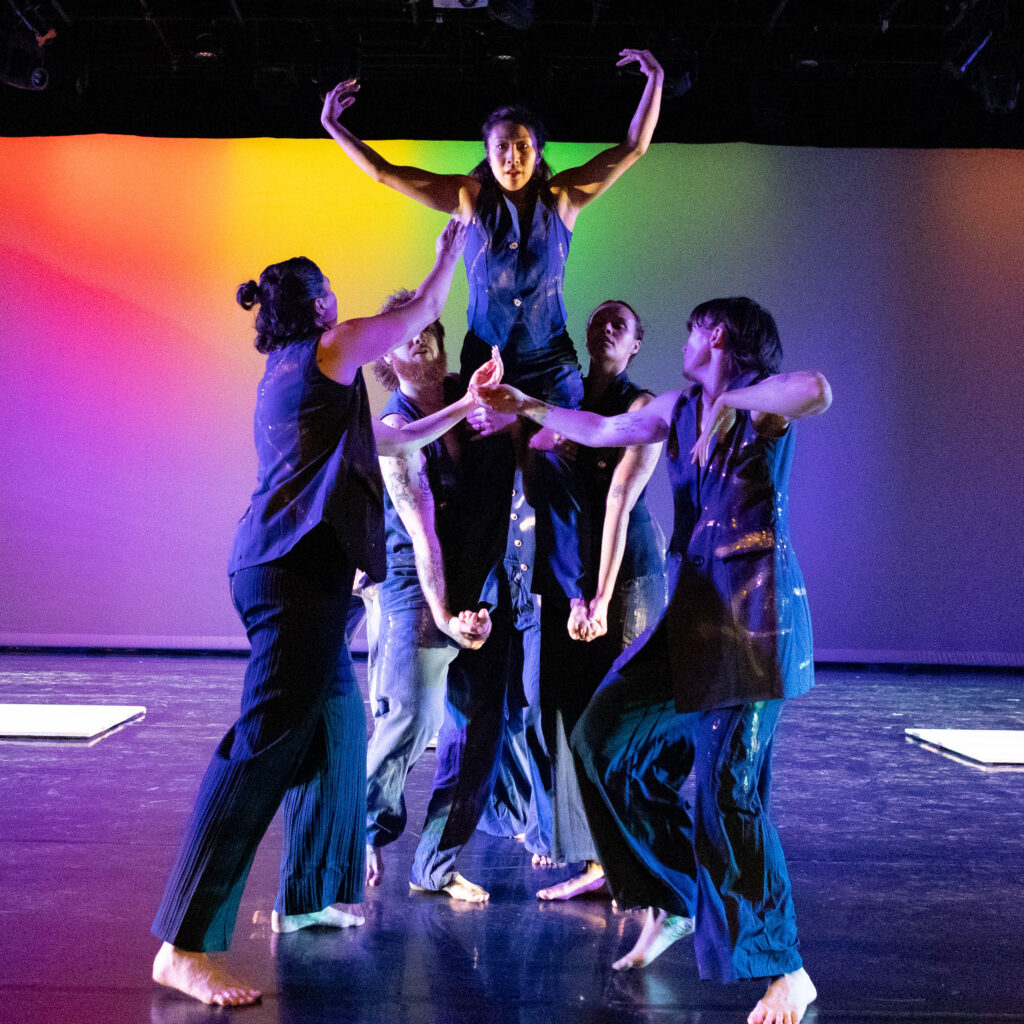
The program culminates in “Not All Gold Glitters,” where dancers wearing black vests painted with sparkling gold swirls make great use of the tap boards as set pieces and props, held like tables for others to crawl under, or as upright springboards from which dancers leap toward and kick off. Barefoot dancers swarm like a school of fish as the tap dancers reappear, this time subdued, their rhythms complimentary to the pulse of the swarm. In a spunky, rousing finale, all the elements previously established in the former works are recapitulated with gusto, the juxtaposition of two art forms complete.
Haskell and dancers pass through creative territory rarely explored (i.e., the synthesis of tap and modern dance) and their solutions to problems noticeable in other tap and modern amalgamations (i.e., how to get on the shoes and what to do with the tap boards) are imaginative and inspired. Haskell is on to something, and “Empty Are My Hands” adds to the canon of tap and modern dance collaborations while finding new ways to innovate within both mediums.
Michelle Haskell presents “Empty Are My Hands,” Aug. 28-29, at the Dance Center of Columbia College Chicago, 1306 S. Michigan. For more information, check out the event page by clicking HERE.
Copyright 2026, See Chicago Dance, All Rights Reserved