
For 25 years, M.A.D.D. Rhythms has lived up to its name: Making A Difference Dancing Rhythms. On October 3 at the Harold Washington Cultural Center, that quarter-century history was celebrated through two world premieres by the company’s co-founders: Bril Barrett’s “Oscar Plays Gershwin” and Martin “Tre” Dumas’ “My Personal Stash.”
Barrett emphasized the distinct voices and personalities of dancers within a collective rhythmic landscape, while Dumas reached backward, using tap to reconnect with family, history and musical tradition. The former looked outward toward the possibilities of the individual within an ensemble; the latter looked inward, demonstrating how the sounds of the past can continue to reverberate through the body. In both, however, the company’s founding philosophy remained unmistakable: tap is rhythm, and rhythm is connection.
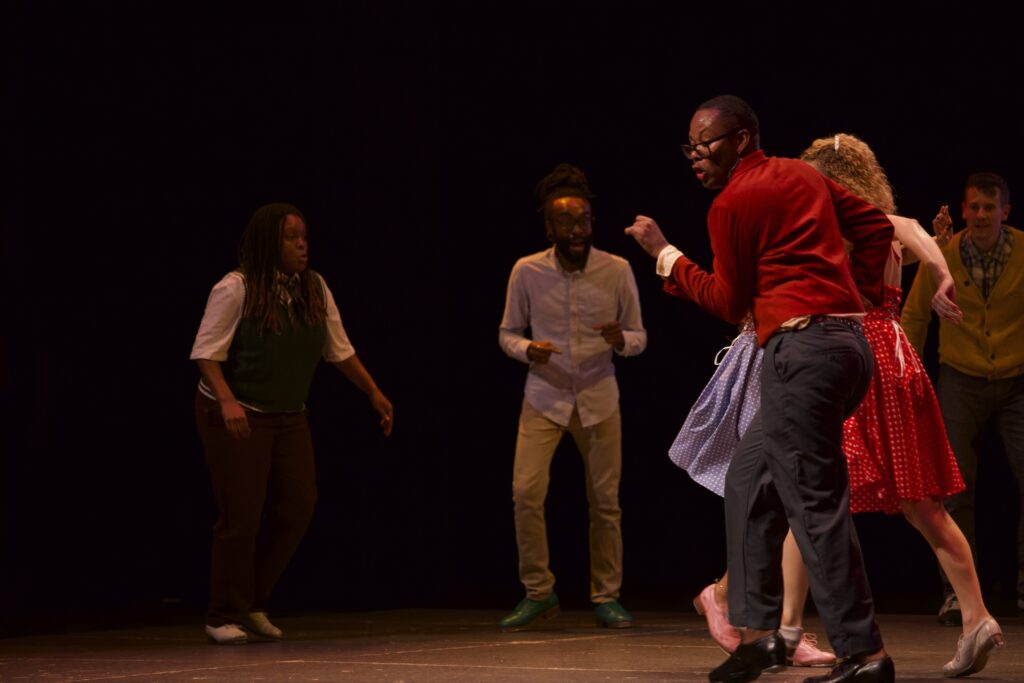
In “Oscar Plays Gershwin,” Barrett celebrated M.A.D.D. Rhythms’ history by bringing together current and alumni company members. Dressed in 1950s-inspired swing skirts, polka dots and suit ties accented with splashes of red, blue and yellow, the dancers inhabited the world of the 1959 album “Oscar Peterson Plays the George Gershwin Songbook.” Each selection was accompanied by a projected image of the pianist against a city skyline, interspersed with photographs of company dancers, visually blending jazz history with Chicago’s tap dance heritage. The dedication to the preservation and uplifting of the history of tap dance is apparent throughout this show, and speaks to Barrett’s role in the dance community as educator and historian.
Peterson’s interpretations of Gershwin’s compositions became the meeting point between two musical greats whose work helped shape the musical landscape in which American tap evolved. Barrett adds another layer by placing that musical history in dialogue with the living bodies of Chicago’s tap community, including greats such as company members Starinah “Star” Dixon, Donnetta “Lilbit” Jackson, Caleb Williams and Tristan Bruns and alumni Ian Berg, Tyler Booker and Case Prime. Barrett and company transformed an iconic album into something immediate and embodied: Gershwin filtered through Peterson, then interpreted again through the rhythms, personalities and individual voices of contemporary tap dancers.
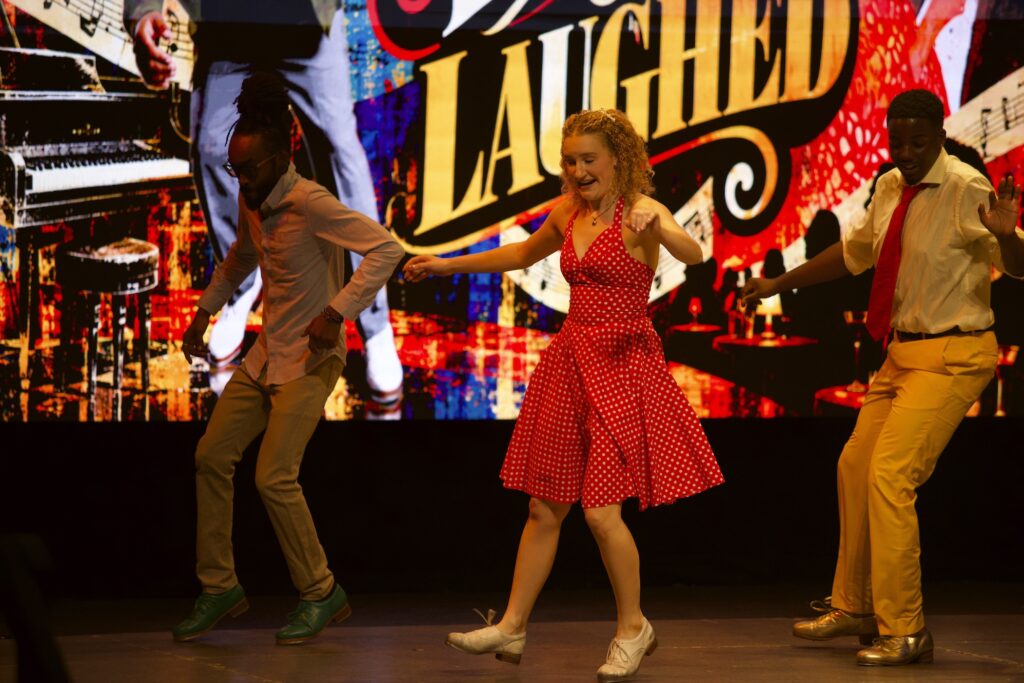
As is characteristic of M.A.D.D. Rhythms, the work moved from one song to the next, alternating from full-company numbers to smaller groupings, duets and numerous improvised solos. Numbers like “Nice Work If You Can Get It” connected the present to tap’s vernacular roots, incorporating foundational jazz and Lindy Hop steps such as the fall of the log, tack Annie and boogie back alongside more complex tap choreography. The juxtaposition underscored tap’s evolution while maintaining a connection to the Black vernacular dance traditions from which it emerged. Other pieces like “It Ain’t Necessarily So” highlight the advanced rhythmic footwork the company is known for, with high flying wings, poly-rhythmic toe and heel drops, and light staging that allowed the choreography to speak for itself.
The first act, however, was hampered by technical difficulties that occasionally interrupted the flow. A transition to a duet between Barret and Chicago tap legend Mr. Taps began awkwardly as the track for “A Foggy Day” failed to start. A brief computer-like blip at the beginning and end of each selection further punctuated the musical transitions, drawing attention away from the seamless interplay between live bodies and recorded sound. The placement of the sound board in the middle of the audience compounded the issue, as technicians’ audible exchanges while troubleshooting errors made the behind-the-scenes mechanics of the performance part of the audience’s experience. These interruptions were particularly noticeable in a work so dependent on musical precision and rhythmic continuity.
Despite this rocky start, Barrett’s duet with his mentor Mr. Taps became an especially poignant. Barrett initially signaled for the music to stop, introducing Mr. Taps before the two continued their exchange. They listened and responded to one another with remarkable generosity. Barrett established a steady rhythmic foundation while Mr. Taps layered his own melodic ideas over it then reversed the roles. The exchange was not a competition but a conversation, demonstrating the trust and attentiveness that make improvisation possible.
Dumas’ “My Personal Stash” is inspired by the soul and funk grooves of Rasputin’s Stash, founded by Dumas’ late father, Martin Dumas Jr. The work transforms a personal musical inheritance into a living, percussive tribute and intimate meditation on family, inheritance and identity. Before each selection, recorded voiceovers featured Dumas recounting childhood memories, describing his father and explaining the musical intricacies and significance of songs from the band’s discography. Photographs of Dumas and his father, Rasputin’s Stash promotional images transformed the stage into an evolving family album.
Yet Dumas’ story was not told in isolation. Performing alongside him were Chicago tap artists Nico Rubio, Jessica Chapuis, Megan Davis, KJ Sheldon, Ivy Anderson and Marty Bronson. Their presence expanded the work’s meditation on family beyond blood relations to encompass the artistic community that has shaped Dumas’ life and career. In “Ooh Girl,” written about Dumas’ mother, real-life couple Chapuis and Bronson embodied the characters in the song as an extension of his own parents, creating another connection between Dumas’ personal history and his artistic family.
Dumas’ choreography also revealed how naturally tap can inhabit the language of funk. His rhythms settled into syncopated grooves, unexpected accents, polyrhythms and, perhaps most powerfully, silence. He allowed pauses to sharpen the rhythms surrounding them and embraced the extended vamp characteristic of funk, establishing patterns long enough for the audience to internalize their structure before branching into new rhythmic territory.
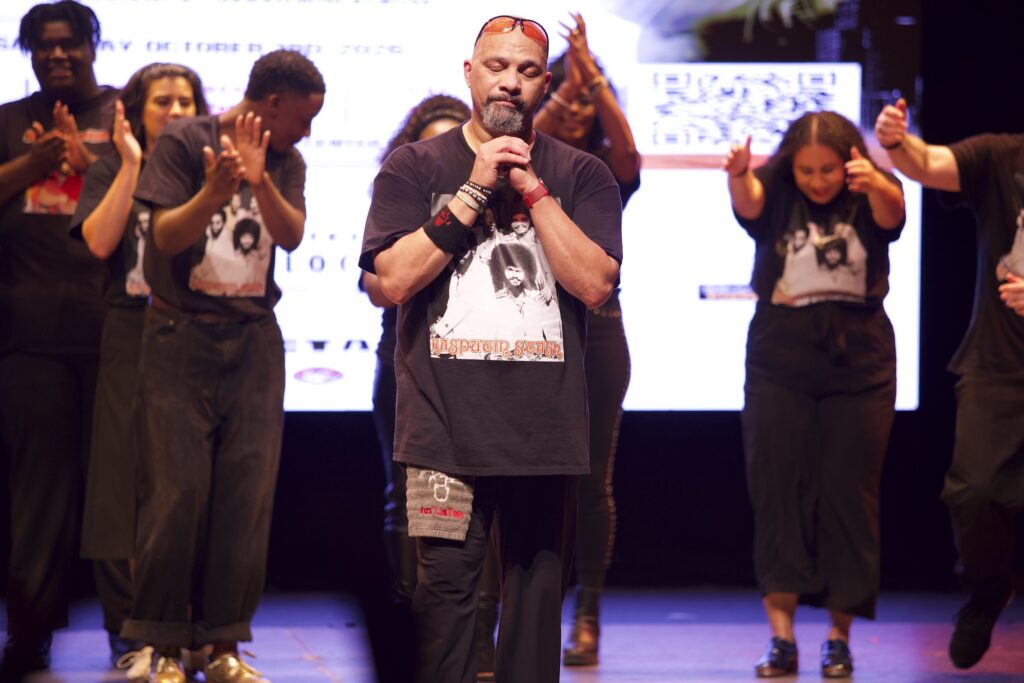
The evening’s most moving moment arrived with “Pick Up The Apple.” Dumas recalled absorbing music firsthand as a child while his father’s band gathered in the family home, eventually recording young Dumas playing bongo fills that became part of the song. Hearing that recording while watching Dumas and his ensemble bring their own rhythmic interpretations to the music created a remarkable convergence of past and present. His father’s playing lives on in the recording; Dumas carries that inheritance forward through his body; and the dancers beside him become part of its continued life. Father and son are, in a sense, performing together across time, with tap dance serving as the bridge between them.
Across both premieres, Barrett and Dumas demonstrated two powerful ways of carrying tradition forward: by giving individual dancers space to find their voices and by allowing personal history to speak through the body. Twenty-five years after M.A.D.D. Rhythms began, the company’s commitment to tap dance excellence remains not simply a musical one, but a way of connecting generations, honoring lineage and making a difference through dance.
For more information, check out the event page by clicking HERE.

Copyright 2026, See Chicago Dance, All Rights Reserved