Water has a striking ability to transform. It can carve through stone with force or ripple softly across a surface, changing forms without losing its essence. Street dance possesses that same elasticity, flowing effortlessly from explosive athleticism to soft openness. Chicago Dance Crash’s “expo/sd,” presented at the Ruth Page Center for the Arts on July 24, harnesses that duality, allowing contrasting movement to ebb and flow as one, turning stylistic differences into a strength and giving the dancers a space for true vulnerability.
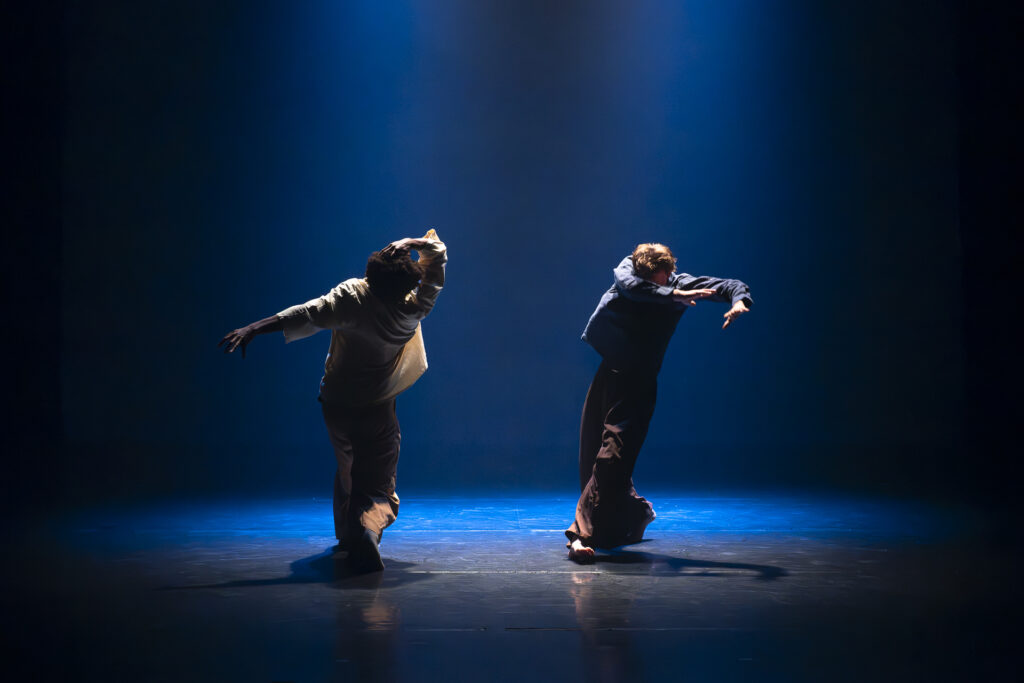
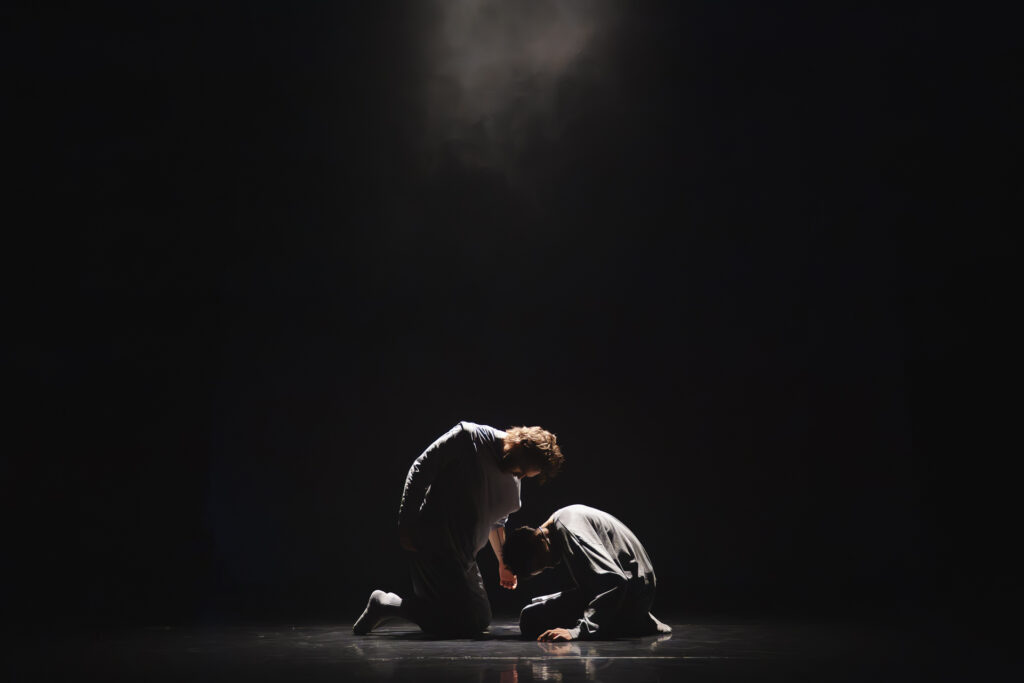
“Noble Cause,” performed by Sawyer Newsome and Phill Wood, is the most satisfying example of this fluidity found within hyper physicality. Choreographed by Cameron McKinney and inspired by Yukio Mishima’s novel, “The Sailor Who Fell From Grace with the Sea,” the duet meditates on ambition and the disillusion that follows its loss. Rooted in “meditative exhaustion,” the work pushes its dancers beyond physical limits, stripping away facades and leaving behind raw honesty.
Like waves rolling toward the shore, the work pushes and pulls in an unpredictable current. The dancers drift in and out of each motion, leaning through nigh-impossible handstands before surrendering to the floor. Moments of struggle give way to quiet collapse as one dancer crawls toward a beam of light only to be pulled back by the other, a gesture that could be interpreted as either rescue or restraint. That uncertainty, paired with the effortless blending of contemporary partnering and street-inspired style, makes “Noble Cause” a very captivating work.
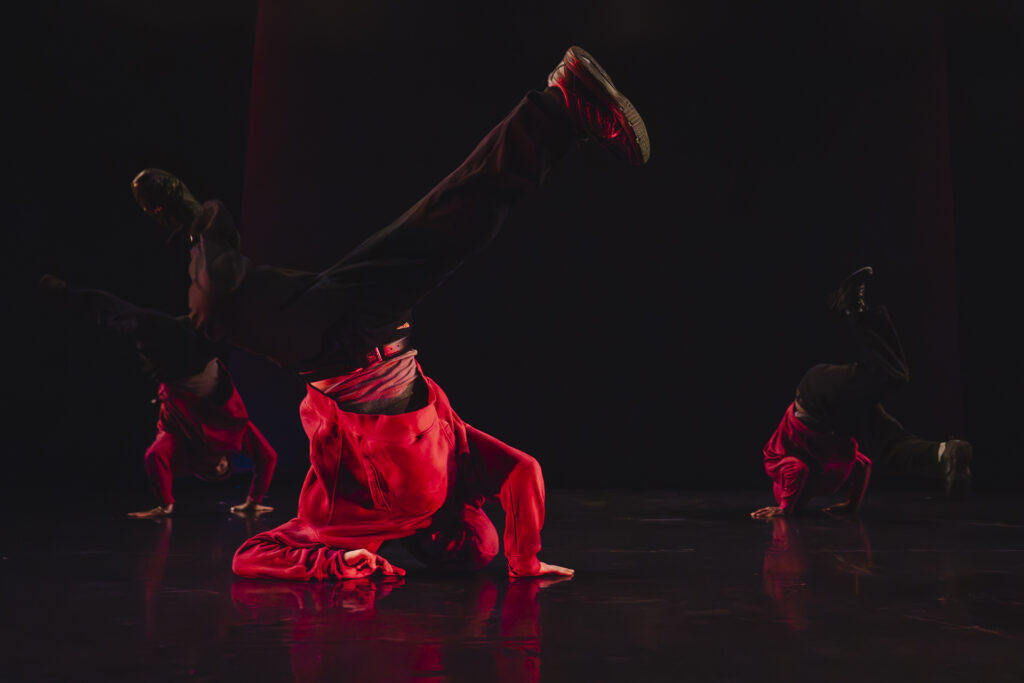
Crash resident choreographer Elijah Motley’s “4 Bar Loop,” performed by Sawyer Newsome, Phill Wood, Logan Howell, and Ibrahim Sabbi, shifts the program into more personal territory. Drawing from Motley’s experiences growing up as a Black man in the South, the piece examines cycles of racial injustice by asking the painful question: how much has truly changed? Through looping phrases, smooth swagger, and recorded voice memos, the work reflects on both progress and regression within civil rights.
Motley voices the questions, “Why am I here?” and “What do I need to do?” before quietly answering, “I guess I just start.” As funk-gospel music by Pastor T. L. Barrett begins, the dancers pull on deep crimson hoodies, tightening the drawstrings around their faces. The movements are somewhat conflicting. Relaxed shoulders and fluid sways are interrupted by images of violence, including hands striking a dancer’s head, one dancer atop another’s back, and a finger gun aimed at a bowed figure. This contrast exposes the tension between freedom and the continued reality of oppression.
The house lights rise as Motley’s voice fills the theater again. “That’s it,” he declares. “It’s always been rage.” The dancers repeat an abridged version of the choreography, their unwavering stares forcing the audience to confront the oppressive imagery before them. Ending with, “I don’t know where to start… but I need to do it,” Motley transforms the piece into both personal reflection and a quiet call to action.
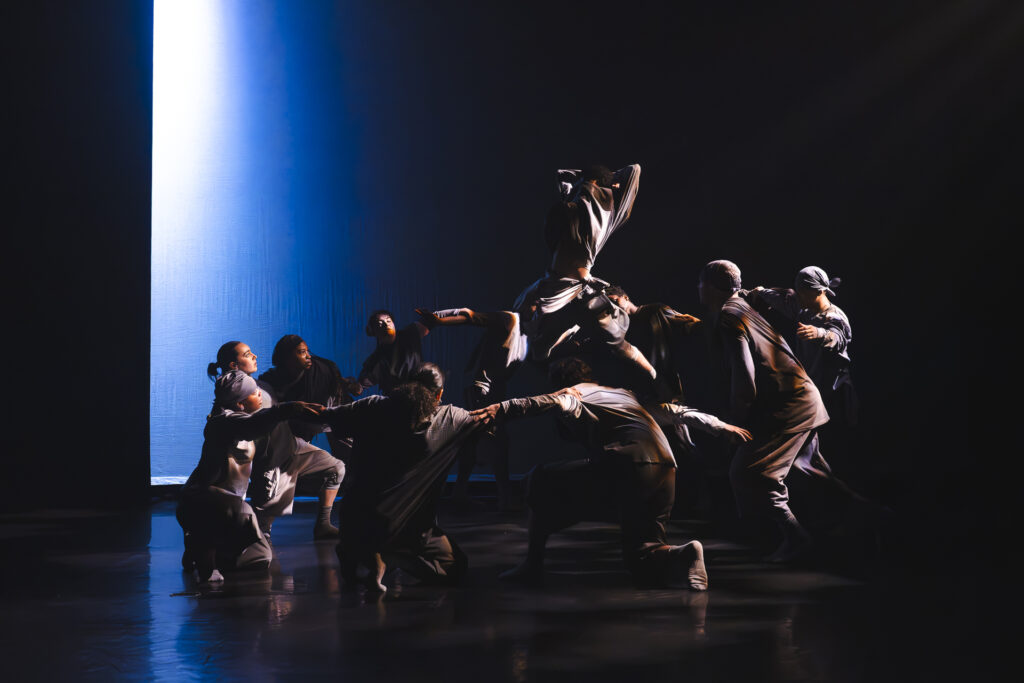
The program’s largest work, Annie Franklin’s “Six Ways to Fall,” performed by the Crash ensemble, is an exploration of vulnerability across six interconnected perspectives: physical, emotional, social, relational, identity, and existential. Accompanied by a haunting original score from Chicago music producer e j e c t, the fifty-minute work explores what it means to be seen, supported, and exposed.
Moving between ensemble, duets, and smaller groups, each section examines a different form of human connection. Dancers physically shield their faces with their hands before slowly building the courage to reach beyond to others in support, creating an image of susceptibility and the building of trust. This trust is developed further through the contrasting improvisation-driven, high-energy street dance, where each performer brings a distinct action that reflects their personal style and confidence of belonging within a larger group.
The final section brings the entire ensemble back together as their distinct modes fully intertwine. The ensemble slowly form a cluster around dancer Barrow in the piece’s final solo, as she reconnects with the group. Her reaching hand reflects both the support of those around her and the courage it takes to be fully seen. While some of the contemporary sections felt slightly repetitive and a bit long, the piece is a testament to the dancers’ stamina, artistic commitment, and the ambitious physical and emotional scope of Franklin’s vision.
“expo/sd” succeeds in celebrating street dance as an evolving artistic language capable of carrying immense emotional depth while seamlessly intersecting with contemporary dance, improvisation, and storytelling. The result is an evening that feels emotional and electrifyingly new, a bold reminder that some of dance’s most exciting innovations happen when seemingly disparate worlds are allowed to collide.
For more information about Chicago Dance Crash’s “expo/sd,” check out the event page by clicking HERE.
Copyright 2026, See Chicago Dance, All Rights Reserved