
A brief review:
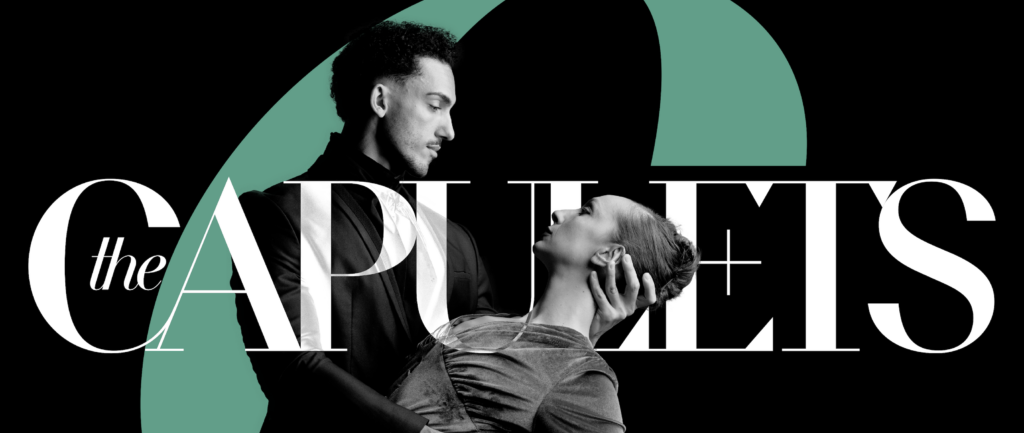
“’The Capulets,’ […] featuring choreography by Chicago Repertory Ballet founding artistic director Wade Schaaf, an original contemporary classical score by Matty Mattsson, and projection design by John Pobojewski and Zach Minnich […] reconceptualizes the world of Shakespeare’s ‘Romeo and Juliet,’ and centers on not the star-crossed lovers who fall in love despite their families’ rivalry, but instead on Juliet’s parents, the Capulets, who are each entangled in an affair. Those familiar with the story will appreciate characters, classic scenes, and themes of desire and loyalty from the original play, but this ballet veers into a world that is very much its own. In CRB’s version, Lord Capulet is having an affair with Paris, Juliet’s young suitor, and when Lady Capulet discovers the lovers, she develops a relationship with the cavalier Tybalt, starting a chain of events that unravels the story into a haunting climax” (Valdez 2025).
Click HERE to read the full review of “The Capulets” (2025) by staff writer, Sydney Valdez.
Tristan: “The Capulets” opened and closed around this time last year, so, why produce the same ballet two years in a row?
Wade: The show was very popular when it opened in 2025, and it sold well, and people really liked it. So, part of bringing it back was to give folks who were not able to attend last year a chance to see it, as well as for folks who loved it to see it again. I don’t intend to produce it for at least another couple of years.
Tristan: What’s new about the 2026 version?
Wade: We do have quite a few new cast members. Lord Capulet, Count Paris and Mercutio are all new cast members, as well as a couple of the female dancers. I’m thrilled to have Bennett Cullen in the role of Paris, Trey Alexander in the role of Lord Capulet, as well as Nikyle Maurice Scott, who is dancing as Mercutio, who are all new dancers to me. All have danced for other companies in Chicago—Bennett is at Cerqua Rivera, Trey works with South Chicago Dance Theater, and Nikyle is at Deeply Rooted—and it’s been a fun and interesting process witnessing each dancer find their own way with each of these roles, and, you know, I am having a really good time working on how to make these roles suit them.
Tristan: Are you a Shakespeare buff?
Wade: It’s not like I’m a Shakespeare historian, but I’m constantly studying, and there’s just something about adapting his stories—we’ve done “The Scottish Play” as well. I thought the characters of the Capulets were so intriguing, because everybody knows them from “Romeo and Juliet.” I thought, what if we looked at this universe from another perspective? I have always been inspired by what motivates Lady Capulet. Shakespeare leaves this space for her to have a monologue right after Tybalt dies, and she’s just so emotionally distraught. Scholars have questioned it, and it’s been alluded to in productions of “Romeo and Juliet.” Did Tybalt and Lady Capulet have a relationship? I’ve always found that idea intriguing, and that’s what I built this ballet around.
Tristan: What’s your process? Do you choreograph closely to the text—like literally trying to tell the story through movement—or do you abstract from the property and make something related but new?
Wade: When I adapted “The Scottish Play,” I used the text, the events and the timeline very literally, and that was a very strong roadmap for me. For [“The Capulets”], I had little to work with, because the events that we see in the show only overlap between this and “Romeo and Juliet.” The opening sword fight scene and then the ball scene were two little touch points that I had to the original text.
Tristan: In what ways have you expanded the story of “Romeo and Juliet”?
Wade: [“The Capulets”] is very character motivated. I thought a lot about what would make these characters behave in this way, what drives them, and what events are important for the audience to see that revolve around Lady Capulet’s affair with Tybalt. That was what helped me really put the story into perspective. Why does Lady Capulet need to have an affair? Well, there must be something going on in her home relationship with Lord Capulet. I started exploring what’s most right for Capulet to be the way he his. That’s where I tied in the affair that he has with Paris, Juliet’s suitor, and then on and on and on. When it came to the movement, I really wanted to start with emotional context; I wanted to figure out what’s at the emotional heart of the characters. How does this addition to the story inform the source material? How will this affect how we read or see Romeo and Juliet”? After creating this ballet, I will never look at “Romeo and Juliet” the same way. I think it offers a fun contemplative shift of perspective for the audience.

Tristan: If you don’t mind an aside, I find it adorable that you won’t say the name of the other play.
Wade: You can print it if you like. It’s supposedly cursed, and I get a little superstitious about it, but then people have no idea what we’re talking about when I say “The Scottish Play.”
Tristan: Let’s not tempt fate. All this talk about adding to the original story reminds me of “Stars Wars” and “Alien” novels that I read as a kid that gave authors a chance to expand on the lore of the property. Can we call “The Capulets” a part of the “Shakespeare Expanded Universe”?
Wade: Yes. You’re reminding me that when I first started thinking about this ballet, I was one-hundred percent inspired by Netflix’s convention of going into a universe and then expanding it into a new series. It informs the original work and in new and interesting ways.
Tristan: What would you say are the advantages of telling this story through movement? Shakespeare and early modern English are not easy to understand, so, is there an advantage that a story ballet has over a play?
Wade: When you read Shakespeare’s text, at least for me, it automatically makes these characters feel like they’re divorced from our everyday lives, [that] they exist in a time long ago and are using this language that’s very different from the type of spoken English that we have today. When you see a ballet, all of that’s removed, and you can really get right into the heart of the characters’ emotional states. I think that the audience will easily immerse themselves in the story without all the challenges of the Shakespearean dialect.
Tristan: What is your favorite moment in the show?
Wade: Aside from the numerous, almost soap opera-esque shocking reveal moments— because there’s more than one—it’s the very first moment of the ballet where we’re listening to the prologue, which is read aloud over recording and underscored by Matty Mattsson’s music, which is original and composed for the ballet—while a curtain of text pages itself open, and then we see a projection of the logo as a voice reads aloud to introduce the audience to the world that we’re about to enter. The first time I saw it will forever stick in my mind.
Tristan: What more can you tell me about the score by Mattsson? Is it similar to Prokofiev’s score for “Romeo and Juliet”?
Wade: It’s a contemporary-classical-minimalist composition, a brilliant score that references moments from Prokofiev’s “Romeo and Juliet” but only as a way to remind the audience, hey, this belongs in the world of “Romeo and Juliet.” There are little Easter eggs that you’re like, oh yeah, that reminds me of Juliette’s theme, or that reminds me of the ball theme, but there isn’t any kind of direct quoting in the score.

Tristan: Is there a fight choreographer, or did you do all the fight choreography yourself?
Wade: Fight choreography has become a passion of mine. I started with fight choreography when I made “The Scottish Play.” I took private lessons with stage combat expert, Katherine Coyl, and we worked on various things, like sword play, safety and technique; I had Katherine come back later to consult and make sure what I created was safe and effective.
Tristan: What’s one element of stage combat that someone will see in this work?
Wade: In any kind of narrative, I’m very focused on events feeling realistic for the audience. I’m not one that enjoys seeing something depicted on stage that makes us suspend our disbelief and say, oh, well that was supposed to be a punch in the face. As an audience member, I want to believe that that occurred, even though, you know, that somebody wasn’t actually hit. So, really finding ways to make the stage combat look as authentic and realistic as possible was something that Katherine and I worked together closely on, using the repertoire of sword play that she taught me to make the fighting feel legitimate.
Tristan: In many of the famous ballets, there comes a point where I think, “Oh, here’s the party scene, or here’s the big ball scene—sometimes there’s two in one show! Is that a trope of classical ballet and will we see a big ball scene this weekend?
Wade: It’s a real thing. Both ballets that I’ve engineered from Shakespeare include a ball scene. I think that the ball scene is a very easy way to give the audience added dance—sometimes it’s hard to find a vehicle for these big group dances when you’re also trying to tell a story. Some of the more esoteric ballets are not going to include a ball scene—like Cathy Marston’s “Of Mice and Men,” or “The Glass Menagerie” by John Neumeier—but I think when choreographers have the opportunity to insert that, they’re going to take it.
Tristan: Do you approach a ball scene through a tried-and-true formula, or do you think, now it’s my turn to put my stamp on this, this thing that numerous choreographers have done?
Wade: I think that you’re going to see similarities. Where “The Capulets” is concerned, a philosophy of mine when I’m creating a narrative is: If it doesn’t further the story, it probably doesn’t belong there. There’s got to be some reason why you’re including something for the audience and simply just because is not my favorite idea. So, there’s a lot of moments that happen during the ball scene that advance the story, including us seeing Romeo and Juliet meet each other, and Tybalt’s reaction to Romeo crashing the ball. But I also toggle back and forth between showing some of the drama that’s happening behind these events and put Romeo and Juliet in the background so that we can focus on Lady Capulet and Tybalt.
Tristan: Do you have your own signature way of setting movement on the dancers, or do you adopt a different aesthetic for each show; is there only one flavor of Wade Schaaf, or are you dipping into strawberry one day and mint chocolate chip the next?
Wade: There are some hallmarks that every choreographer has that you just simply know—you say, “this is a Twyla Tharp,” “this is a George Balanchine”—and there are certainly things about this ballet that fall right into a hallmark style of mine, which is using ballet lines and conventions, pointe shoes, pas de deux, all of that stuff, but also incorporating contemporary dance and a contemporary approach to that presentation. At the same time, I was thoughtful that some characters have much more of a ballet presentation to their movement. I use more ballet “vocabulary” for those characters, and other characters are much more contemporary. For instance, I juxtapose Tybalt and Lady Capulet, who live much more in the ballet world compared to Lord Capulet and Paris, who are kind of the secondary leads, and their movement vocabulary is much more contemporary. That’s on purpose to give the audience a sense that these four characters are different and set apart.
Chicago Repertory Ballet presents “The Capulets,” November 5-8, at Ruth Page Center for the Arts, 1016 N. Dearborn. For more information, check out the event page by clicking HERE.

Copyright 2026, See Chicago Dance, All Rights Reserved