Joffrey Ballet’s fall season has gifted Chicago audiences with modern iterations of the story ballet in “Matters of the Heart” (Harris Theater, November 6-9, 2025), in two very different takes on love and the complexities of relationship.
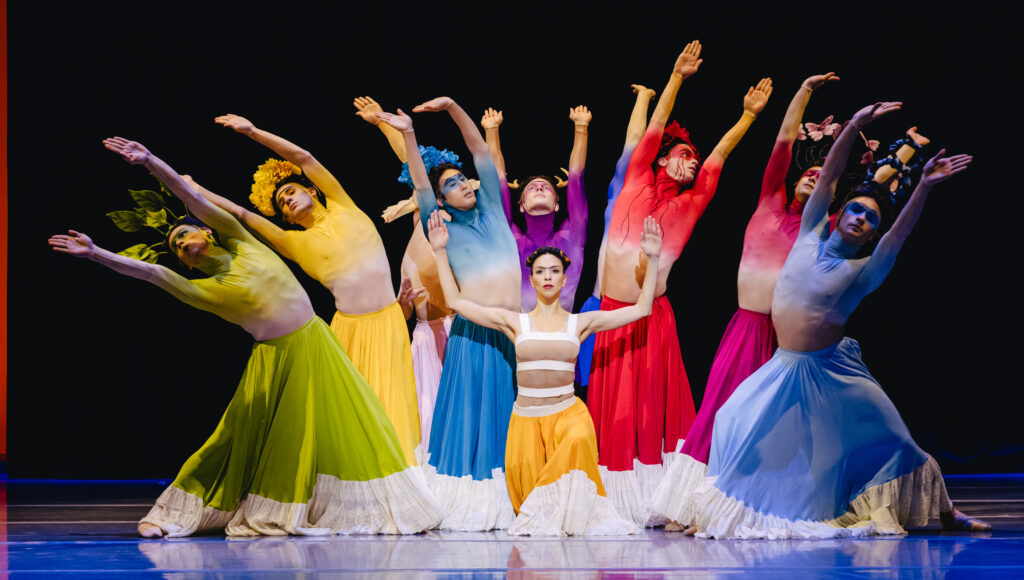
The first, Annabelle Lopez Ochoa’s “Broken Wings” (2016) tells the story of Mexican artist Frida Kahlo (1907-1954). Kahlo’s work reflects the diverse heritage of her parents and the cultural melting pot that infused that community with both artistic and intellectual richness. Her mother was of Spanish and Mexican/Indian descent, her father German/Hungarian Jewish. The mixed cultural heritage of her parents figures strongly in the body of Kahlo’s work as well as in her personal development from childhood through adulthood. A victim of polio, her medical issues were compounded after she was hit by a bus at the age of 18. All of these elements comprise the artist’s palette of Ochoa’s choreographic portrait, including composer Peter Salem’s original score, performed live by the Chicago Philharmonic under the direction of Scott Speck.
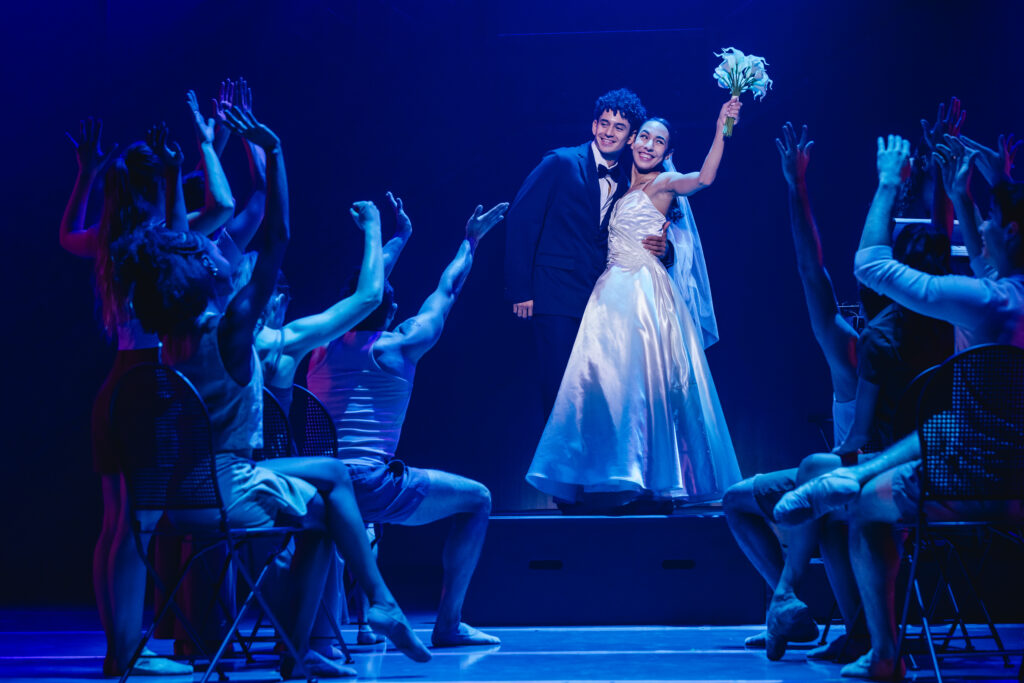
Choreographer/Director Chanel DaSilva’s premiere, “Wabash and You,” a love letter to Chicago, comprised the second half of the program. Based on a true story, it begins as a lighthearted frolic in a fairly conventional “girl-meets-boy” tale, then pulls the happily-ever-after rug out from under our feet. That stroke of stage truth came as a welcome relief after a few scenes that verged on cliché. Fabulous music, played onstage by the Chicago band, “The Main Squeeze,” played an integral role in the storytelling, and went a long way toward mitigating the somewhat cloying nature of some of the scenes. One can make an argument for the deliberate use of cliché to make a point. Simply told, with plenty of entertaining and truthful moments, “Wabash and You” teetered on the brink. Sweet and sometimes even funny, eliciting laughs from the audience, the work has much to recommend it, as the Harris audience attested with resounding cheers and a standing ovation. Clearly there is much to applaud in DaSilva’s achievement.
Both “Broken Wings” and “Wabash and You” are contemporary story ballets in every sense of the word, and yet the two pieces contrast wildly in their use of dramatic structure. Both use conventional ballet vocabulary as well as contemporary movement invention and gestural material unique to each of the two choreographer’s imaginations. Both pieces require the dancers to be actors as well, and to infuse the choreography with dramatic truth and gestural naturalness, which the Joffrey dancers do quite masterfully.
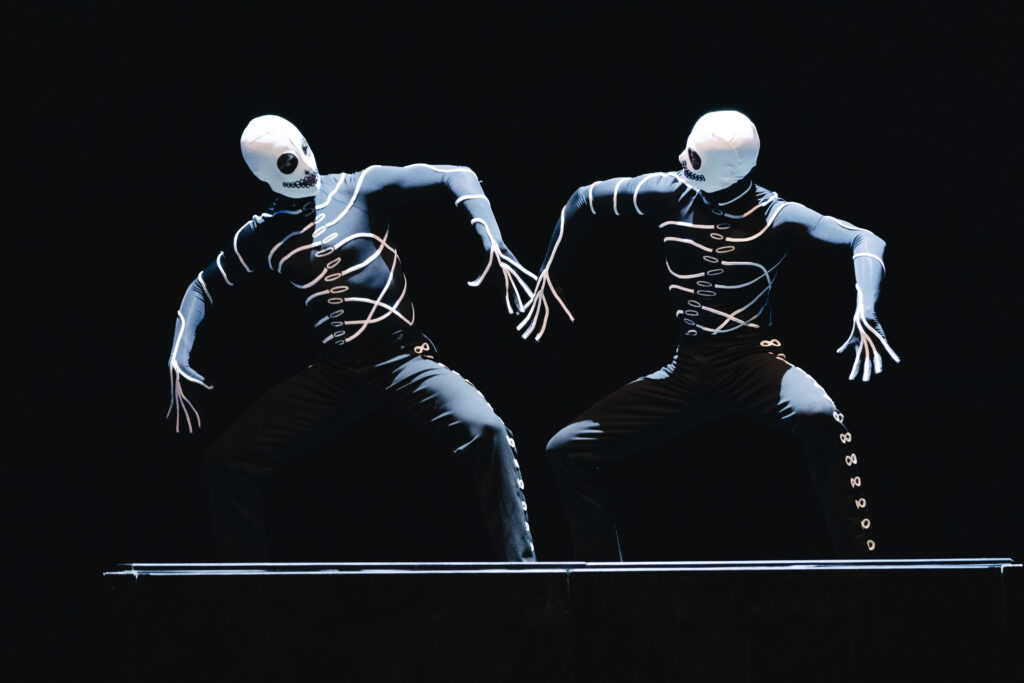
In “Broken Wings,” they bring dramatic intensity to the mechanical movement of a chorus of skeletons in white death masks, their jutting arms and robot-like staggering steps a sharp contrast to the folkloric authenticity of the male corps’ Mexican Deer dance and to the dramatic realism of Kahlo’s physical and mental pain.
Rhythmic drumming that accompanies the scene where Kahlo receives a paintbrush recalls the ritual of a totem ceremony, mirroring the stark geometry of Aztec design in angular elbows and gestural rigidity.
In “Wabash and You,” the characters are a bunch of happy twenty-something “kids” having fun and “hooking up” at a neighborhood watering hole, reminding me that these exquisitely-refined artists are real people, too. Amanda Assucena is the new girl on the block, moving into the big city on her own, perhaps for the first time. Xavier Nuñez, an engaging dancer and appealingly ingenuousness, plays the boy she falls for.
If “Wabash and You” is an urban legend, “Broken Wings” expands upon the legend of the Mexican Deer Spirit that figures prominently in Kahlo’s imagery and in her self-portraits as the bleeding stag pierced by arrows.
Ochoa weaves Kahlo’s Mexican folklore into the fabric of her many-layered choreographic collage, but to call it a collage or multi-disciplinary hardly does it justice. If you could take a mixing bowl of paint, prose, poetry, biography, light, color, movement and music, whip it to frothy proportions in a stand mixer, and pour the batter onto the stage as a live production, that would be “Broken Wings.”
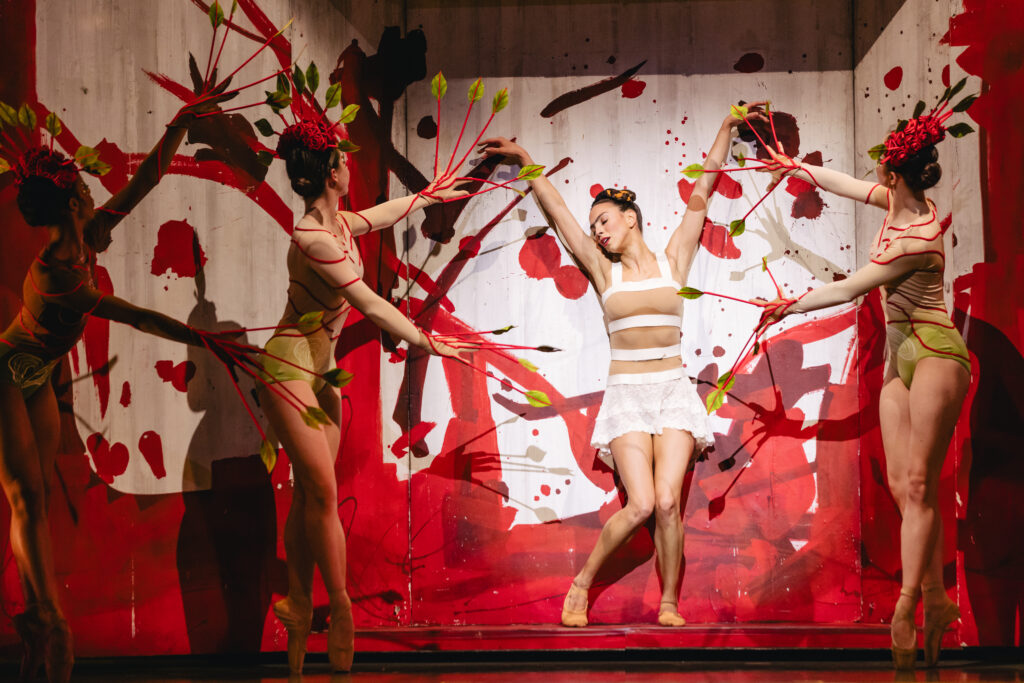
Anais Bueno, a compelling actress and exquisite dance artist, portrays Kahlo with heart-wrenching poignancy, vulnerability, and indomitable strength in the role of a lifetime. The statuesque Dylan Gutierrez as the painter Diego Rivera, Kahlo’s husband, brought a powerful portrayal of the older suitor who won Kahlo’s heart and then broke it by committing adultery with Kahlo’s sister, portrayed by Yumi Kanazawa. Together, Rivera and Kahlo shared a passion for art that addressed social and political issues.
Their love duet depicts a layered relationship, both lyrical and playful, teasing and elusive, with the choreographic specificity of the spoken word. Their dance is a conversation that is both sexual courtship and negotiation, setting the stage for the complexity of their relationship and their artistic partnership through the metaphor of conventional social dancing. Kahlo’s bloody miscarriage and her subsequent depression after losing her baby gives graphic meaning to her loss.
While “Broken Wings” takes a deep dive into the psychological complexity of Kahlo’s life and work, “Wabash and You” is a simpler story whose visual backdrop is just that, scenic designer Alexander V. Nichols’ Chicago-specific cyclorama of the stairway leading up to the “L” platform that creates “the loop” and transports commuters to and from the many neighborhoods that make up our fair city.
The storytelling in “Broken Wings” jumps across vast boundaries of time and space, chronology, and physical and psychological reality, what can be justified as more abstract storytelling. Yes, there are specific scenes, especially those with the painter Diego Rivera. Gutierrez’s portrayal managed to represent Rivera as a three-dimensional character, both his charm and dramatic depth and his devastating duplicity and infidelity.
In contrast, “Wabash and You” sticks with linear events, strung together as a strand of beads, save for one “dream” sequence where the female lead, Assucena, imagines her wedding to her heartthrob, played by the superb Nuñez.
“Wabash and You” employs standard ballet variations—chassée pas de bourré, glissade, assemblé—mixed with street moves and club dancing. There’s a fresh summer vibe on the street and a flood of city types getting off the “L” from a day at the office. In a nod to the age of the cell phone, a group sequence drums the point home with relentless repetition. We get it! The girl-meets-boy blush of first infatuation has all the marks of turning the corner into a serious relationship, but then, for no apparent reason, boy abandons girl after a first night sleeping with her in her apartment and breaks her heart.
The liberation solo that he dances for his friends back in the ‘hood is a tour de force, both for the Nuñez and DaSilva. She seeks him out and begs for an explanation, but he ignores her desperate pleading. Then, for seemingly no reason, he decides he really loves her after all. Too late! She’s not having any of it, packs her suitcase, and leaves town. What’s missing here? There is no dramatic justification for his sudden change of heart. The fickle nature of love? No luck elsewhere? Alignment of the stars? Take your pick, but whatever his reason, we applaud DaSilva’s choice to give her female protagonist the integrity not to make the same mistake twice.
The two halves of “Matters of the Heart,” each so different from the other, congeal, echoing across our personal sensibilities and forming a thoroughly satisfying evening, proving that there is definitely success to be had for programming that focuses on a unifying theme!
The Joffrey Ballet presents “Matters of the Heart,” Nov. 6-9 at Harris Theatre for Music and Dance, 205 E Randolph. For more information, visit the event page by clicking HERE.

Copyright 2026, See Chicago Dance, All Rights Reserved