
Martha Graham is one of the few household names when it comes to modern dance. So it’s not a surprise that the famed Martha Graham Dance Company, celebrating its one-hundredth anniversary with a one-night stop in Chicago, would sell out the Auditorium Theatre. Luckily, the Auditorium snagged the group’s knockout program as part of this season’s acknowledgement of women leaders in dance. Known for throwing away the conventions of ballet technique, Graham developed a style that pushed audiences to see dance in a new light. A hundred years later, that style still holds power and artistry while challenging the movement possibilities of the human body.
No longer dedicated solely to showcasing Graham’s choreography, Saturday night’s bill placed three older reconstructed Graham pieces with a new one, the Chicago premiere of “En Masse” choreographed by former Alvin Ailey company member, Hope Boykin. The varied and strong program came to life through a particularly glowing and consistent ensemble of top tier dancers.
Graham’s 1948 masterpiece, “Diversion of Angels,” jump-started the celebration with skillful and playful explorations of love—young, romantic and mature. Filled with extended leg tilts, curved torso bison leaps, and of course, pelvic contractions that set movement in motion, “Diversion of Angels” introduces Graham’s unparalleled, technically demanding style with a lively energy.
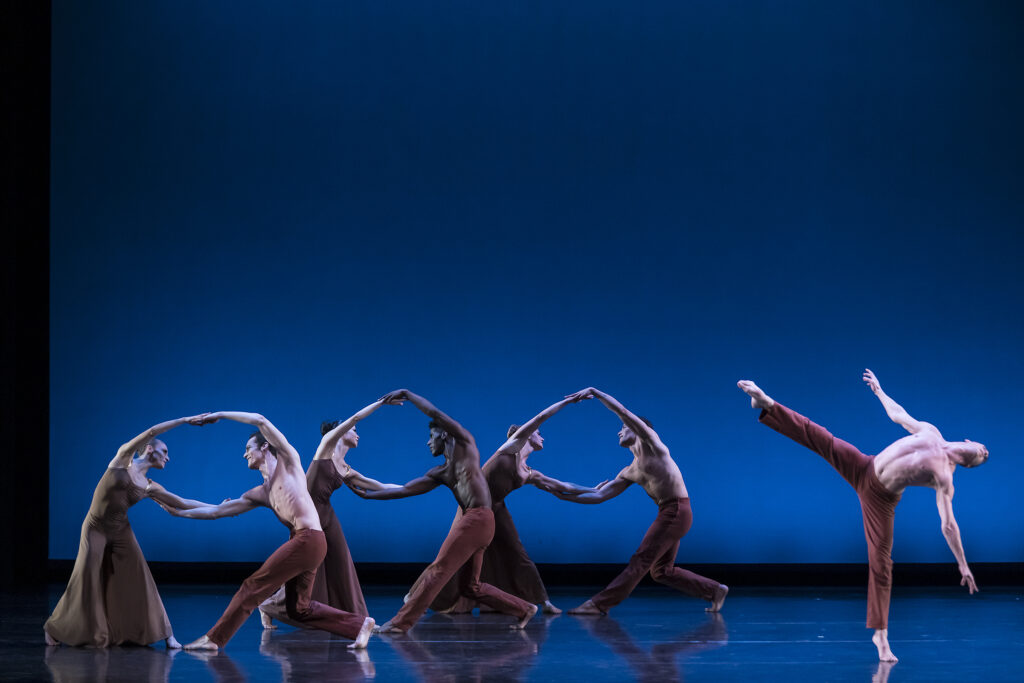
As the sprightly adolescent lovers in yellow chase, flirt and blow kisses, Zachary Jeppsen-Toy seamlessly lifts Marzia Memoli head over heels then places her on his shoulder, spinning as if showing off a prized statue. The steadfast woman in white, Leslie Andrea Williams, embodies mature love, balances on one leg center stage like a firmly rooted lightening bolt, then carefully shifts to a balletic arabesque. In a breathtaking simple and intimate gesture, partner Ethan Palma lies chest down creating a boat shape on which Williams gently climbs aboard, sitting on the soles of Palma’s feet. Throughout, sections are introduced by a solid chorus of five (Ane Arrieta, Meagan King, Amanda Moreira, Jai Perez, Laurel Dalley Smith), energetically unveiling each couple as if turning the pages of a lover’s photo album.
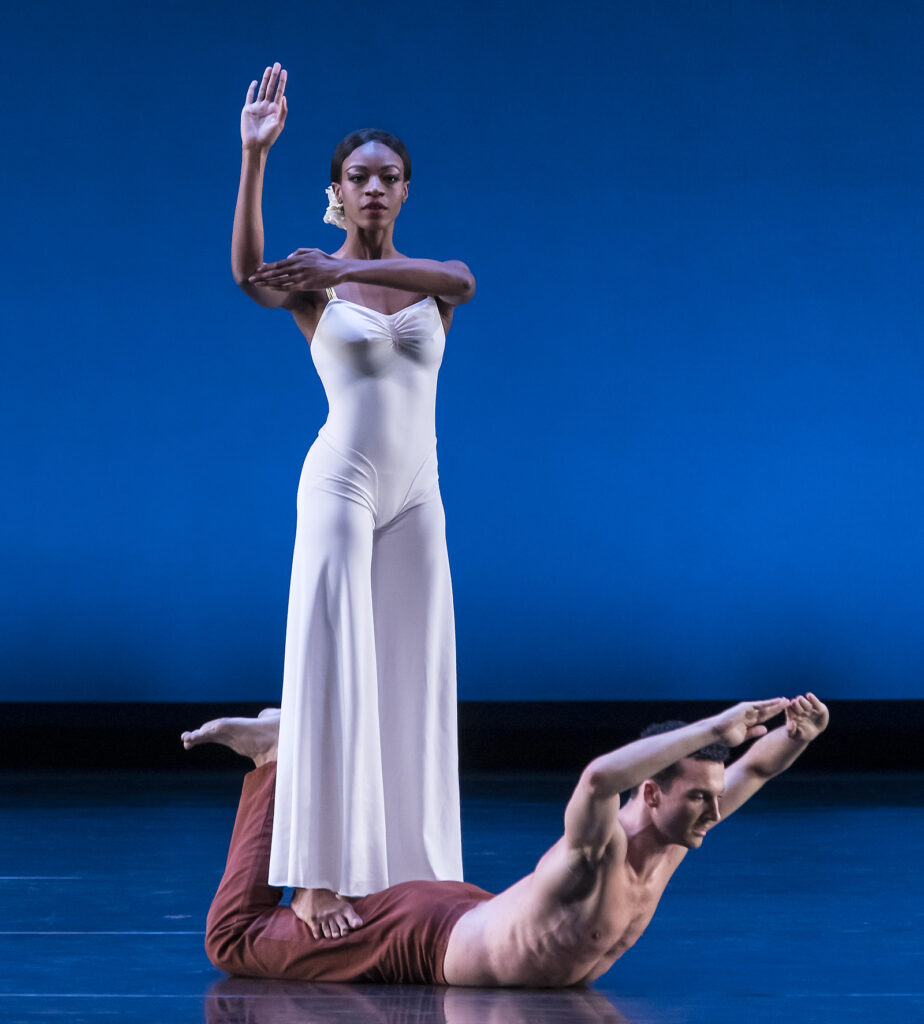
“Diversion of Angels” has a distinctive mid-century modern vibe. Sleek brown and gold toned dresses, bell bottom pants and Norman Dello Joio’s accessible musical score could make the dance feel dated. Instead, timeless and exquisitely crafted, it reveals one image layer after another as if bringing to life the Kandinsky paintings that first inspired it.
In a complete flip-flop of mood, Graham’s trademark, “Lamentation,” (the senior piece on the program, clocking in at 96 years old) features soloist Xin Ying. Stark, angular and swaying, half alien, half nun, Ying seems a living sculpture longing to escape the black fabric tube that binds her. Precise tics, prayer-like gestures and sharp angles keep Ying entrapped until at one point, her head seems to float in the center of an expanding fabric triangle unable to emerge from the cocoon. It’s a curious piece loaded with angst, and perhaps not as powerful as it was in its 1930 debut.
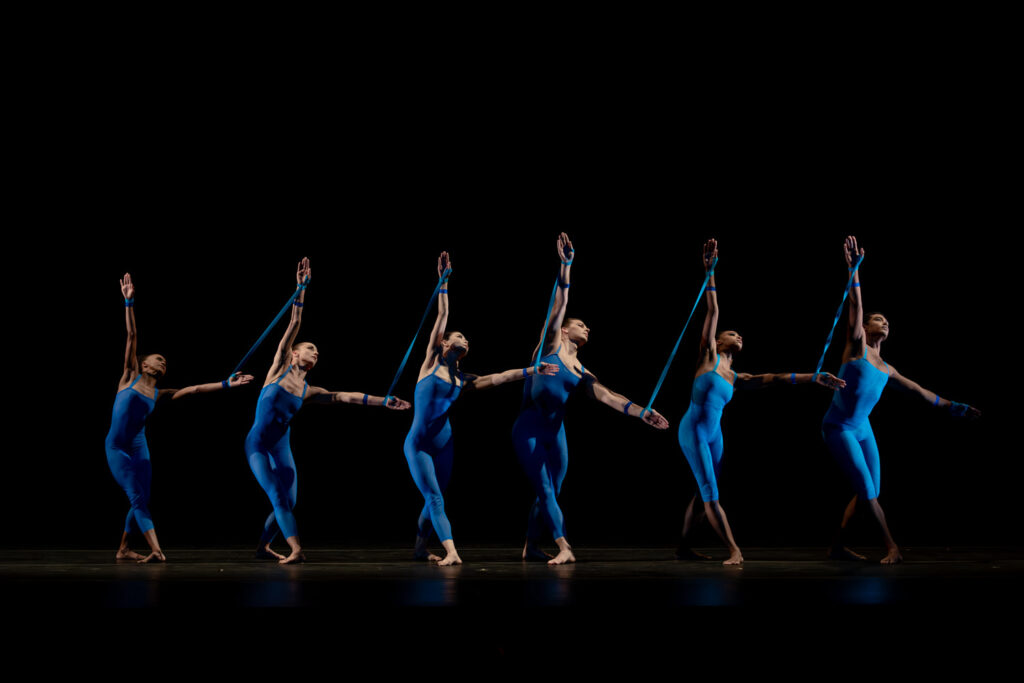
Boykin’s “En Masse,” set to numerous short musical segments by Leonard Bernstein with additional arrangements by Christopher Rountree takes a while to get going, but ends with great payoff. Experiencing this piece is akin to paddling a canoe down a gentle river gradually moving to more challenging waters. From linear familiarity to released freedom, dancers seem to explore every possible articulation of the body. One soloist raises a hand in a wave hello (or goodbye?) then melts to the floor in an impossible side arc, like the the start of a water whirlpool. An accompanying group of six, connected at the wrists by strips of fabric, form sharp-edged lines like a collection of restricted paper dolls. As the music segments grow in jazziness and intensity, the dancers shift from entrapment to individuality. (This shift is also reflected in Karen Young’s blue-toned shirts and pants which begin tight-fitted and gradually loosen up to become more fluid.)
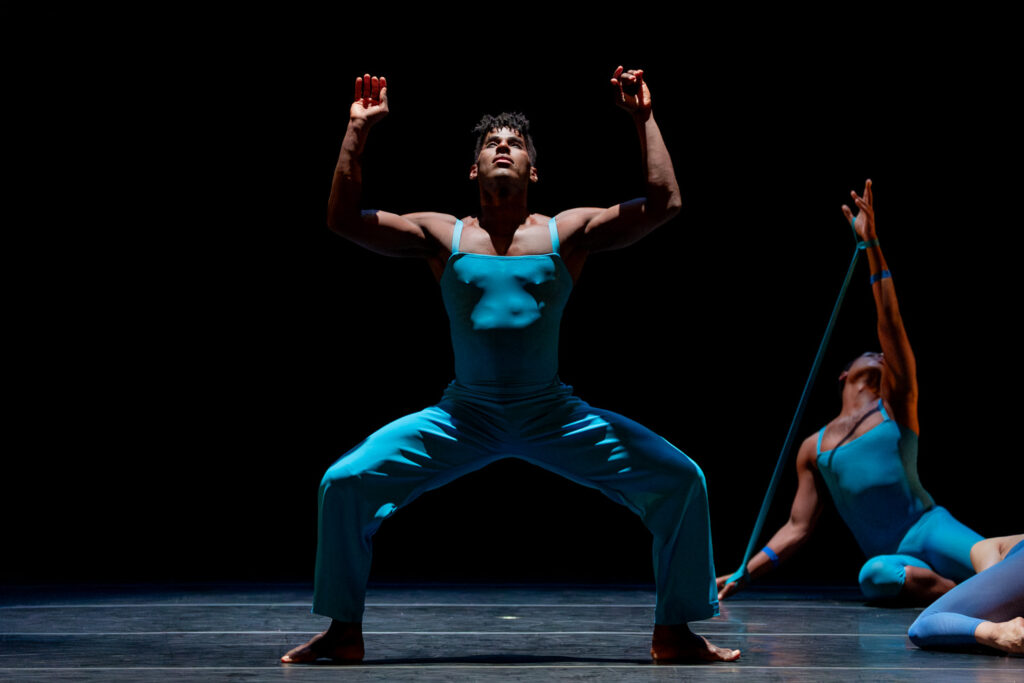
In a moment of liberation, one dancer breaks free (although the impetus for this shift is unclear), nodding like a push-button puppet and jumping backwards out of a spotlight as if propelled by an invisible force. From here, the dots begin to connect and the piece gains levity. Feeling more contemporary and uncontrolled, arms are no longer bound and restricted but dangle freely. Detail and speed increase until finally the entire group, in stark silhouette, waves and arches sideways, then leaps like a full-on waterfall.
Closing the program, the slow burn of “Chronicle,” Graham’s stringent anti-war message, initially made after Graham declined the invitation to perform at the 1936 Olympics in Germany, feels fitting for the times. The eleven women of the company take on this challenging piece with great precision and care.
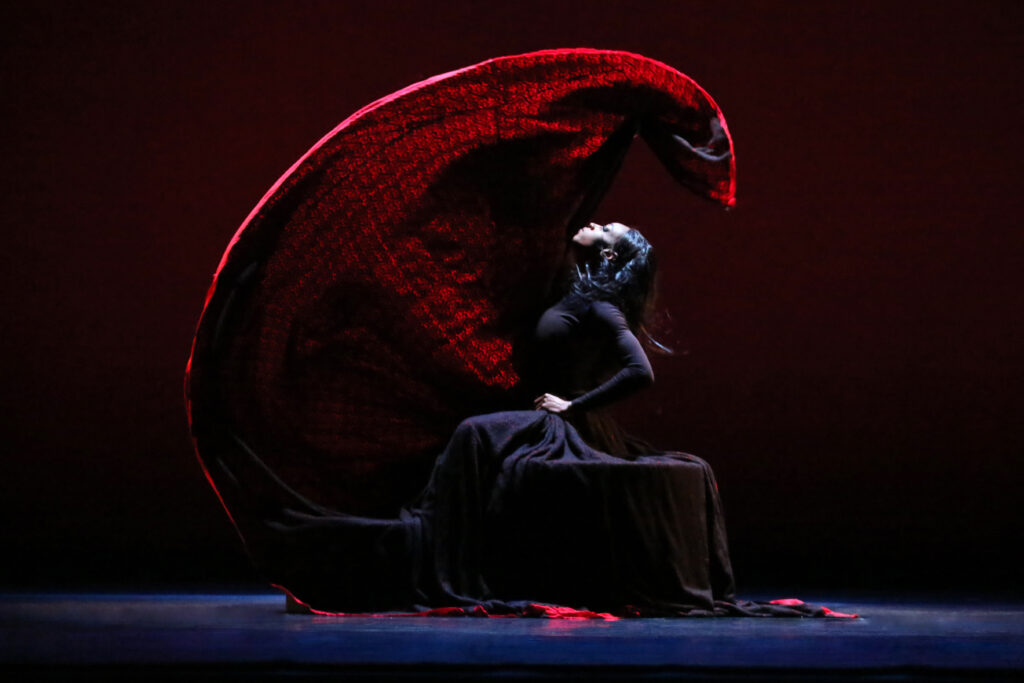
“Spectre–1914″ conceals Ying’s legs in a super long flowing black skirt atop a small platform. Simultaneously haunting and frantic, Ying becomes a dark apparition, eerily growing taller as she rises, the skirt flashing a red underside, appearing to have a life of its own. Ying swirls and jumps like a tortured rocking horse, ultimately losing the battle, her head dangling from a diagonal of blood red fabric.
Robotic and almost military in precision, the “Steps in the Street” section feels isolated and devoid of breath. The corps of ten black-clad women walk backwards stiffly and stilted, resisting each step, yet with hands contrastingly soft, resting at their shoulders and hips as if comforting themselves through some regressive event. Together yet alone, they create a maze pattern, pound their fists and toss their torsos back, lunging and lurching. They jump repetitively in place with the power and urgency of gazelles trying to escape confinement.
The final section, “Prelude to Action,” demonstrates Graham’s 1936 response of putting negative energy into making something beautiful. Powerful, repetitive, rousing and relevant, no matter the era, this call to action and plea for peace holds up in what can only be called a triumphant return for the company and a grand centennial celebration.
The Auditorium Theatre, 50 E. Ida B. Wells Dr, presents the Martha Graham Dance Company, Saturday, January 24 at 7:30 PM For more information, check out the event page by clicking HERE.

Copyright 2026, See Chicago Dance, All Rights Reserved