
Ballet Chicago’s “Fascinatin’ Ryhthms,” a dazzling program of Balanchine and Balanchine-inspired works, with a little Chopin, Tchaikovsky, Brahms, Gottschalk, and Gershwin into the mix, this past Saturday, May 9, for two performances at Chicago’s Harris Theater—I caught the 2 PM show.
In a pre-curtain welcome, Ballet Chicago’s (BC’s) Founding Artistic Director, Daniel Duell, expressed the mission of the company and school: to provide an environment that supports the healthy development and growth of the whole artist, mind, body, and spirit, to demand excellence, and to give every student the opportunity to become the best version of themselves that they can hope to become. Under his direction, along with Associate Artistic Director, Patricia Blair, that ethos was in full view on stage in “Fascinatin’ Rythms.”
New York City Ballet Founding Director George Balanchine’s choreography—dating as early as 1922 (“Strike Up The Band,” from “Who Cares” (1970)—dominated the program, with BC resident choreographer Ted Seymour’s two pieces complementing an afternoon that brought the audience to its feet and sent them tripping the light fantastic out onto Randolph Street.
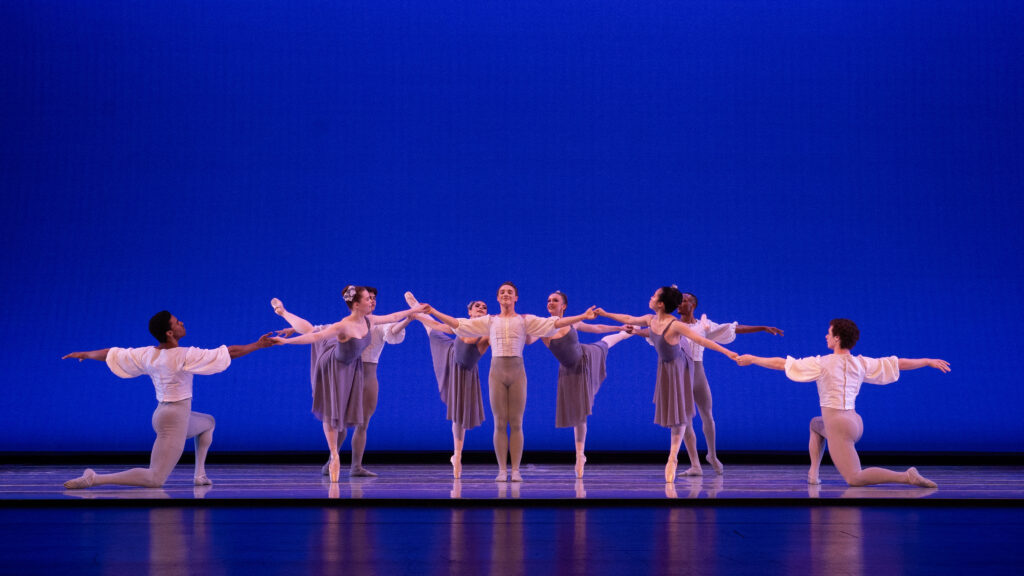
If you’re in love with tutus and the classicism of traditional ballet, Balanchine’s “Allegro Brillante” (1956) was the perfect opener. The ballet is a frothy showcase for the four corps male/female couples and principals Caroline Stoughton and Quinn Rutman. Balanchine’s use of both visual and musical counterpoint between the ensemble and soloists infuses the space with energy and excitement. The corps’ execution was crystalline, and the complex partnering, with tricky lifts that would have challenged any bodybuilder worth his salt, came off as just plain fun. Of note is that Balanchine, whose early training was as a concert pianist, employed musical complexity in choreographic details. The flick of a wrist, a change of direction, the tilt of the head, all added to the visceral experience of the whole.
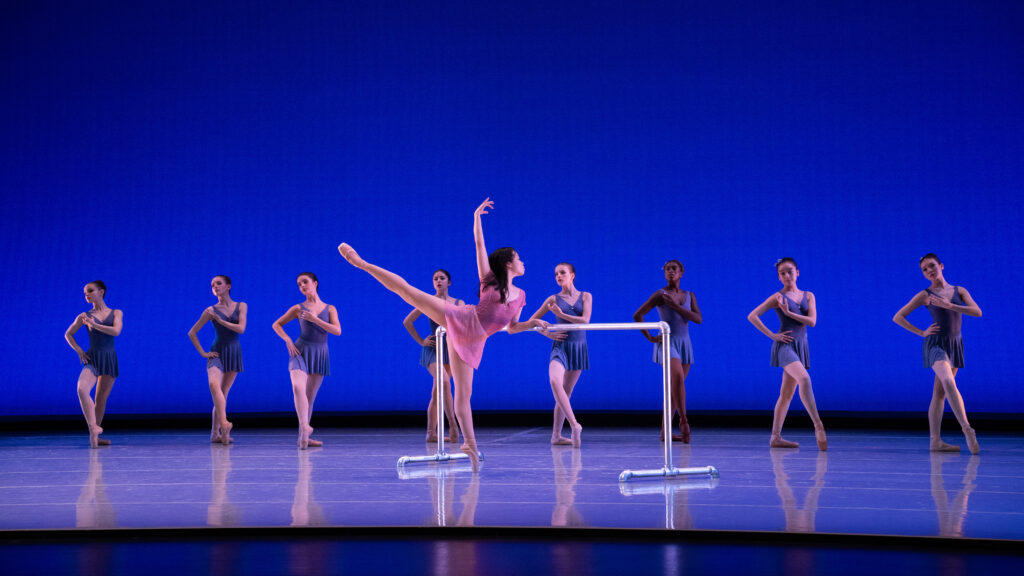
Seymour’s “Intermezzi” (2014), set to ”Three Intermezzi for Piano” by Brahms and performed live by John Mannos, uses a ballet barre—universal symbol of ballet class— as both a prop and a metaphor. All dancers, from beginners to professionals, begin class at the barre. In Seymour’s piece, the barre is also a measure of personal growth, of bonding, and of connection. The three young women soloists en pointe, their long hair flowing, each brought a sense of discovery, sensuality, and grace to their dancing. Alec Kherson, in the role of a devoted cavalier prince to each of them, brought evolving maturity to young love. Seymour’s choreography and Brahms’ music call for passion, and these young dancers eventually got there.
I have seen Balanchine’s “Tarantella” (1964), a tour de force of ballet pyrotechnics and theatrical playfulness, countless times, performed by world-famous dancers, but Ballet Chicago’s Leighton Baumgartner and guest artist Nikyle Scott put a unique spin on “wow!” The authenticity of the choreography’s traditional Italian folk dance roots, including comedia del arte gestures, blended seamlessly with Balanchine’s brand of classical ballet. BC alum Scott and BC’s Baumgartner were totally snazzy in their flirtatious competition. They tossed off great tricks, he whacking his tambourine amidst spectacular jettés en tournants, and she pretending sassy boldness in emboités and piqué turns en ménage. Balanchine’s humor here has an almost diabolical twist in a duet that’s so much fun and yet so extremely difficult, one could just about die dancing it!
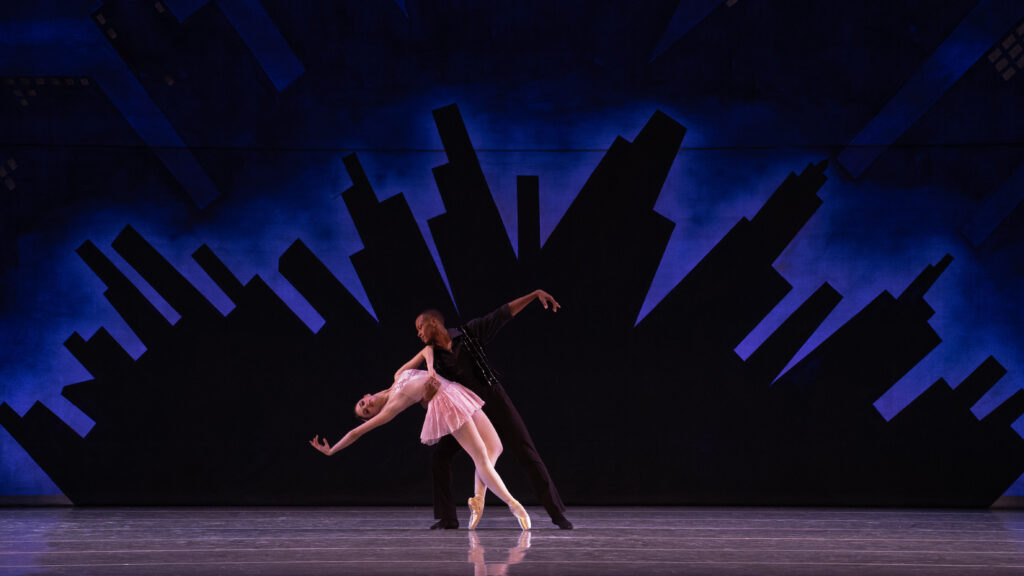
Closing the program, Balanchine’s “Who Cares?” (1970) mirrors Broadway and the movies in twelve episodes. It’s at once a great showcase for the unique talents of individual dancers and the choreographer’s admission of his secret love affair with “The Big Show.” Balancés resemble a Rockettes kick line, men’s beats, cabrioles, and brisée-volés an homage to soft shoe dancing. Lighting designer Margaret Nelson’s city silhouette and sultry spatial delineations contribute to the building momentum of drama and suspense in the big city. Set to the music of George Gershwin and Hershey Kay, “Who Cares” drives home two meanings. The first is a question that could have the sad answer: nobody in New York City. The second meaning could be a colloquialism for care-free insouciance, something the young and ambitious bring to New York, a city like no other in the world. Merging the light, breathy lyricism of jazzy moves that toss off all cares with the heartache of rejection and disappointment built tension. No big show is complete without thirty-two fouetté turns. Delivered! Casual skitters and lazy turns morphed into flying leaps and crisp body isolations, a sharp turn of the head, and a flick of a wrist. Gershwin’s “I Got Rhythm” closed the spectacle with a high octane full-ensemble finale.
So by all means, strike up the band for Ballet Chicago, for Balanchine, and for all of us in Chicago who don’t have to go all the way to New York to experience the genius of Balanchine and beyond.
For more information, check out Ballet Chicago’s website by clicking HERE.

Copyright 2026, See Chicago Dance, All Rights Reserved