
A “socially relaxed atmosphere” is how Ballet Chicago Artistic Director Daniel Duell describes the company’s Sensory-Friendly alternative to the company’s annual seasonal production of “The Nutcracker,” for one performance at 5pm on Sunday, December 21 at Chicago’s Harris Theater.
“The house lights don’t go to full blackout, and there’s no continuously loud music,” Duell explains of the performance. In addition, neurodivergent audience members will receive “fidgets,” small toys provided by Harris Theater for audience members to handle during the performance. The conventional expectation that audience members sit quietly is lifted to allow for free expression of involvement with the stage action.
There will be soft cushions on the floor for alternative seating and quiet spaces in the lobby for anyone who needs a break. The Harris Theater will also remove Row R so that audience members in wheelchairs can sit together with their parents, companions, and caregivers. Service dogs will also be allowed.
Other neuro-affirming accommodations include eliminating intermission. This posed a particular challenge for Duell and Ballet Chicago Co-Director Patricia Blair. The Snow scene at the end of Act I is normally followed by an intermission of approximately 20 minutes. “It takes 10-15 minutes to sweep up all the snow on the stage,” Duell said, something that is routinely done during intermission. How would they accomplish this for the Sensory-Friendly performance?
Duell and his creative team proved that necessity is the mother of invention. A projected backdrop of falling snow will replace the onstage snowfall and eliminate the need for it to be swept up.
Instead of an intermission, there will be a three-minute pause with a sign that reads, “Act 2 will start in just three minutes, please be ready in your seats!”
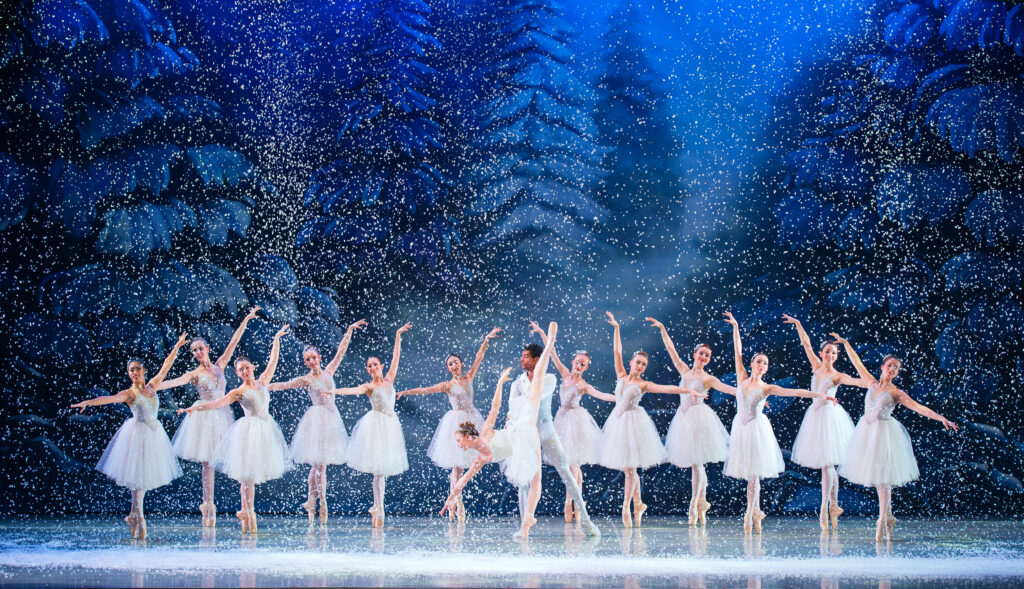
Duell and Co-Artistic Director Patricia Blair decided to eliminate the Snow Queen and King pas de deux because Tchaikovsky’s score calls for very loud music for this scene, which runs 4-5 minutes. The beloved Polichinelles, Marzipan, and Russian (called Ukrainian Babka in this production) scenes were also eliminated because they were deemed too loud and shrill.
Blair and Duell enlisted a team of professional consultants that includes physicians, therapists, special education teachers, and caregivers. “Do we need to eliminate the battle scene?” Duell recalls asking them, concerned that the swordfight between the mice and the Nutcracker Prince might be too violent. A resounding “No!” was the experts’ overwhelming consensus. Their explanation? It’s important for neurodivergent audiences to experience conflict in a safe environment. Because the battle scene in the Nutcracker is make-believe, performed on a stage in a theater, it makes a clear distinction between real life outside the theater and the world of the stage.
Having a child who is hospitalized over the winter holidays is especially difficult, says Ballet Chicago board member Dr. Mahima Keswani. A pediatric neurologist at Lurie Children’s Hospital and Ballet Chicago mom of children ages 8 and 11, Dr. Keswani says they have made significant inroads to bring The Nutcracker to hospitalized children.
Ballet Chicago will bring a videotape of its Nutcracker Ballet to Lurie Children’s Hospital. Its family-friendly ethos aims to normalize being a child who is sick, for the patients as well as their parents and families. “It allows them to participate in a way they never thought they could,” Blair remarks.
It’s clear from watching Duell and Blair teaching their classes, and from the comments of Ballet Chicago directors, teachers, students, and parents, that the excellence and high standards of the school and the Studio Company have more far-reaching objectives and outcomes than mere dance training.
When parents were asked in a survey why they bring their children to study at Ballet Chicago, both Duell and Blair expected the typical reply: the high level of performance opportunities offered in major theaters. Instead, the overwhelming response was that they were there for the experience their children have in the studio—the values, discipline, and respect for the art form and all participants within it.
Dr. Patrick Myers, a BC board member, credits his daughter, who danced her teenage years with Ballet Chicago, for his involvement with the company. “High standards says it all,” he recalls. His daughter’s experience growing up as a student showed him that excellence was achievable for students of all ability levels. The confidence, work ethic, and strength of character that grow from that ethos made him want to play a larger role in the company’s future. “The environment is competitive, but equally supportive,” he says.
Ballet Chicago’s “Gift of Dance” program for special needs audiences began in 2012. It was the company’s first season of self-presentation at the Harris. It was so successful, Duell said, “we just couldn’t stop the program.” Since then, “It’s been part of Ballet Chicago’s DNA.” Today, the “Gift of Dance” program serves over 20 groups, including Veterans through VetTix (200 – 300 per performance), Mercy Home for Boys and Girls, Misericordia, Make-a-Wish Illinois, Family Focus, and Pierre Lockett’s Forward Momentum Chicago program, among others.
In 2022, when Duell choreographed the Frances Burnett Hodges story “The Secret Garden” for its Harris Theater spring performances, he sought advice from Ginger Lane, a former professional dancer who, following a skiing accident, uses a wheelchair. Lane, who received See Chicago Dance’s 2023 Leadership award, is a founding director/choreographer and dancer in Momenta, performing “physically-integrated dance” performed by dancers both with and without disabilities. Lane’s advice informed Duell and Blair’s Sensory-Friendly Nutcracker adaptation.
At that time, Lane guided the young boy portraying the role of a disabled child by helping him to understand disability without changing the story. “I tried to help him understand what it would be like to be shunned and discriminated against, and [to] be an outsider,” Lane says. “We live in an ‘ableist’ society,” she says. “But disability is part of the human condition.” She has been an advocate for normalizing disability through her pioneering work with Momenta and Access Living.
“Ballet Chicago’s Sensory-Friendly Nutcracker is a wonderful way to help get disability in front of the public,” Lane says. As an advocate for disabled people, she says, “We fight very hard against the stigma and oppression of disability. [The general public] sees it as a negative rather than as an alternative.” She sighted the medical model of disability as a dysfunction and an exception to “normalcy” versus an alternative aspect in a range of diverse qualities that define the human condition.
Ballet Chicago’s partnership with Lurie Children’s Hospital of Chicago extends far beyond welcoming Lurie patients and their families to its Sensory-Friendly Nutcracker. On Christmas Eve, Ballet Chicago dancers—fully costumed and brimming with holiday spirit—will visit children at Lurie, offering a special treat for those too ill to attend the performance in person.
“This partnership with Lurie Children’s Hospital is something I hold very close to my heart,” explains Blair. “Bringing Nutcracker magic to children who must spend the holidays in the hospital feels especially important, and we hope it offers them—and their families—a little joy, maybe even a sense of normalcy in a challenging time.” In addition to their work with Lurie, Ballet Chicago is also honored to partner with Shriners Children’s Hospital and Endeavor Health.
Ballet Chicago dancers sign a contract with clear guidelines. Its credo reads: “Weather your disappointments and celebrate your triumphs with equal grace.” To be sure, the company’s Sensory-Friendly performances are a triumph to be celebrated. When asked what the most important lessons she hoped would be transmitted by Ballet Chicago’s Sensory-Friendly production, Lane responds: “Be open, be receptive to a variety of experiences. Be understanding of different kinds of people.”
Ballet Chicago’s Sensory Friendly “The Nutcracker” performs on December 21 at 5pm at the Harris Theater, 205 E Randolph; other performances include Athenaeum Center for Thought and Culture, December 12-14, and Harris Theater, December 19-21. For tickets and more information, check out the event page by clicking HERE.

Copyright 2026, See Chicago Dance, All Rights Reserved