
The 2025 Chicago Tap Summit culminated in “Wonder”, a new evening-length work by M.A.D.D. Rhythms, created and choreographed by company member Caleb Lawrence Jackson, live music led composed by Thaddeus Tukes, presented before an energized crowd at the Harold Washington Cultural Center.
When the lights dimmed for “Wonder”, the audience’s enthusiasm was electric. “Close your eyes and enter a dream state full of wonder,” a voice invited, “and let your ears guide you back.” What followed was a meditation on rhythm, sound, and self.
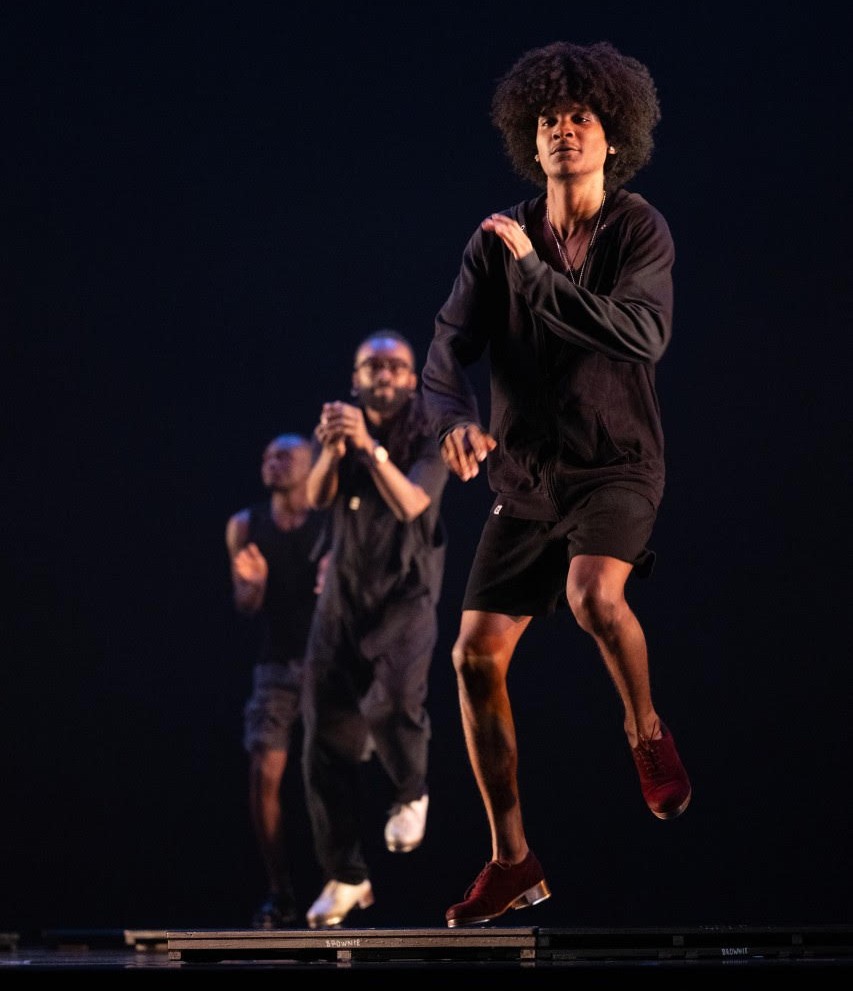
The curtain rose on a dreamscape: a live band, led by pianist Thaddeus Tukes, glowed in the background, while dancers swayed in silence, eyes closed. Jackson stood center stage, the show’s 21-year-old director and choreographer, who began to speak to his audience not with words, but with his feet. His opening solo, performed a cappella, was a dense, intricate monologue of rhythm—an invocation of sound conjured from his imagination.
As the company joined in, simple heel and toe drops evolved into layered rhythmic counterpoint. Movements became looser, more trance-like; dancers spun as if overtaken by dream currents. The next sequence burst with joy—an echo of a street cipher or dance party—where rhythm-making expanded beyond the feet into the whole body. In true M.A.D.D. Rhythms fashion, the ensemble opened into a semicircle as M.A.D.D.’s artistic director, Bril Barrett, took to the floor for an improvised solo, followed by co-founder “Tre” Dumas and alumnus Ian Berg. The moment felt almost spiritual: three incarnations of M.A.D.D. Rhythms, sharing the floor in succession.
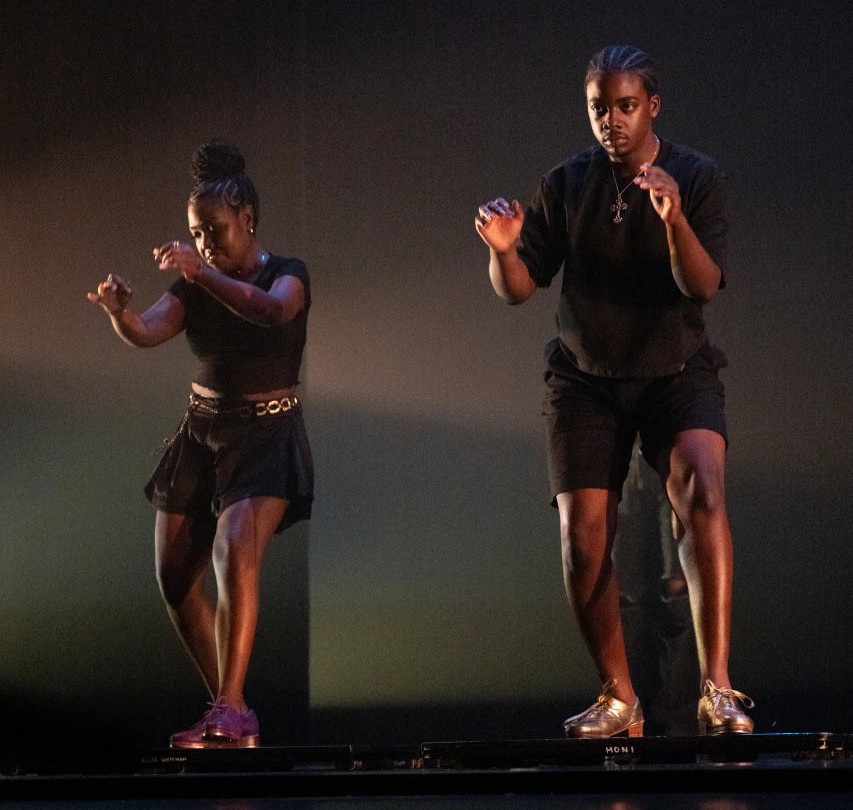
From there, the show zigzagged through scenes like fragments of a dream—some abstract, some cinematic. A duet sequence in red and black played with Latin rhythms, conjuring a flirtatious nostalgia reminiscent of an old Hollywood dance film. A standout quintet featuring Star Dixon, Donnetta “lilbit” Jackson, William Wims, Andrew Carr, and Jackson encapsulated the company’s signature aesthetic: a deceptively simple rhythmic motif that suddenly accelerates into a storm of precision footwork. The dancers’ interplay with Tukes’ original score revealed hidden melodies, surfacing beats and accents that might otherwise go unnoticed—like discovering new patterns in a familiar painting.
A men’s quintet led by Jackson revealed another facet of his artistry. His choreography moved between muscular, explosive phrases and quiet, sliding transitions that suggested introspection. Jackson rarely performed to the audience, instead channeling something deeply internal. His sweat, shouts, and bursts of polyrhythmic clapping made visible the labor of his expression—the physical manifestation of creative struggle. It was both vulnerable and arresting.
After a brief blackout, Jackson’s voice echoes out, reciting a spoken-word poem beginning with “piercing the veil.” The phrase hinted at the show’s central question: Where does consciousness end and the dream begin? The scene that followed was a sharp tonal shift—dancers in 1950s-inspired costumes performing synchronized, Motown-style steps behind solo improvisers downstage. It was surreal and nostalgic all at once, another layer of a dream.
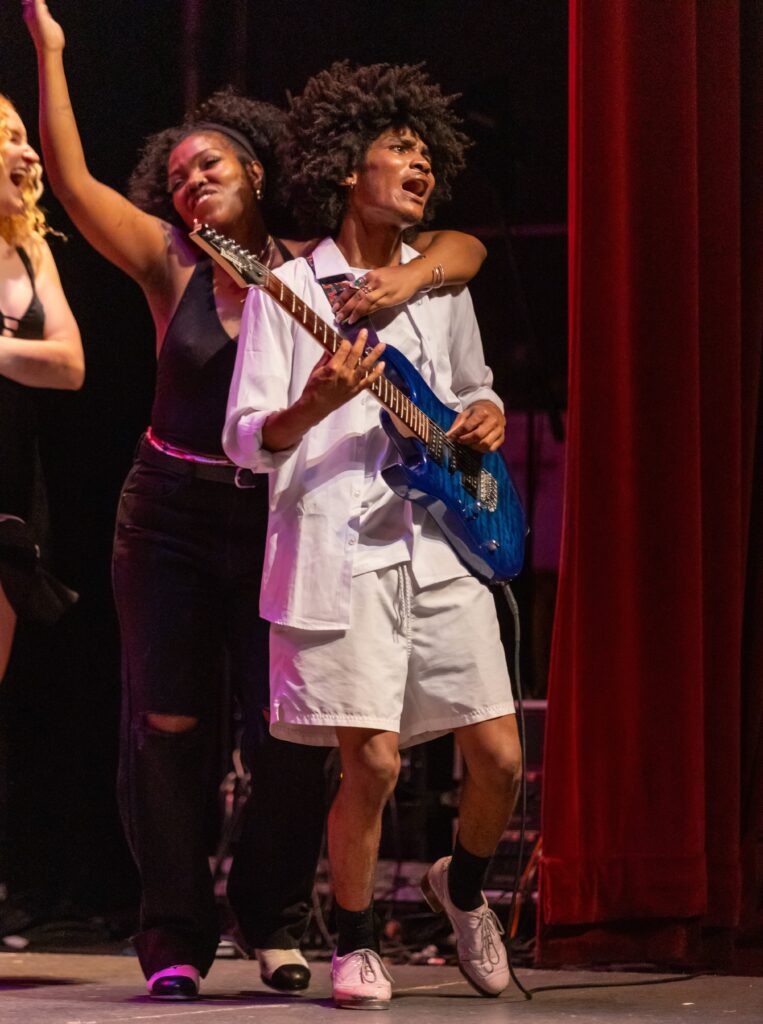
The performance concluded in an intimate moment: Jackson alone, tapping a final a cappella solo—bare wood, metal plates, and breath. The ensemble rejoined him, gathering around as he lifted an electric guitar and strummed a gentle melody. The dancers’ taps answered in kind, creating a communion between sound and motion—a fitting end to a show rooted in listening.
The first half featured faculty artists, alumni, and three student groups—Konquer Dance Company, Chicago Contemporary Dance Theatre, and Expression Dance Studio—performing a diverse array of rhythmic styles and approaches. Guest artists Jennifer Miller, Reggio McLaughlin, Mark Yonally, Jay Fagan, and Ayrie “Mr. Taps” Kind III brought distinctive flavors to the stage. While audiences were treated to the theatrical showmanship of McLaughlin and Mr. Taps, they also received raw visceral performances from Latrell Garnet and Martin “Tre” Dumas III. The student performances, meanwhile, offered a glimpse into tap’s vibrant future—youthful energy fused with the grounded respect for tap’s history that M.A.D.D. Rhythms have long cultivated—an apt prelude to the main event, displaying the depth and continuity of Chicago’s tap lineage.
“Wonder” was a compelling, ambitious vision from a young choreographer who wears his influences and his lineage openly. While the work brimmed with talent and technical brilliance, it sometimes felt like a series of potent ideas searching for cohesion. Still, the emotional honesty in Jackson’s performance and the virtuosic musicianship of M.A.D.D. Rhythms affirmed that this company remains one of the most exciting voices in American tap. With further development of the integration of spoken word, dream-like scenes and live instrumentation—”Wonder” could evolve into a fully realized statement of artistic identity.
“Wonder” directed and choreographed by Caleb Lawrence Jackson, was presented by M.A.D.D. Rhythms on October 4, 2025, at 7:30 p.m. in the Harold Washington Cultural Center as part of the annual Chicago Tap Summit.

Copyright 2026, See Chicago Dance, All Rights Reserved