

Ensemble Español Spanish Dance Theatre pulled out all the stops (and castanets!) with flair in its one-night-only performance at North Shore Center for the Performing Arts in Skokie this past Saturday for its fiftieth-anniversary concert celebrating the legacy of Founding Director, Dame Libby Komaiko (1949-2019).
Dame Libby’s legacy is in good hands under the direction of Executive Director, Jorge Perez, and Artistic Director, Irma Suarez Ruiz, both of whom still perform with the company. Their programming represents an arc of Spanish dance styles, rhythms, sounds, music, geographic regions and history—a buffet of sensory delights.
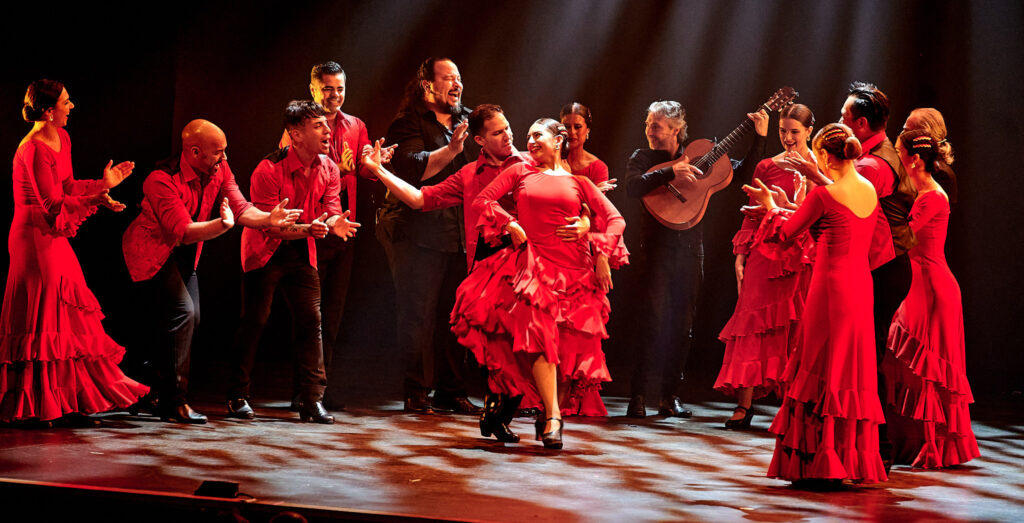
Guest artist Isaac Tovar’s “Amangue” (2023), set to original music by guitarist Curro de Maria, opened the program. Curling articulation of the dancers’ fingers matched plucked guitar strings. The intimate relationship between movement and music served up an amuse-bouche, whetting one’s appetite for what was to come. The company’s tight ensemble work was flawless, with rhythm in every corner. Tovar and Lighting Designer Dustin Derry’s “choreographed” lighting breathed life and energy into this Spanish hootenanny of sorts, providing an entertaining arena for individual dancers to shine.
Ruiz’s full-company work, “Escenes Villanescas” (world premiere), set to the music of Enrique Granados, makes an impressive contribution to the company’s mission to shepherd the art of Spanish dance into the future. Kudos to Ruiz for her blend of technically demanding ballet vocabulary—double and triple pirouettes, sissones, and cabrioles—with traditional Spanish dance gestures and a decidedly Latin emphasis on the pelvis.
A video of wild horses running across an open plain began the drama of Dame Libby’s “Leyenda / Asturias” (1987), revived by José Torres in 2026, and set to music by Isaac Albéniz. Two men and three women dressed in black entered the stage in slow procession. The sound of their castanets merged with the percussive rhythm of horses’ hooves. The dancers’ steamy intensity and fiery physical dialogue raised the temperature in the room and breathed a haunting chill across the stage that brought yet another layer to the emotional range of Spanish dance.
“La Vida Breve” (world premiere), set to music by Manuel de Falla, is a passionate collaboration between dancer and musician, with Ruiz on castanets and Brian Torosian on double-necked guitar. Seated at the lip of the stage, Ruiz danced from her chair, proving that locomotion isn’t a choreographic necessity! Their affection for each other shone in their constant eye contact and smiling faces with an authenticity that couldn’t help but touch the hearts of anyone watching.
Music segments throughout the program served the multiple purposes of providing time for the dancers to change costumes and for the tech crew to reset lighting, focusing our attention on the artistry of singer/guitarist Jose Moreno, guitarist Andrea Salcedo, percussionist Bob Garrett, and classical guitarist Brian Torosian.
Tovar’s “El Aparecido: Danza Del Terror,” a flamenco set to music by Manuel de Falla, unleashes the dancer’s unseen demons, which he alternatively overcomes and capitulates to. Here, Tovar delivers a dramatic monologue in movement. As an actor/dancer, his artistry takes flamenco into the realm of narrative drama.
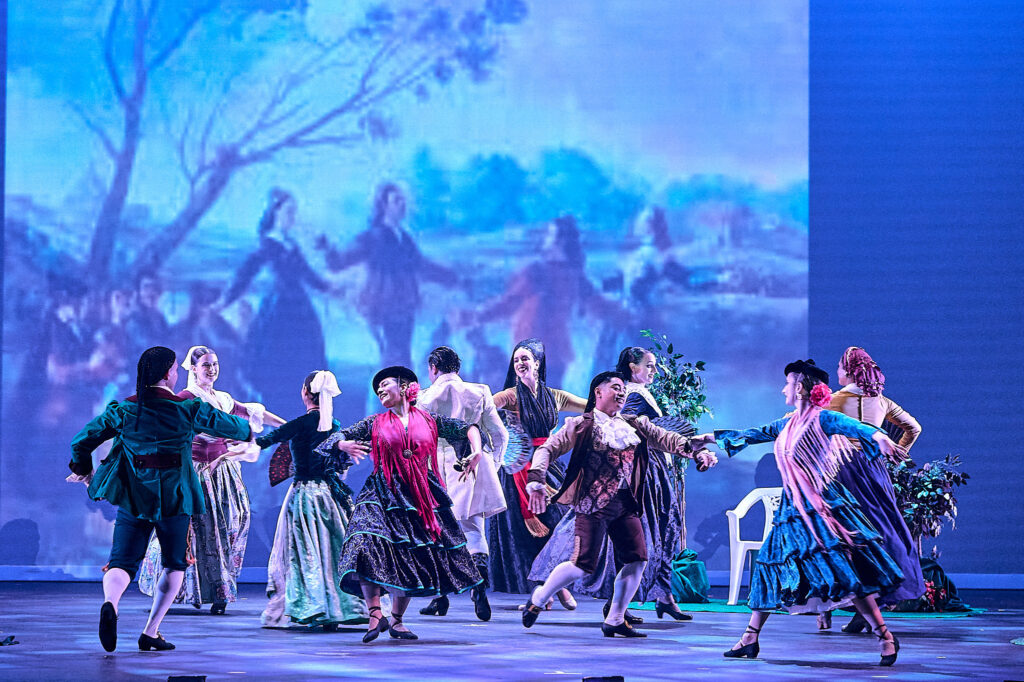
“Costumbres Valencianas” (2000) is a folkloric suite choreographed by Juanjo Linares, danced by the full company and youth company with recorded music by Padilla. The sunny romp opens to the sound of the ocean and a winsome child holding a conch shell to her ear. A pastoral ballet evocative of 18th-century country life and danced in soft-soled character shoes and ballet slippers, the choreography blends balletic sissones and double pirouettes with historic Spanish folk dance forms. A countryside picnic for everyone in the village includes a visit from local nobility, and provides a chance to entertain them, reminiscent of classical ballets such as “Giselle” and Swan Lake.”
Act Two opens with Ruiz’s “Pasión Occulta”(2019), a full-company work to the music of Escala, a contemporary all-female electronic string quartet, demonstrating the company’s march into the future. The piece is all angles in movement and lighting, the knife-edge sharpness of each creating a dramatic tension where flamenco meets the twenty-first century. Throughout, the five couples’ castanets and the amplified sounds of their heels carry the energy of the piece into a new-age vibe.
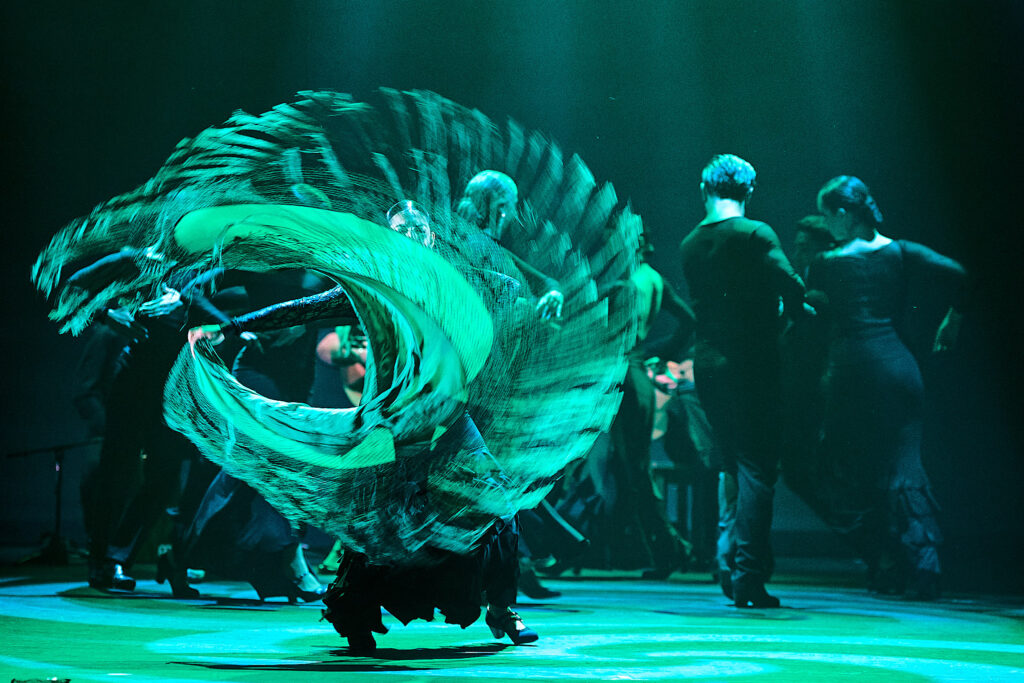
A sculptural silhouette of the full company, heads resting on each other’s back, opens Torres’ “Antecesores /Ancestors” (2025). As if we are carrying our ancestors on our backs, the dancers tell us, and within our bodies, this starkly arresting piece in a more classic flamenco style, featuring musicians Moreno, Salcedo, and Garrett at the lip of the stage and interacting with dancers center stage. Dancer Abigail Mosquera’s green shawl swings, twirls, and floats in arcs of color and motion, creating a choreographic unity of body and costume/prop, where the costume becomes a prop, and the prop part of the costume—it’s a thrill!
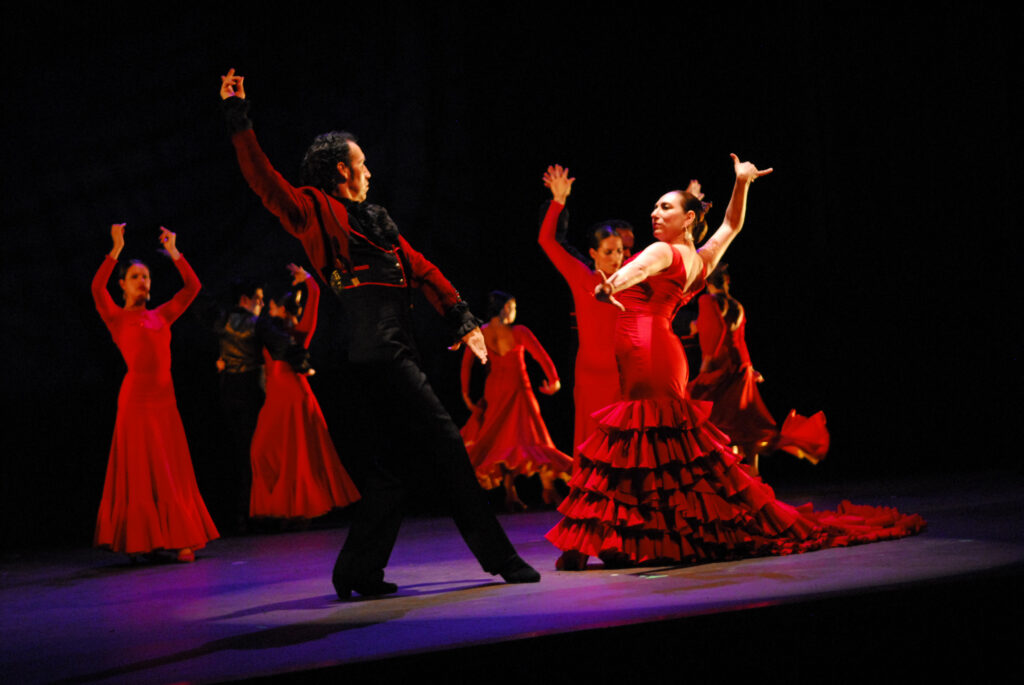
Tovar’s unaccompanied flamenco tour de force, “Desde Cai” (2019), is a knock-out that ends, and then it doesn’t. He bows, takes a breath, restores himself, and begins again, his energy a wonder. Tovar wowed us, sustaining complex rhythms in his feet with contrapuntal accents in a shoulder hitch, tushy twitch, shrug or kick. His sheer love of the dance radiated well into the balcony and brought the audience to its feet.
Dame Libby’s “Bolero” (1993), an extraordinary re-imagining of composer Maurice Ravel’s iconic “Bolero” (1928), continues to be the company’s signature work and closed Saturday night’s program to roaring ovations. The work visualizes the music’s many-layered orchestral build, as if Ravel had composed it expressly for it. Giant projections of Picasso paintings moved with the stage action and complemented the unity of movement and music. New layers of dancers rushed in with fans like ocean waves. As the music soared to ever higher planes of excitement, Ruiz and Perez dazzled with red-caped passion as the heart of the choreography and of the company.
It’s an understatement to say Ensemble Español knocked it out of the park, and it’s after-vibes are probably still echoing somewhere in our galaxy!
For more information, check out the event page by clicking HERE.

Copyright 2026, See Chicago Dance, All Rights Reserved