There are numerous ways to enjoy a numinous experience, when the sensations of belief, ritual, community, and deep feeling combine in one phenomenal event; “At the Edge of Us,” presented by Noumenon Dance Ensemble at The Edge Theater last Friday, is a search for the numinous, realized through the filters of humor, platonic love, horror, and the supernatural while embodying a tremendous obedience and respect to the music. Featuring works by artistic directors Erin Murphy and Nina-Rose Wardanian, company members Faith Koleczek, Kaylah King, and Madison Santos, and guest artist, Dawn Heilung, lighting design by Megan Wines utilizes The Edge’s limited rig to adeptly construct various environments, like murky milieus and night-out-at-the-club dance parties.
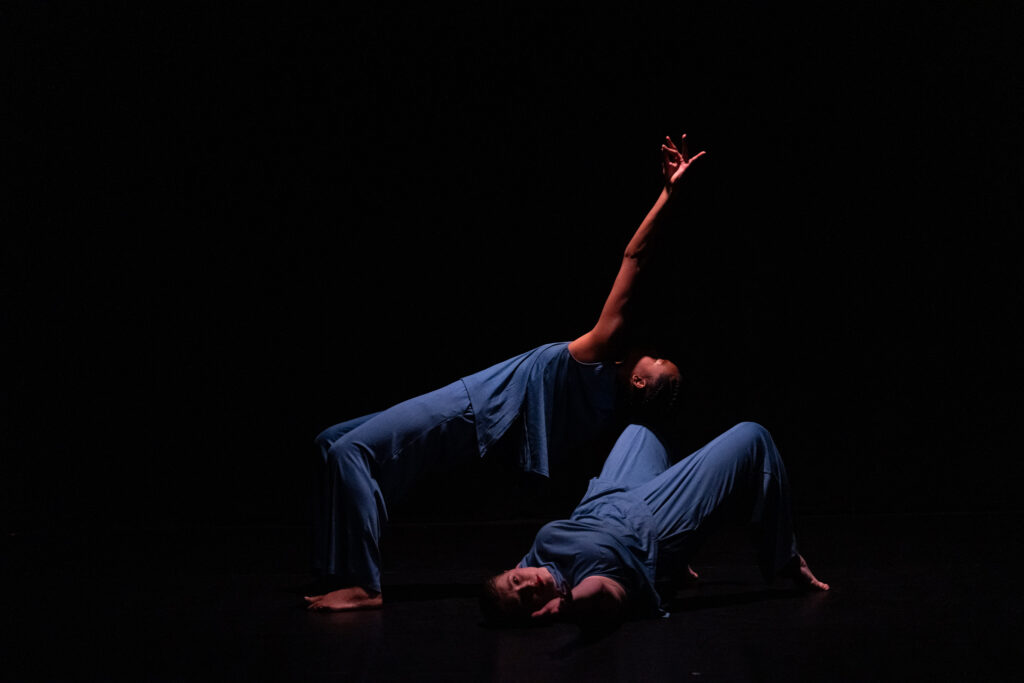
Obedience to the music does not imply subservience but reciprocation, and the works by Murphy are the best representatives. Opening with “Together” was the right choice. The whole ensemble, wearing t-shirts emblazoned with plus, minus, and equal signs, burst onto the scene and form an immense rippling sea of limbs timed succinctly to the ripple of instruments—accompanying music by local composer, Nick Jones. In a duet set to a somnambulic version of The Rolling Stones’ “You Can’t Always Get What You Want,” dancers Julie Ferrell-Olson and Kara Farmer, draped in blue, billowing garments, are locked in a cause-and-effect relationship, the actions of one causing near mimicry in the other, a tremendous display of symmetry. Bending backwards in succession, they roll through each vertebrae in time with the rhythm of the song’s lugubrious vocal motif. This obedience to music is found elsewhere in the program, as in Wardanian’s “Save Myself,” a snappy trio that never fails to hit a recurring “bum-bum-bum” rhythm in new and interesting ways, but Murphy’s works best embody the sense of a physical-sonic collaboration, a partnership between music and dance.
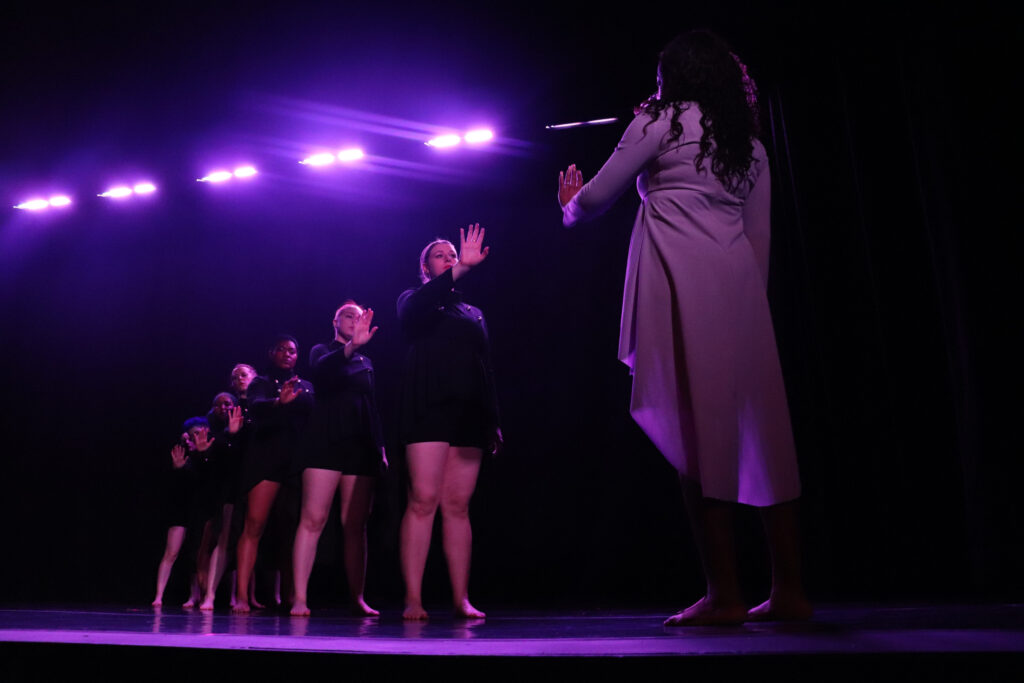
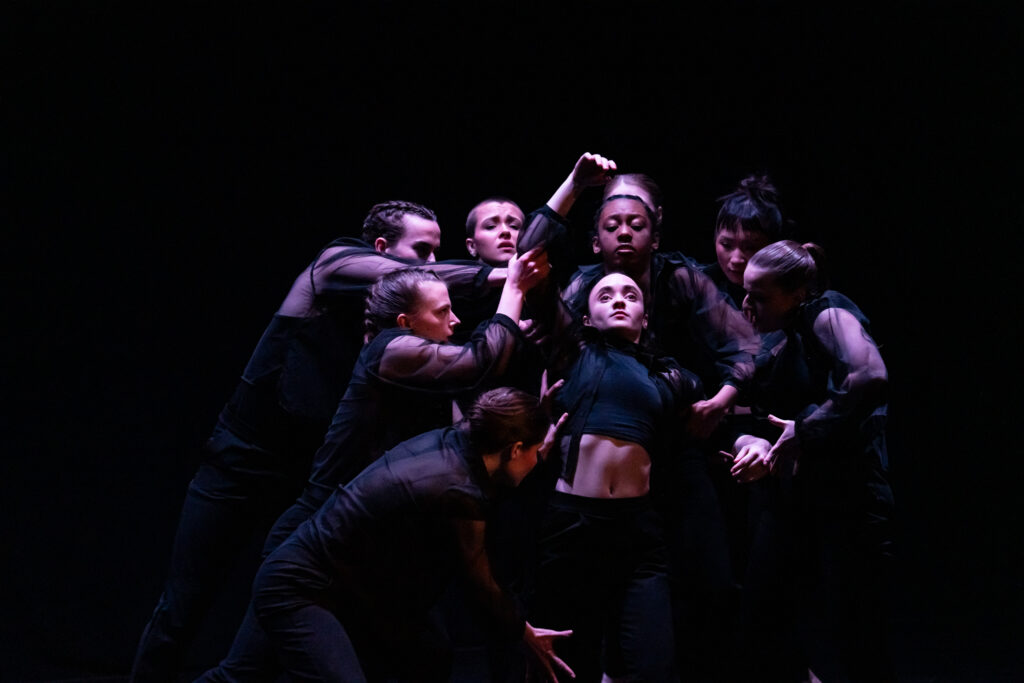
The works of Wardanian and Murphy are similar in their witty sense of humor—in this regard, Wardanian takes the lead. Wardanian appears to take a page from Steven King’s “Carrie” in the piece, “Nemesis,” where a crowd of conformists-in-black attack an innocent bystander, dancer Nadia Cohn, wearing white. The story of the individual against society has been told ad infinitum, but what stands out here is Cohn’s nonchalant expression as she is pushed, pulled, swung, and throttled by the mob. Wardanian twists the story; Cohn gains the power of telekinesis. She belts and flings her opponents backwards with a wave and push of her hand, and Cohn, exploding from her stupor, now revels in her power. What began as an unsettling piece blossoms into an allegory about valuing patience and self-improvement over anger and reaction.
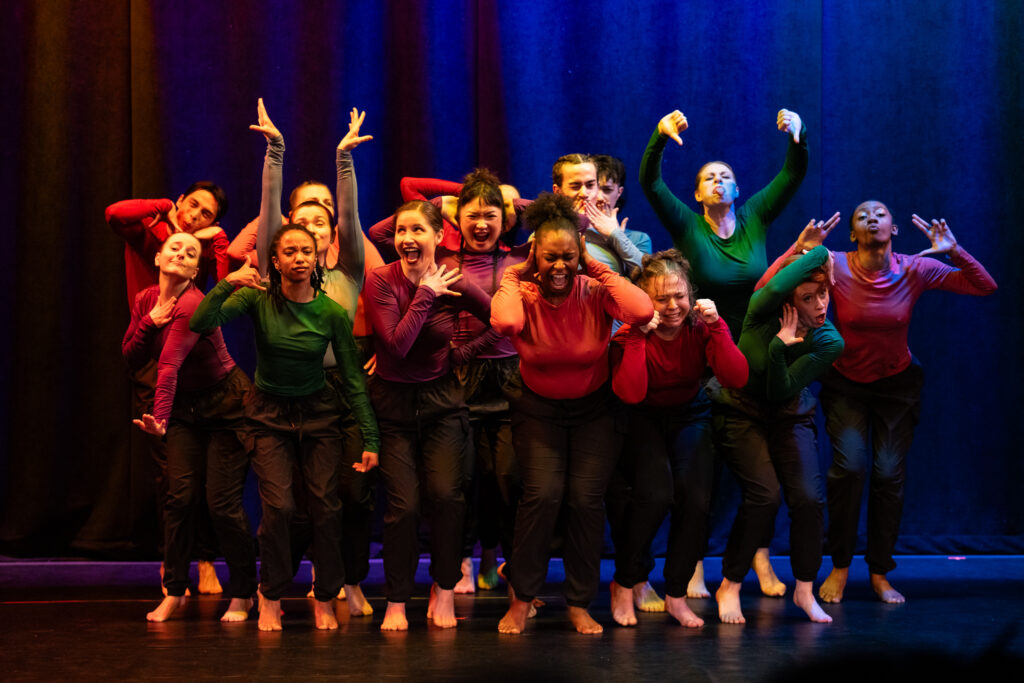
In the titular “At The Edge of Us,” Wardanian combines all four elements of the numinous in one showstopping, energetic number. Featuring the ensemble in a myriad of bright colors, the nonchalant attitude returns with a hint of smirk. Bodies bound about in disparate routes. Near misses result in no reaction. The belief in their paths is absolute. When the action threatens to become overwhelming, their bodies congeal into an ostinato pattern resembling bent-kneed, ritualistic, communal folk dance. With eyes locked on one another, the mass of bouncing bodies express real joy, and it’s contagious.
“The Exorcist” meets “American Psycho” in “Smiling Faces” by Wardanian, featuring soloist Deidre Dillon as a slimy business executive in a suit coat who creeps, slithers, and pounces on the rhythms produced by a funky soul track. Every time she straightens her devil-red tie, she chokes; caught in a noose, she is both the condemned and the hangman. Dillon gives a possessing performance, transforming before our eyes into various fiends, familiar and grotesque.
Murphy verges on the supernatural in “Every Piece of Me,” where prowling figures awash in red light appear to shed their skin and grow gnarled claws that grasp and twitch. Some are brave enough to wrestle in a splash of moonlight, while the others loiter in the corner like spastic, blood-soaked zombies. We all have an angry beast within us, Murphy seems to say, that, if we are not careful, will eat us from the inside out.
In line with the Noumenon aesthetic is Kaylah King’s “External Thoughts,” where four robotic individuals ominously come to life and try on different skins vis-a-vis genres of dance to feel (become?) human, another capable allegory for the exploration of identity.
Some works stray from the general aesthetic of the program. “when we get to heaven,” by Madison Santos, is a sharp, biting criticism of the military industrial complex and the treatment of human beings as expendable. In the work, two soldiers succumb to long, agonizing deaths, and one survivor with PTSD writhes like a wounded animal as the song “God Bless America” blares from the speakers. Santos succeeds in creating a tense atmosphere, with soldiers stalking the enemy, stalking each other, their bodies exploding in agony… But the message is too on-the-nose and clashes with the witty abstractness of other works in the program. “Unburdened Corporeality,” by Faith Koleczek, and “A Lot to Know a Man,” by Murphy, are throwbacks that resemble elements of mid-twentieth-century modern dance, slow and slogging, like animate Greek statues. While one appreciates the references to classic modern dance and the change of pace, these two works put the brakes on what is overall a consistently fast-paced production.
An exception to the rule is found in Dawn Heilung’s “We Got to Have Hope,” featuring the ensemble boogieing down to a bouncy pop music track with voiceovers reciting stanzas from a poem inspired by Harvey Milk. The message is clear—overt, in fact— that the goal of the piece is to raise awareness of and to resist the most recent wave of anti-everyone-who-is-not-straight moral panic; the message is virtuous, but like “when we get to heaven,” it’s too on-the-nose when placed alongside the cerebral works of Murphy and Wardanian. Visually pleasing, it’s like watching fireworks up close—Bang! Zoom!—each moment a showcase of an historic dance move or expression of attitude from modern queer history. Quick transitions keep one engaged, but the constant entrances and exits make for a less cohesive story. But here’s the kicker, the work tells a story on its face but is really meant to be an anthem, rousing and positive, designed not for muddy contemplation but to drive people to action. “We Have Got to Have Hope” instills one with a shared sense of purpose and connection with the queer community, a numinous experience.
For more information, check out the “At The Edge of Us” event page by clicking HERE.
Copyright 2026, See Chicago Dance, All Rights Reserved