

In their Chicago debut at the Museum of Contemporary Art on May 15, 2026, Kimberly Bartosik’s “bLur” unfolded as a visceral meditation on trauma, rescue, embodied desire, and human interdependence. Presented as a 45-minute continuous work, the performance resisted narrative clarity in favor of emotional accumulation, creating a theatrical environment where sensation often overtook certainty. Like its title suggests, “bLur“ occupied a liminal space between perception and comprehension—where memories fracture, bodies collide, and meaning remains intentionally indistinct.
Rather than offering answers, “bLur” asked audiences to sit inside uncertainty. Bartosik’s work suggests that trauma resists coherence, that moments of fear, grief, rescue, and desire often arrive blurred together. Yet within that distinction, the performance also illuminated something profoundly human: even amid chaos, bodies continue reaching for one another.
Before the performance formally began, the atmosphere of unease was already carefully established. Soft, haunting vocalizations drifted through the auditorium as audience members entered, appearing and disappearing like breath. Onstage, shimmering opalescent panels hung at either side of the bare performance space, blown subtly by an artificial breeze and rippling like garments suspended on a clothesline. Light filtered through the fabric onto the otherwise stark stage, immediately establishing an environment suspended between intimacy and instability.
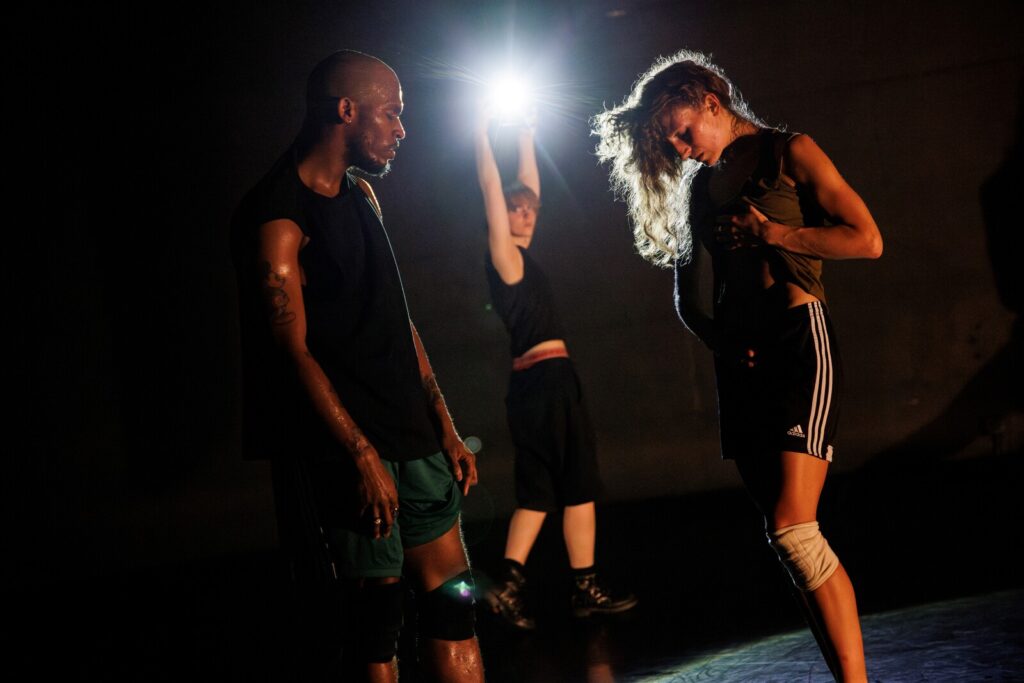
Although the program listed five performers, two additional figures functioned as silent architects of the stage environment. Manipulating handheld lighting apparatuses throughout the performance, they guided the audience’s focus while simultaneously reshaping the visual field. Their presence framed the dancers’ bodies in striking ways, emphasizing moments of vulnerability, collision, and surrender.
The performance opened with these lighting designers embracing in a prolonged hug, dressed in intentionally non-gendered pedestrian attire—black tank tops and jeans. As the house lights dimmed, sirens emerged from the soundscape, a resonant sonic choice familiar to the museum’s patrons given the MCA’s proximity to a hospital entrance. The sound gradually intensified, evoking the unsettling familiarity of emergency vehicles passing an accident scene. Simultaneously, dancers erupted into motion, sprinting and leaping diagonally across the stage. Bodies collided with audible force, sometimes crashing into one another with startling slaps of flesh, other times narrowly avoiding impact through instinctive directional shifts.
Bartosik’s choreographic language embraced chaos while allowing stillness to surface unexpectedly. Repeated physical motifs emerged—jumps, high kicks, sudden collapses, and surrender to the floor—yet never appeared identically. Instead, movement vocabulary seemed uniquely tailored to each performer’s body, emphasizing individuality over formal unison. At one moment, a dancer crouched low to the floor, frantically searching as if for something irretrievably lost in tall grass. Her hands clawed through empty space before anguish overtook her when nothing was found. Such images resonated as fragmented memories of grief rather than explicit narratives.
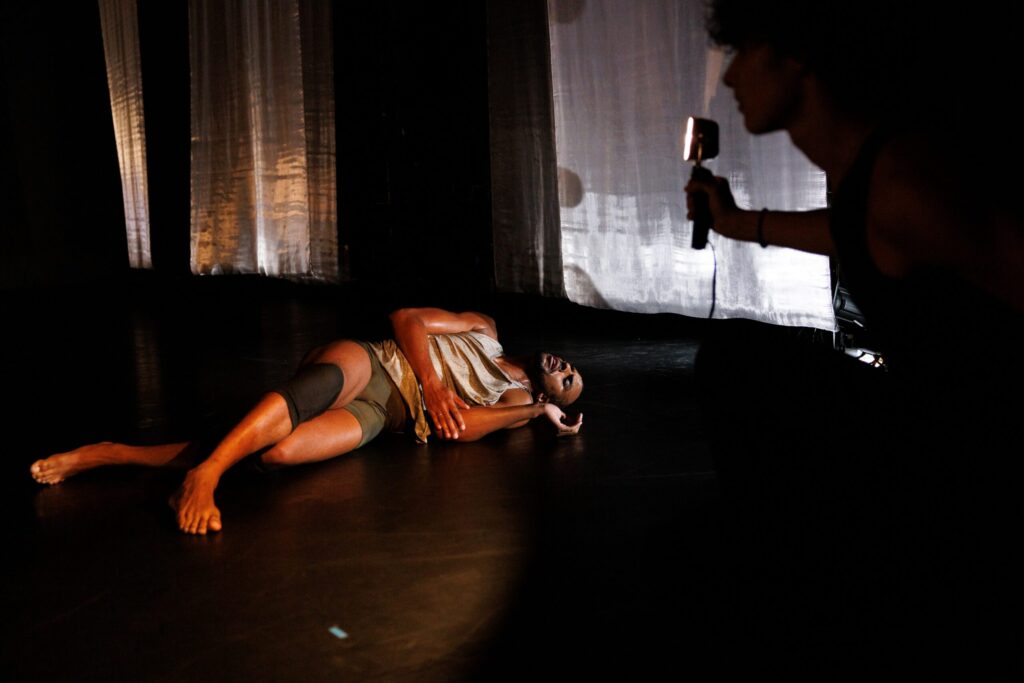
The sensory intensity of “bLur” was amplified by its sound design. A warning regarding elevated noise levels greeted audiences before entering the theater, and with good reason: the score vibrated physically through the chest as movement escalated in urgency. Meanwhile, strategically placed lights projected monumental shadows onto the upstage brick wall, transforming dancers into larger-than-life figures of anguish and desperation. Pain became magnified, impossible to ignore.
Yet amidst frenetic motion, moments of devastating quiet emerged. At one striking juncture, two dancers huddled tightly together downstage left, clutching one another in protective desperation. Nearby, another performer traversed the floor in agonizing slow motion, limbs strained rather than elongated, muscles visibly trembling, toes contorted into uneasy positions. Elsewhere, a standing dancer swayed alongside their shadow, appearing to commune with a fragmented version of themselves projected on the back wall.
Throughout the work, bodies repeatedly hurled themselves against the floor, the wall, and one another. These actions suggested surrender—not graceful yielding, but violent capitulation to overwhelming forces. When the music suddenly dissolved into the irregular pulse of a heartbeat, dancers’ audible breathing became part of the score itself. Images of caregiving and grief surfaced repeatedly: one dancer supporting another against the back wall evoked cinematic scenes of mortal injury, bodies clinging together not for comfort but survival.
The title “bLur” offers a compelling framework for interpreting these moments. Trauma often renders experiences visually, mentally, and emotionally indistinct. Memories lose sharpness; our understanding fractures. The performance embodied this instability, blurring distinctions between rescue and helplessness, ecstasy and despair, isolation and connection.
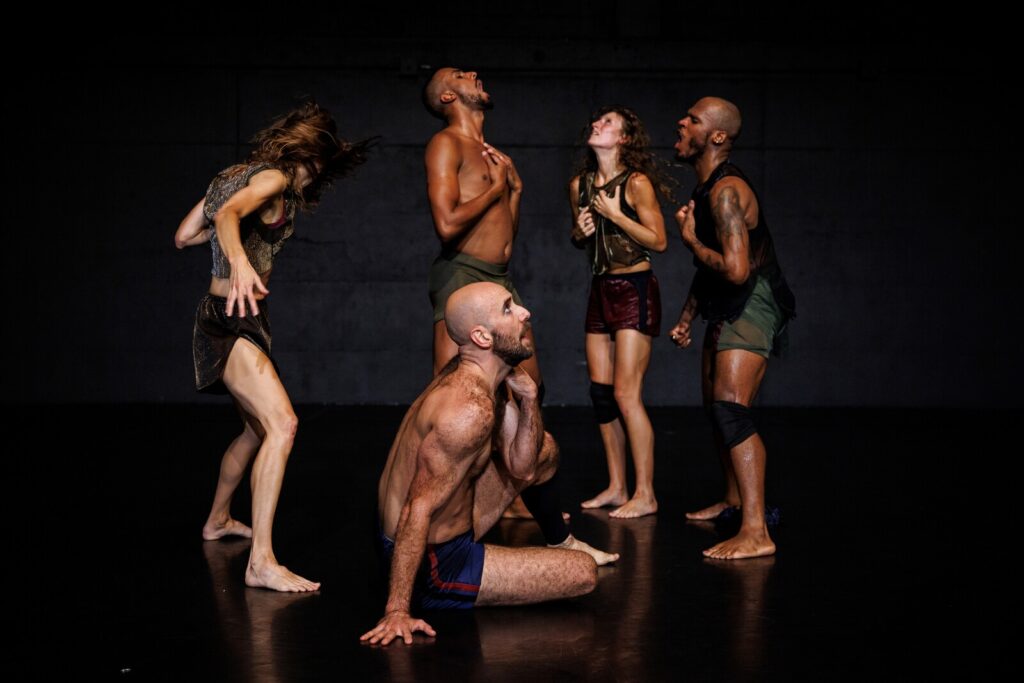
One of the performance’s most affecting motifs emerged in a sequence resembling CPR. Kneeling performers aggressively pressed their arms downward into empty space, exhaling forcefully with each repetition. The image unmistakably echoed chest compressions, as if dancers were attempting to revive an unseen body—or perhaps grief itself. As the action migrated across the stage, performers alternated roles: some enacted the labor of saving while others surrounded them in postures of mourning and despair. The scene culminated in collective stillness, all five dancers focused on the empty center space between them, clutching their chests, faces, and stomachs in gestures painfully familiar to human suffering.
As the performance progressed, emotional intensity transformed into embodied desire. Under pulsing percussion and glaring full-stage lights, dancers convulsed and trembled as if rattled by forces beyond their control. Some reached outward, others stomped rhythmically, while several appeared suspended between ecstasy and collapse. Physical intimacy intensified: hands gripped arms, waists, and clothing; bodies clung together before separating abruptly. Sexuality emerged not as seduction but as urgency—desire tangled with vulnerability, shame, and confusion. Moments of intimacy dissolved as quickly as they formed, dancers retreating into solitude almost immediately after contact.
Notably, “bLur” resisted choreographic unison entirely. Every performer occupied their own emotional and physical reality, reinforcing the work’s investment in individual bodily experience even amidst collective trauma.
Eventually, the dancers separated and exited, leaving the stage empty save for the gently moving fabric panels. The imagined breeze persisted, indifferent to human suffering.
In a quietly profound gesture, the two lighting performers returned to center stage, clasped hands, and exited together through the hanging panels. House lights rose gradually as sound dissolved into silence. The audience remained motionless for several moments, seemingly unwilling to disrupt the emotional residue left behind until the performers finally returned for a deeply deserved bow.
Kimberly Bartosik’s “bLur” ran May 14-16 at the Museum of Contemporary Art Chicago, 220 E. Chicago. For more information, check out the event page by clicking HERE.
Copyright 2026, See Chicago Dance, All Rights Reserved