

The Museum of Contemporary Art’s 2026 “On Stage” series continues with “La Nuée,” choreographed by Nacera Belaza, presented last Saturday at the Edlis Neeson Theater. Built on the principles of circularity and rhythm, Belaza’s work merges these elements within this performance after exploring them separately in “Le Cercle” (2018) and “L’Onde” (2020).
The title “La Nuée,” translated as The Swarm, suggests a sense of communal structure, of separate lives orbiting a focused center. Drawing inspiration from the dances of First Nation Dakota tribes, Belaza also crafts this piece as a meditation on ritual, repetition, and community.
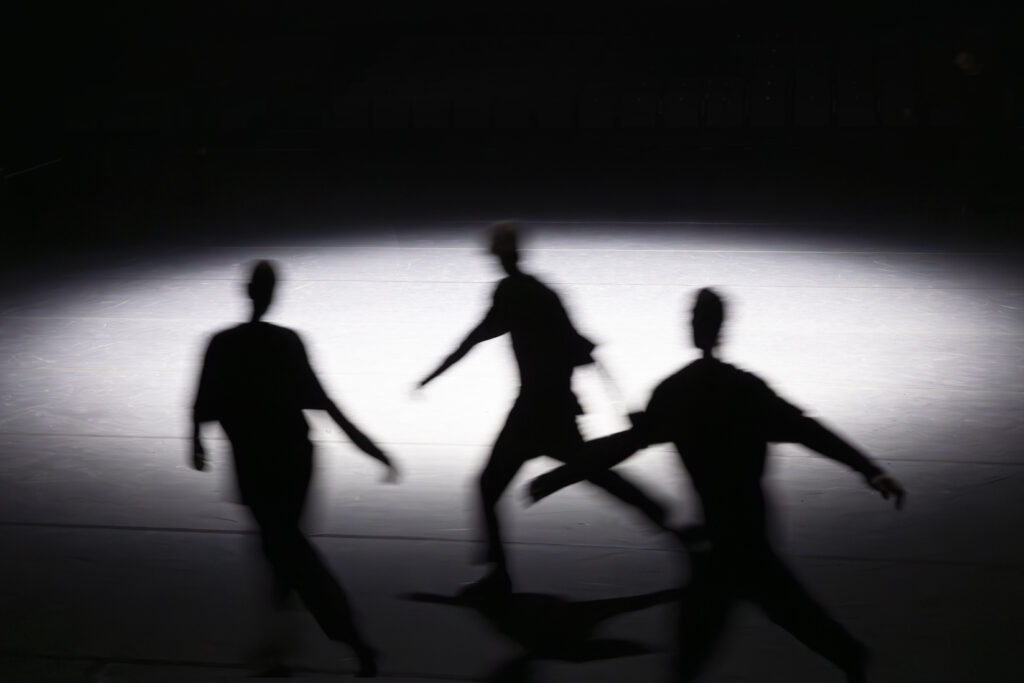
It begins with a single, faint spotlight staining the center of the stage. A dancer is seen spinning furiously within the light’s dim circle. Fast. Relentless. They trace the edges of the spotlight. The light and speed create a blur effect, as if forcing the mind to witness the performance in snapshots of pure, unapologetic motion. Dressed in black, their silhouette flickers in and out of perception. The strain to see is intentional, creating a meditative haze where time loosens and reality feels just out of reach.
When all six dancers take up the spin, the stage transforms into a whirlpool. Arms extend wide, they rotate around themselves, collectively tracing the spotlight’s edge, individual currents circling a larger pool. Each body subtly influences the next, as the ebb and flow in momentum ripples backward through the swarm, affecting the entire community. The swirling repetition stretches on until it becomes the norm, a default state of being that dancers repeatedly return to between sets.
One set involved a dancer encircled by the others in a ritualistic ceremony of performance. The sound design never settles into a clean beat, continuously swelling with layered vocals and thrumming drums that felt guided less by counts and more by instinct. His feet begin with soft taps that grow into grounded stomps, showing high knees and quick cuts of the feet, as he is egged on by the sounds. His arms remain by his sides, energy forced to be contained even as it spills out elsewhere.
He shuffles off balance, a servant to gravity, letting each shift in weight determine the next move. His flat feet and low movement grounded him to the stage as he shifts around. Occasionally holding the hem of his shirt, he loses himself in the speed and intensity of the performance. With the audience wrapped around him in a circle of their own, the energy and ritual extend beyond the stage. It is here that the themes of rhythm and community feel most palpable.
In another set, two dancers face each other from opposite ends of the stage. They stand still, eyes locked. Gradually, their bodies begin to twitch in the dim light. Shadows flicker with every torso contraction and knee bend. Every jolt seems triggered by the other dancer’s own twitch, each becoming a mirrored dialogue of discovery and connection. Slowly, they inch closer, the space between them charged with tension, and subtle jolts carry the momentum of their shared rhythm.
The dancers move at an almost imperceptible crawl, bobbing toward one another in slow, twitching rhythms. Then, as if time skipped, they suddenly appear nearly side by side, discovery realized in a blink. For the first time, they are close enough to fully register each other’s presence, their subtle movements and mirrored gestures creating a quiet, intimate exchange. In that moment, the audience feels the tension and connection of two bodies finding one another, a reflection of the work’s communal meditation and the circular nature of encounter.
During the entire performance, the dancers’ stamina, composure, and musicality, particularly
during the extended spinning, were undeniably impressive. At the same time, some of these more
repetitive sections felt too long and left me craving a bit more variation. The initial moments of
each sequence were captivating, with interesting movement paired with striking visual and audio
design, but as certain sections lingered, they occasionally felt excessive and ready to be
concluded.
Overall, “La Nuée” turns spinning bodies and pulsing stillness into a swarm of shared breath,
proving that when rhythm and circularity converge, community is not simply suggested, it is
physically felt. As the second of four performances in the Museum of Contemporary Art
Chicago’s 2026 “On Stage” series, Belaza’s piece underscores the collections commitment to
innovation, leaving the final two works properly poised to further explore contemporary dance.
“La Nuée” is presented by Nacera Belaza at the Edlis Neeson Theater located within the Museum of Contemporary Art Chicago, 220 E Chicago, IL 60611. Upcoming show times include 2/28 at 7:30 pm & 3/1 at 2 pm. Tickets range from $10-$30. For more information, check out the event link by clicking HERE.
Copyright 2026, See Chicago Dance, All Rights Reserved