

In honor of the 100-year anniversary of the Martha Graham Dance Company, See Chicago Dance is proud to release this feature article by Editor Emeritus, Lynn Colburn Shapiro, whose knowledge of the company and its history is extensive, informed by her own prolific dance career and her contacts within the company. Please enjoy this special feature, only on SeeChicagoDance.com! – Managing Editor, Tristan Bruns
The Martha Graham Dance Company returned to Chicago for one performance only at Chicago’s historic Auditorium Theatre on Saturday, January 24, as part of the venue’s year-long Celebration of Women Leaders in Dance.
As the oldest continuously performing dance company in the United States, the company’s return to Chicago was also a significant milestone commemorating its 3-year, 100th-anniversary tour.
After my junior year in high school, I spent a summer as a ballet major at Interlochen Arts Camp, in Interlochen, Michigan. One of my classmates was a girl named Janet, a tall, sunny young woman with a special quality that compelled you to watch her.
Two years later we met again, this time at Juilliard, where we were again classmates, studying both modern dance and ballet with some of the greatest dance luminaries of the 20th century, members of the Martha Graham Dance Company and the José Límón Dance Company among others.
Janet Eilber went on to dance with The Martha Graham Dance Company where she performed many of Ms. Graham’s roles. No longer performing herself, she now leads the company as Artistic Director.
I loved the Graham Technique. The centrality of impulse from the spine and pelvis transformed my sense of my body, my sense of movement, and my artistic direction as a dancer and choreographer.
Which brings me to the 100th-Anniversary Tour of The Martha Graham Dance Company.
What I witnessed last Saturday night at the packed Auditorium Theatre was truly an event of historic proportion, for me personally, for the venue, for Chicago’s audiences, and for the art of dance.
The performance reminded me of the crucial importance of understanding our artistic roots. We cannot truly know who we are, what we have to say, or where we want to go in the future until we know where we come from, our artistic DNA.
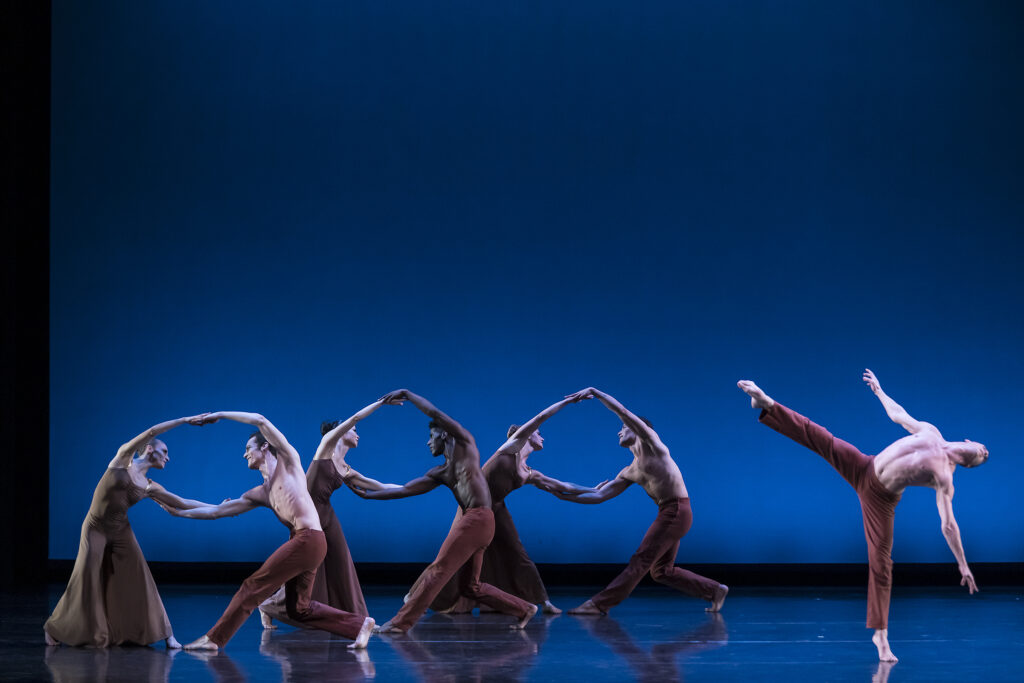
The program was curated to do just that, consisting of four works: Miss Graham’s “Diversion of Angels” (1948), “Lamentation”(1930), and “Chronicle”(1936); and “En Masse”(2025), by Alvin Ailey dancer Hope Boykin. The score by Christopher Rountree features fragments from a recently discovered piece of music by Leonard Bernstein thought to be intended for Ms. Graham.
Janet greeted the audience in front of the curtain to introduce the program. She detailed Ms. Graham’s contribution to the art of concert dance in an elegant and reverent prelude, providing historic perspective on Ms. Graham’s genius. Her revolutionary influence on 20th-century concert dance, from ballet to contemporary, avant-garde and even jazz, was based on the human body, breathing, sitting, standing, walking, skipping, jumping, and running. She drew from her own background as well as from other cultures, blending styles and borrowing structures and vocabulary from primitive forms, folk dance, art and religious ritual. She dared to shock with her ideas about dance and the human body. Her use of mythology and folklore to represent human sexuality, the duality of love and hate, and hypocrisy in society took the world by storm.
Janet had danced many of Martha’s roles and has taught those roles to the next generation of dancers. As I watched “Diversion of Angels,” a piece I had seen performed countless times, I recognized sequences from combinations we did across the floor in our technique classes at Juilliard. What better way to internalize the technique than to practice the very choreography that gave a foundation to her teaching and codified her training syllabus?
It was in Chicago that Ms. Graham, as a young performer, first encountered The Expressionist Movement in a visit to The Art Institute of Chicago. There she saw Kandinsky’s magnificent canvas with a red slash across it, which became the inspiration for “Diversion of Angels.”
What struck me most about “Diversion” at this concert was the clarity of the contraction and spiral in the dancers’ bodies, and their origin in the pelvis and spine, creating a confluence emotion and movement. The choreographic style of the piece is carefully sculpted in its reduction to the bare essentials of form and expression in episodes that depict four stages of love, from innocence to passion to the deep human bonding of mature love.
The dancers didn’t “act” their feelings. The choreography did that work for them. Dancers Marzia Memoli and Zachary Jeppsen-Toy’s “Couple in Yellow” electrified the stage with quick, tiny runs and flirtatious overtures instantly evoking the blush and racing heart flutter of adolescent love.
The men’s barrel turns in a circle and their buoyant sissones showed off their strength and bravado for the ladies. Devin Loh’s “Girl In Red,” true to Kandinsky’s painting, slashed breathtaking streaks of red across the space.
“Diversion” is a perfect example of one of the hallmark’s of the Graham technique: using the contraction and spiral to propel dancers, seemingly without transition, from lying down on the floor to flight and locomotion across the stage. Her use of levels—on the floor, standing, and airborne—created exciting spatial design, often placing contrasting groups of dancers across diagonals from each other, or one group upstage and another downstage in contrapuntal movement sequences.
“Lamentation,” danced by Xin Ying, is a signature Graham solo performed almost entirely sitting. The female dancer was enshrouded in a tube of stretchy fabric that served as both prop and costume. It is a dance of profound loss, we don’t know of whom or what, that is achingly visceral. Rocking, first gently, builds in breadth to a wale, a defiant protest, and submission to grief. The shroud-like fabric tube was womb-like, then became wings that breathed and almost took flight, then wrapped the dancer in a blanket of comfort and consolation as unseen arms and legs folded themselves in on the hidden torso.
“En Masse,” choreographed by Boykin, closed Act I with a shift in tone and texture. The work served as a palette cleanser, a fitting transition to Intermission. Pleasing in its lyricism, but short on subtlety, it incorporated genuflections into the gestural material and other symbolism that mimicked Graham’s use of the chorus as acolytes, a preacher harping against sin, and sinners roasting in Hell and leaping out of flames. More successful and perhaps at the heart of Boykin’s choreographic center was the jazzy saxophone trio that told a little story with street-smart dancers and an urban-cool vibe. Spiral turns and a sway and swagger of fluid arms gave a saucy joy to hanging out in the ‘hood. Rapid short segments were effective in delivering a complex, multi-textured world of dissonance and harmony. A sonorous solo dancer in black built to a group climax and one-two-punch finish.
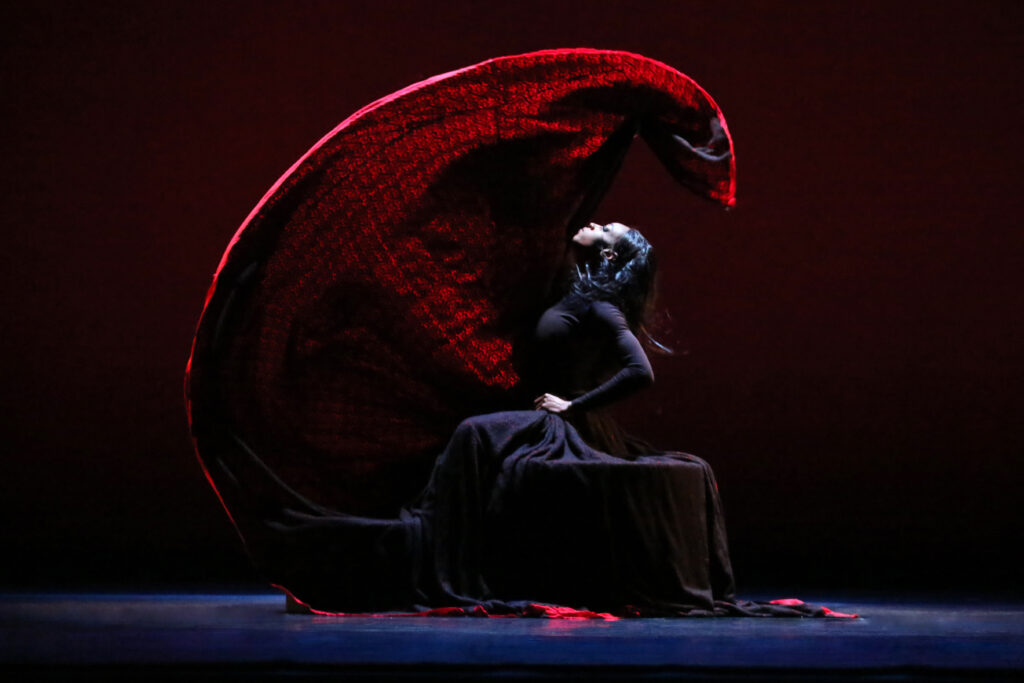
“Chronicle”(1936), the earliest work on the program and the evening’s finale, was Graham’s response to the rise of fascism. Set to music by Wallingford Riegger, its intent was to universalize the tragedy of war, according to program notes. Part I, “Spectre-1914,” danced by Xin Ying in black was a dark foreboding set to Riegger’s ominous score. The military drill of snare drums foretold the massing of arms. The blood-red fringe on the hem of the dancer’s dress, (Graham’s own design) periodically erupts in the dancer’s rage to reveal the skirt’s bright red interior as her movement expands to explosive rage, anger, and pain. As with “Lamentation,” the costume serves as both prop and clothing. The dancer transforms into death itself, melts into a puddle of fabric and limbs, and then revives. She becomes an enchantress, a witch casting incantations and spells.
Part II, “Steps In The Street,” is performed by the ensemble, eight women in black dresses, as if maimed, move backwards in silence with slow, halting strides. When the music begins, only one woman remains onstage. The others join her in jittery jumps, peppy with the kind of energy generated by fear. They cradle imaginary babies. They evoke the intensity of Harpies in the Greek chorus. Part III., “Prelude to Action,” danced by the ensemble, offers a glimmer of hope.
Prior to the work’s premiere, Ms. Graham refused an invitation to participate in the 1936 Olympic games in Germany, yet another example of her determination to speak truth to power through her art, something we can all take a lesson from today.
To learn more about Martha Graham Dance Company’s 100th-Anniversary performance, click the event link HERE.
To read an alternate review by SCD staff writer Maureen Janson, click HERE.

Copyright 2026, See Chicago Dance, All Rights Reserved